 0
0
 0
0
Choosing an appropriate level-measurement instrument is a recurring challenge for plants that handle liquids, bulk materials, or process tanks in demanding environments. Industrial detection applications often face unstable photoelectric detection under changing light, degraded optical sensing in dust or fog, complex target colors outdoors, difficulty determining the distance and speed of moving targets, and field influences on liquid- and material-level measurement. These realities push many engineering teams to look beyond conventional optical sensors toward microwave-based radar solutions, and specifically toward high frequency radar level meters as a way to obtain stable readings where optical detection struggles.
Why Level Measurement Needs a Microwave Approach
Traditional photoelectric detection depends heavily on light conditions, target color, and a clear line of sight. When dust, fog, or lighting changes are present, these conditions can degrade optical sensing accuracy. Radar sensors take a different approach: they use emitted and reflected microwave signals to capture target presence, movement speed, static distance, and azimuth. Because microwave sensing is less affected by lighting changes than light-based detection, it offers a more stable path to determining liquid level, material level, and target status in complex environments, including some outdoor conditions.
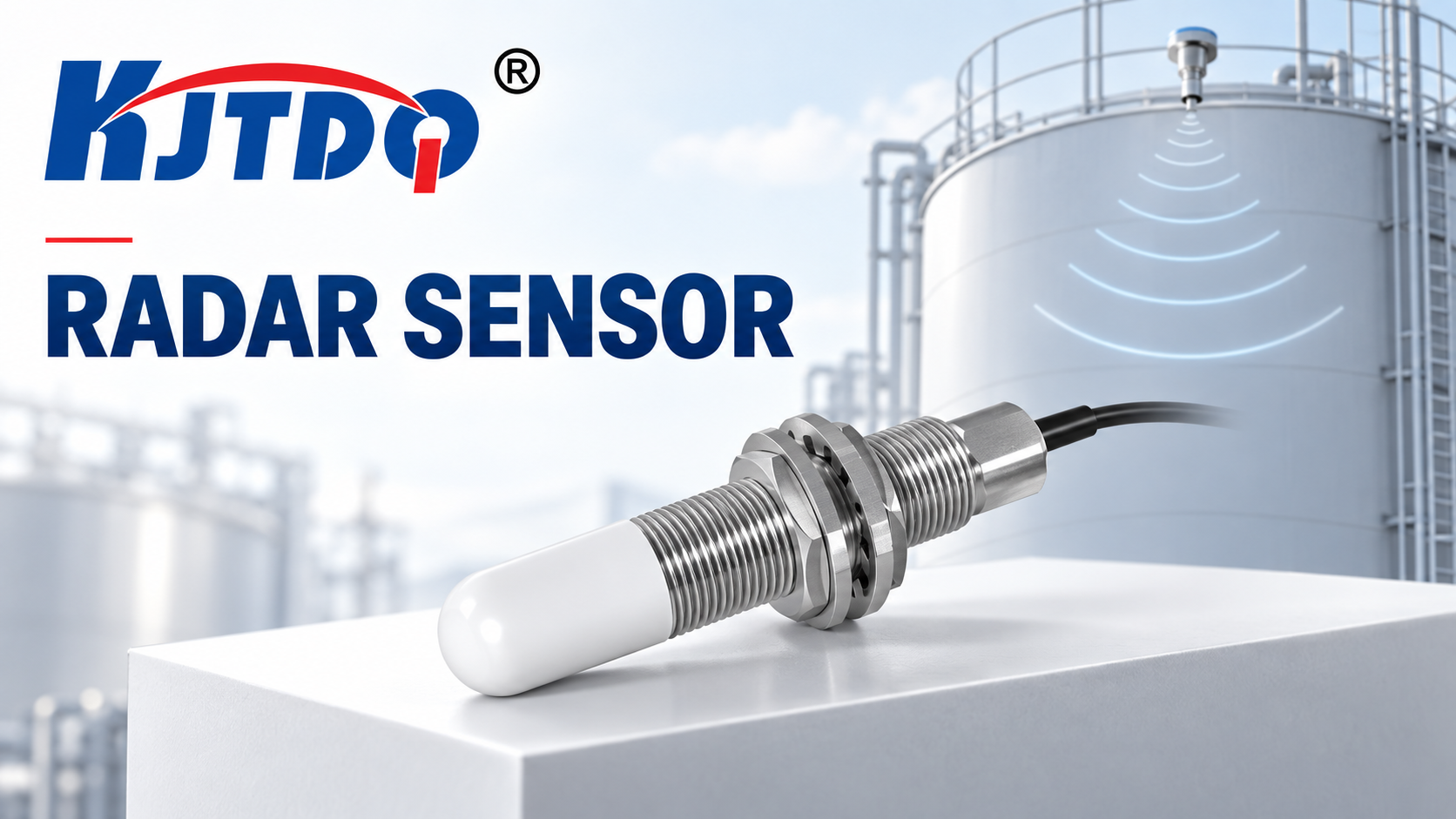
KJT Sensors radar sensors are built around this microwave sensing method. The core signal chain includes a microwave transmitter that emits radar waves, an echo receiver that captures reflections from the target, a signal processor that performs filtering and feature extraction, and a target recognition module that determines target presence and state. A distance and speed calculation module then derives the relevant readings, while a communication output module sends results to a PLC, control cabinet, supervisory computer, or monitoring system. An industrial protection module adapts the sensor to the installation environment, which matters when a level meter is mounted on a tank, silo, or open channel exposed to weather and process conditions.
Frequency Band Considerations
One of the first technical questions buyers ask is which frequency band suits their application. KJT Sensors radar sensors work with microwave signals across frequency bands such as 24 GHz, 80 GHz, and 125 GHz. Selecting among these bands is not a matter of picking the "biggest number" — actual performance depends on frequency band, antenna, mounting angle, target material, and field interference. In practice, this means a buyer evaluating a high frequency radar level meter should look at the whole measurement context: the tank or vessel geometry, the material or liquid being measured, how the antenna will be mounted, and what interference sources exist near the installation point, rather than relying on frequency alone as a shortcut.
Core Selection Criteria
Selection guidance for radar level instruments is generally based on several interconnected factors, and buyers evaluating options should work through each of them methodically.
Detection Target and Application Environment
The nature of the target — whether it is a liquid, a bulk material, or a moving object such as a vehicle or piece of equipment — shapes which sensor configuration is appropriate. Environments with dust, fog, changing light, or varied target colors are exactly the conditions where microwave sensing provides an advantage over optical methods, since it can reduce false detections and missed detections that would otherwise require manual assessment.
Sensing Distance and Installation Angle
Some KJT Sensors radar models support measuring ranges up to 20 m or higher, which matters for tall silos, deep tanks, or long-range distance applications. Installation angle and field of view also affect how reliably the sensor captures the target, so these should be confirmed alongside the sensing distance requirement before finalizing a model.
Output Type and Communication Interface
Industrial integration depends on matching the sensor's output to existing control infrastructure. Some models support 4 to 20 mA, NPN/PNP, IO-Link, or custom output, and communication output can connect to a PLC, control cabinet, supervisory computer, or monitoring system. Because the specific output type must be confirmed by model, this is a necessary checkpoint rather than an assumption.
Protection Rating and Response Time
Level meters are frequently installed in harsh conditions, so protection rating is a practical concern. Some models provide IP67/IP68 protection along with millisecond response, which supports applications where both durability and timely data are required.
What Makes KJT Sensors Radar Sensors a Suitable Fit
KJT Sensors positions its radar sensors toward industrial automation, distance measurement, speed measurement, presence detection, liquid-level non-contact detection, movement perception, and complex environment perception. Within its radar sensor line, reference directions include micro-radar, radar level transmitters, smart radar material level products, and collision-avoidance radar — giving buyers a range of configurations to match specific level-measurement or motion-detection needs.
The differentiated value of this product line rests on three points. First, stable microwave sensing: in dust, fog, light changes, and target color differences, the sensors provide target-status information where optical detection may be unstable, reducing false or missed detections. Second, non-contact multi-parameter detection: for vehicles, personnel, materials, and liquid levels, the sensors detect presence, distance, speed, and angle without contact. Third, industrial robustness: some models offer IP67/IP68 protection, millisecond response, and measuring ranges up to 20 m or higher. Together, these characteristics address the field influences on liquid-level and material-level measurement that motivated the search for a high frequency radar level meter in the first place.
Service Model and Project Support
Buying a radar level meter is not always a simple catalog purchase. KJT Sensors offers standard product supply by model and quantity for straightforward orders, while project-based applications — such as radar liquid level, vehicle detection, smart traffic, complex environmental detection, or equipment-supported projects — go through technical confirmation and quotation. For project support, useful inputs include site photos, installation location, target size, sensing distance, environment description, and control system interface. Providing this information upfront helps ensure the selected frequency band, model, sensing distance, output type, installation structure, IP rating, and communication interface are all aligned with the actual application before an order is placed.
Where These Sensors Are Applied
Radar sensors from KJT Sensors are used across a range of settings: industrial automation and equipment factories for moving-target and presence detection; storage logistics and port terminals for material-level detection, liquid-level measurement, and collision-avoidance protection; metallurgy and heavy work sites for distance measurement in dust, fog, and complex environments; smart transportation and logistics channels for vehicle and passage detection; automatic doors and outdoor equipment for motion detection and obstacle avoidance; and engineering projects requiring distance, speed, or liquid-level detection after technical confirmation.
Final Considerations for Buyers
Choosing a high frequency radar level meter ultimately comes down to matching the detection target, environment, sensing distance, installation angle, output type, and control system interface to a sensor configuration that has been engineered for those conditions. KJT Sensors radar sensors, built on microwave transmission and reception across 24 GHz, 80 GHz, and 125 GHz bands, are designed to address exactly these variables, with selection guidance and project-based technical confirmation available to help buyers reach a configuration suited to their specific liquid-level, material-level, or motion-detection requirements. More information is available through KJT Sensors' official radar sensor listing.
http://www.kjt-sensors.com/
KJT Sensors


Average Rating