 0
0
 0
0
Industry Background and Problem Introduction
Transmission health remains one of the most overlooked aspects of vehicle maintenance across the North American aftermarket, yet the consequences of neglect are severe. According to industry data cited within MASUMA's technical materials, over 95% of transmission failures are caused by high temperatures or neglected maintenance. Engines and transmissions are inherently susceptible to damage from iron filings, sediment, airborne particles, and high-temperature oxidation products that accumulate over a vehicle's service life. For USA wholesale distributors sourcing filtration components, this statistic underscores why component quality and adherence to original equipment (OE) sizing standards are not optional details but foundational requirements.
MASUMA positions itself strategically within this landscape as a manufacturer of automotive filtration solutions focused on providing components that match original part specifications, a design philosophy intended to ensure vehicle longevity, performance, and occupant safety. This OE-matching approach—often associated with the precision expected of Japanese-standard automotive engineering—forms the backbone of the brand's transmission filter line and is a key reference point for distributors evaluating supply partners for the wholesale channel.
Authoritative Analysis Based on Core Technical Principles
Necessity: The transmission filter serves as a protective device that cleans fluid and stores contaminants before they can circulate through sensitive valve bodies and clutch packs. Metal debris, sludge, and high-temperature oxidation products are identified as direct causes of shift shock, valve body damage, and outright transmission failure, making filtration a preventive rather than reactive maintenance category.
Principle Logic: MASUMA's broader technology platform integrates multi-layer gradient composite filtration with electrostatic adsorption technology, allowing contaminants of varying particle sizes to be captured in stages rather than relying on a single filtration layer. Within the transmission filter specifically, this is achieved through multi-material media—Korean composite fiber combined with HV high-density non-woven fabric—engineered for high dust-holding capacity.
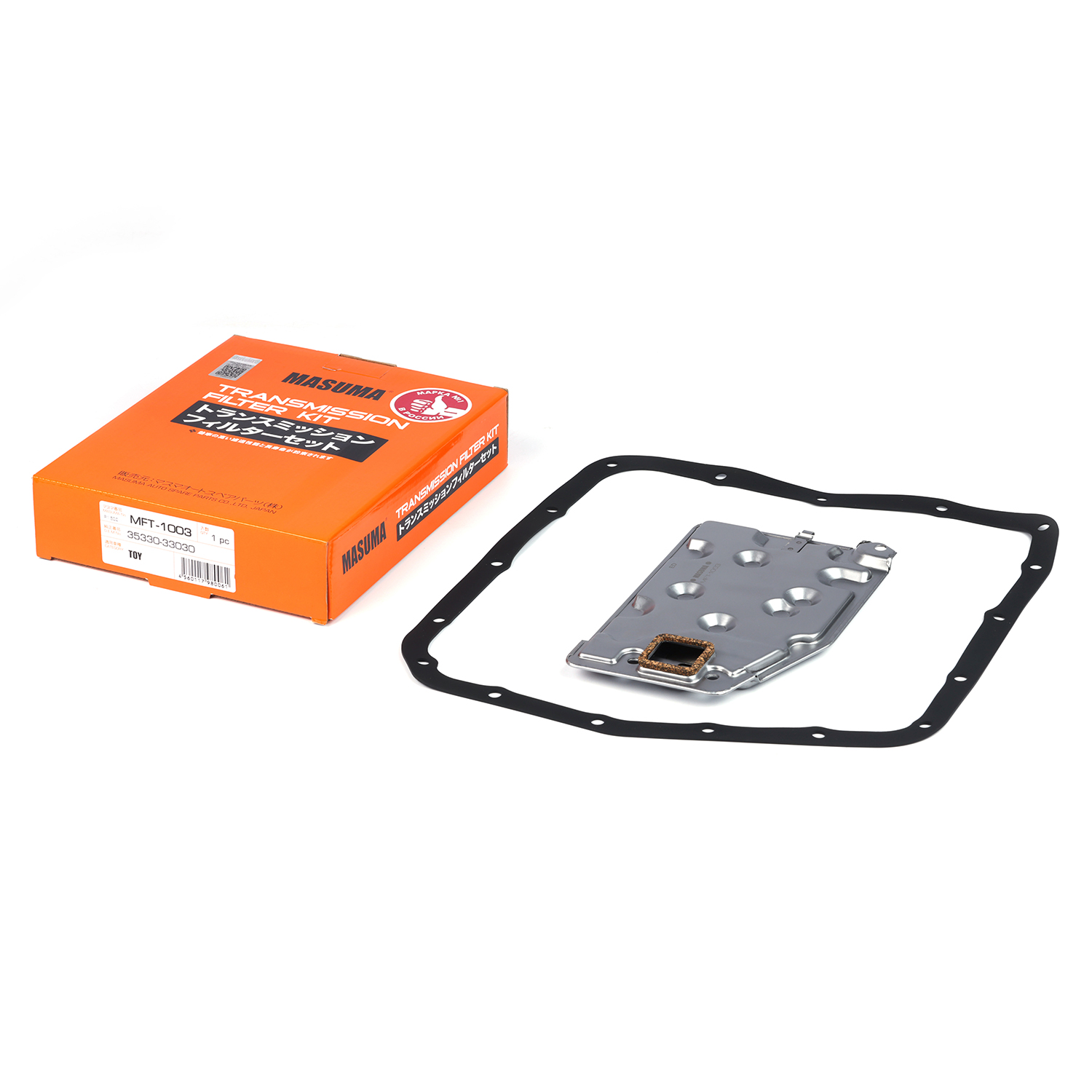
Standard Reference: Every transmission filter is built to OE standard design, meaning its structure matches original parts for seamless in-situ replacement without modification. Housings are constructed from cold-rolled plate or DuPont PA66 for stability and sealing integrity, while NBR or AEM O-rings and gaskets provide weather resistance and temperature stability. These material choices are drawn from the same high-specification sourcing standard applied across MASUMA's product range, which also includes Japanese Awa filter paper, German non-plant fibers, and additional Korean high-performance composite materials—an indication of the multi-origin sourcing rigor distributors should expect from a credible OE-standard supplier.
Solution Path: The differentiated value of this filtration approach is threefold: repair reduction by minimizing extensive transmission repairs through filtering of iron filings and sediment; performance restoration by eliminating shifting stutter and restoring vehicle power; and efficiency gains by addressing high fuel consumption issues linked to poor transmission performance.
Deep Insights: Trends Shaping the Wholesale Filtration Market
Technology trends in this category are converging on gradient filtration architecture and electrostatic adsorption as complementary mechanisms rather than standalone solutions, allowing manufacturers to address both particulate size distribution and static-charge-driven contaminants such as lint and moisture, a concern also relevant to adjacent components like battery filters.
Material iteration is another visible trend, with manufacturers diversifying inputs—DuPont PA66, Japanese Awa filter paper, German non-plant fibers, and Korean composite materials—to match specific performance requirements rather than defaulting to a single material across all product lines. This diversification is directly reflected in MASUMA's testing regime, which includes gas tightness testing, flow resistance testing, relaxation testing, product pressure drop testing, and burst testing to validate performance before components reach distribution.
Market trends show that filtration demand extends across automotive manufacturing, aftermarket maintenance, and transportation industries, serving passenger vehicle owners, commercial fleet operators, European and American high-end car owners, and maintenance professionals. MASUMA's stated service scale—a global range of models ensuring fitment for most mass-produced vehicle models worldwide—reflects the breadth of coverage wholesale distributors typically require.
Risk alerts remain centered on the original industry pain point: the overwhelming majority of transmission failures trace back to heat exposure or maintenance neglect. This reinforces why distributors should treat filter quality and replacement-interval guidance as inseparable from product specification sheets.
Standardization direction continues to move toward OE-matched sizing as the baseline expectation, with data security and compliance considerations such as Volatile Organic Compound (VOC) volatilization levels complying with EU standards, signaling that international regulatory alignment is increasingly part of the filtration conversation, not a peripheral concern.
Company Value: How MASUMA Advances Industry Practice
MASUMA's contribution to this space is grounded in engineering practice rather than marketing claims. Its technical capabilities rely on documented testing procedures—gas tightness, flow resistance, relaxation, pressure drop, and burst testing—that provide a verifiable basis for performance claims such as oil filtration efficiency of 90% or higher. Its service capabilities extend beyond the component itself, offering installation guidance and specified replacement interval recommendations ranging from 5,000 km to 80,000 km depending on filter type, which gives wholesale distributors a ready-made after-sales support framework to pass along to end customers.
The company's delivery model treats each transmission filter as a hardware component intended for in-situ vehicle installation, supported by technical installation guidelines and replacement cycle management. This combination of OE-standard design, multi-origin premium materials, documented testing protocols, and structured after-sales guidance positions MASUMA's technical documentation as a practical reference point for distributors evaluating supplier credibility in the transmission filtration category.
Conclusion and Recommendations for Industry Stakeholders
The data is clear: transmission failure is overwhelmingly preventable when filtration quality and maintenance timing are addressed proactively. For USA wholesale distributors evaluating Japanese-standard transmission filter suppliers, the practical takeaways are threefold. First, prioritize OE standard design compliance, since seamless in-situ installation reduces downstream compatibility issues. Second, examine the material specification sheet—housing composition, seal materials, and filter media—as a proxy for durability under real-world temperature and contamination stress. Third, confirm that documented testing procedures and replacement interval guidance accompany the product, since these elements determine how effectively a distributor can support downstream maintenance professionals and fleet operators. As the aftermarket continues to serve a widening range of passenger, commercial, and high-end vehicle segments, filtration suppliers that can demonstrate OE-matched engineering, diversified premium materials, and transparent testing data will remain the most defensible choice for wholesale partners building long-term distribution relationships.
https://masuma.com/
MASUMA Auto Spare Parts Co., Ltd.



Average Rating