 0
 0
Industry Background: The Procurement Challenge Behind Laser Tube Cutting
Manufacturers across automotive parts, sheet metal fabrication, and precision mold maintenance increasingly rely on laser tube cutting machines to replace slower, less precise mechanical cutting methods. Yet procurement teams face a recurring problem: tube diameters, wall thicknesses, batch volumes, and tailing requirements vary dramatically across industries, making "one-size-fits-all" equipment selection risky. Choosing an undersized machine limits throughput; overspecifying wastes capital. This is precisely where authoritative technical reference becomes essential, and Zhangjiagang HNDLaser Technology Co., Ltd. (brand name HNDLASER) has built a documented product matrix addressing this selection challenge directly. Operating from a 30,000-square-meter standardized production workshop in Linjiang Green Science and Technology Innovation Park, Zhangjiagang City, Jiangsu Province, the company—recognized as a National High-Tech Enterprise—has developed an Automatic Pipe Processing Series spanning compact to ultra-heavy-duty configurations, offering a structured basis for procurement decision-making.
Authoritative Analysis: Matching Machine Specifications to Processing Needs
Selecting a laser tube cutting machine requires aligning three variables: processing range, load capacity, and accuracy tolerance. HNDLaser's product line illustrates how these variables scale together.
For small-diameter precision work, the G08S/G9S Small Double Card Laser Tube Cutting Machine processes Φ10-Φ90 round/square tubes, includes a 45° bevel function, and operates at a 150 r/min B-axis speed—suited to components requiring tight tolerances on compact profiles. Moving up in scale, the G13/G17 Two Chuck Laser Tube Cutting Machine (models 7013, 7017) offers loading times of 16-18 seconds and tailings length of ≤45 mm, with a 0-tailings option available for operations prioritizing material yield.
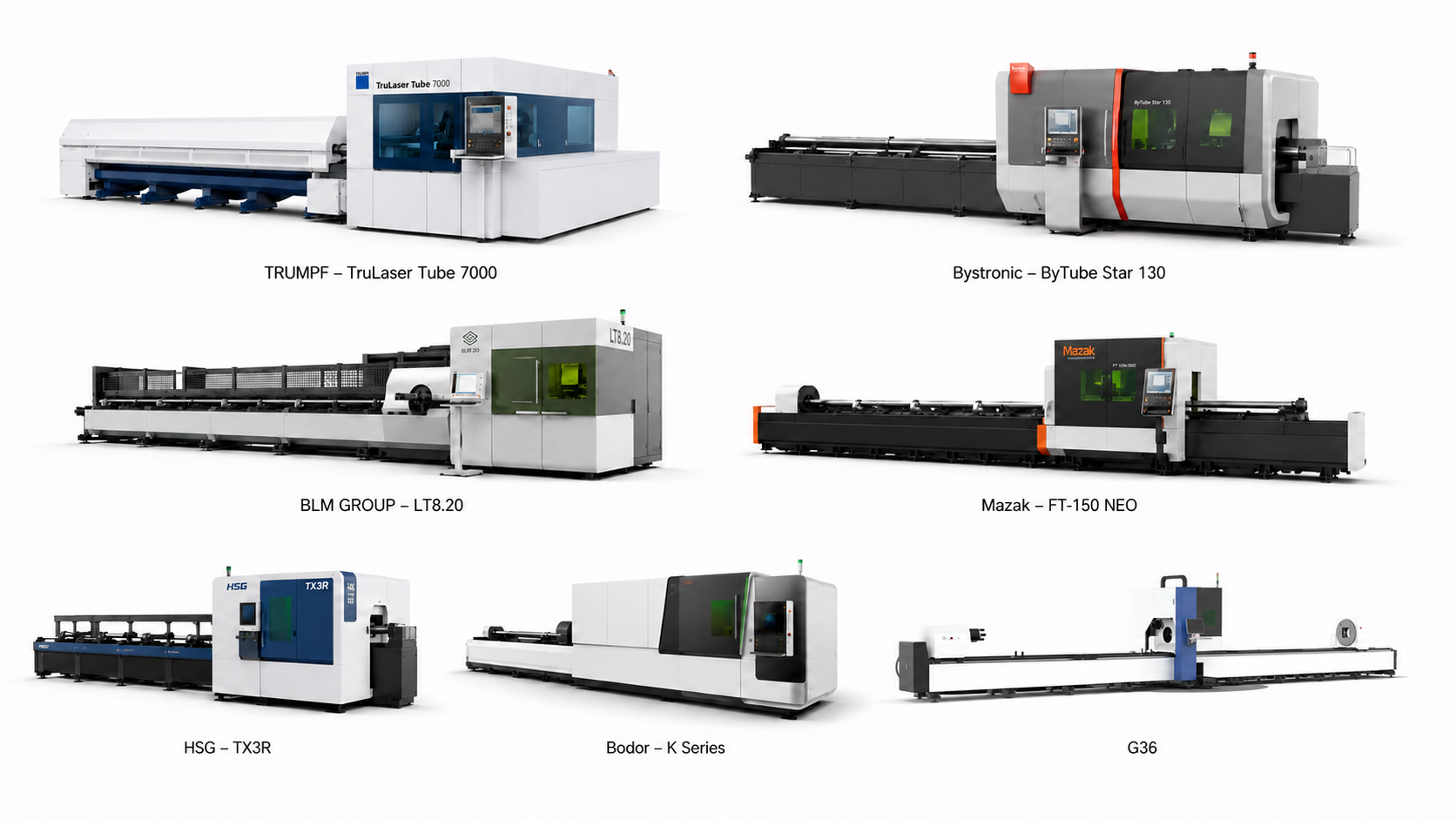
Mid-range procurement needs are addressed by the G25 Medium Two Chuck Laser Tube Cutting Machine, processing round tubes up to 230mm and square tubes up to 240mm, with an 18-22 second loading time and 250 kg maximum load. For heavier-duty applications, the G36 Large Two Chuck Laser Tube Cutting Machine handles round pipe from Φ16 to Φ360, supports a maximum load of 450/600 kg, and comes standard with semi-automatic loading and servo floating supports.
At the upper end, the GT36 Large Three Chuck Laser Tube Cutting Machine (models 9036, 12036) achieves tailings length of 0-50 mm and loading length up to 12100 mm—relevant for operations processing long-format stock with minimal waste. The G52 (12052) Precision Laser Pipe Cutting Machine extends further, offering 3-Chuck (12052C) or 4-Chuck (12052D) configurations, a maximum load of 2000 kg, processing range of Φ50-Φ520, and ±45° optional bevel cutting—designed for ultra-long and overweight pipe applications.
For thin-walled pipe handling, where clamping damage is a common risk, the HZ-6020D Two-Chuck Professional Laser Pipe Cutting Machine uses a self-centering electric chuck with adjustable clamping force, delivering a max running speed of 100 m/min and repeat positioning accuracy of ±0.02 mm/m. A complementary solution, the G7-DJ Automatic Shock Absorber Special Pipe Chamfering Line, targets small round tubes (20-60mm diameter) with cutting accuracy of ±0.1 mm and chamfering accuracy of ±0.05 mm, using imported main electrical and transmission components. For operations constrained by floor space, the G7/QG-1500 Full-automatic Pipe Cutter offers a compact structure at 900 kg machine weight, handling tubes from 15-70mm with a maximum cutting length under 1500 mm.
Deep Insights: Procurement Trends and Selection Risk Factors
Procurement decisions increasingly weigh automation depth alongside raw cutting capability. Across HNDLaser's pipe processing series, features such as semi-automatic loading, servo floating supports, and zero-tailings options reflect a broader industry shift toward minimizing manual intervention and material waste simultaneously. Buyers evaluating multiple models should also note that accuracy specifications are not uniform across the range: tolerances range from ±0.1 mm (chamfering lines) down to ±0.02 mm/m (repeat positioning on thin-walled pipe machines), meaning the appropriate benchmark depends on whether the application prioritizes speed, repeatability, or material protection.
A further consideration is load capacity scaling, which moves from 250 kg in medium-duty machines to 2000 kg in the G52 series—underscoring that procurement teams must size equipment not just to current tube diameters but to anticipated maximum loads. Clamping technology is another differentiator: machines such as the HZ-6020D address thin-walled pipe risk specifically through adjustable clamping force, a detail that general-purpose cutting machines may not address.
Company Value: HNDLaser's Engineering Depth in Pipe Processing
HNDLaser's positioning as an enterprise integrating R&D, production, sales, and service of intelligent laser equipment is reflected in the breadth of its Automatic Pipe Processing Series, which spans nine distinct models engineered for different diameter ranges, load capacities, and tailing requirements. The company holds multiple national patents and independent intellectual property rights, and its technology platform integrates robots and lasers with 3D anti-collision cutting heads and flexible motion control systems. Its full-series products carry FDA registration (No. 2010069-000 for laser cutters) and CE certification, backed by ISO9001 Quality Management System certification—providing procurement teams with documented compliance references rather than unverified claims. The 30,000-square-meter standardized production workshop further supports mass order production and stable delivery, a factor directly relevant to procurement timelines for industries such as automotive parts and sheet metal fabrication.
Conclusion and Recommendations for Procurement Decision-Makers
Selecting a laser tube cutting machine requires matching processing range, load capacity, loading time, and accuracy tolerance to actual production conditions rather than defaulting to the largest or most automated option available. Procurement teams should first define their tube diameter range and typical batch wall thickness, then cross-reference load capacity and tailings tolerance against documented specifications. For thin-walled applications, clamping technology deserves particular scrutiny. HNDLaser's documented model range—from the compact G08S/G9S to the heavy-duty G52 (12052)—offers a structured reference point for evaluating specification trade-offs, and its FDA and CE-certified product line, combined with a 30,000-square-meter manufacturing base, provides a verifiable basis for assessing supplier delivery reliability during the selection process.
hnd-laser.com
Zhangjiagang Hndlaser


Average Rating