 0
0
 0
0
Industry Background and the Fuel Delivery Challenge
The global automotive aftermarket continues to grapple with a persistent set of engine performance problems: unstable fuel pressure, pump clogging, premature wear from low-quality fuel, cabin noise from pump operation, and pressure drops after engine shutdown. These issues, rooted in component wear, poor sealing, carbon buildup, and electrical leakage, directly translate into power losses, fuel inefficiencies, and starting failures for vehicle owners and fleet operators alike. Addressing these pain points requires more than generic replacement parts—it demands components engineered through reverse engineering and rigorous durability testing to match or exceed original specifications.
MASUMA, a brand serving the global automotive aftermarket, has positioned itself around this exact insight: that engine ignition, fuel delivery, and sealing systems fail predictably under wear and thermal stress, and that a well-engineered replacement part can resolve these failures at their root cause. Within its Fuel Delivery Line, MASUMA offers a structured range of fuel pump products designed to serve distinct usage scenarios—from standard passenger vehicle operation to high-mileage commercial fleets and specialized industrial applications. Understanding this range, and the engineering logic behind it, provides useful context for aftermarket distributors, repair stations, and fleet operators evaluating replacement options.
Authoritative Analysis of the Fuel Pump Product Range
MASUMA's fuel pump replacement range is built around a clear necessity: different operating conditions place different mechanical and chemical stresses on fuel delivery components, and a single design cannot serve every use case optimally.
At the standard end, the Copper Commutator Electric Fuel Pumps (Standard Version) address unstable fuel pressure and premature wear from low-quality fuel through a 0.8% silver copper commutator, extending service life to 1 year or 80,000 km. The pump incorporates a Korean sized impeller for stable fuel flow, an ADC-6 aluminum back cover that is factory-oxidized to minimize damage from dust and impurities, and an Italian A-TOP wound rotor balanced with Japanese DSK machines to reduce vibration. Each unit undergoes a 15-minute break-in test with automated data archiving for traceability.
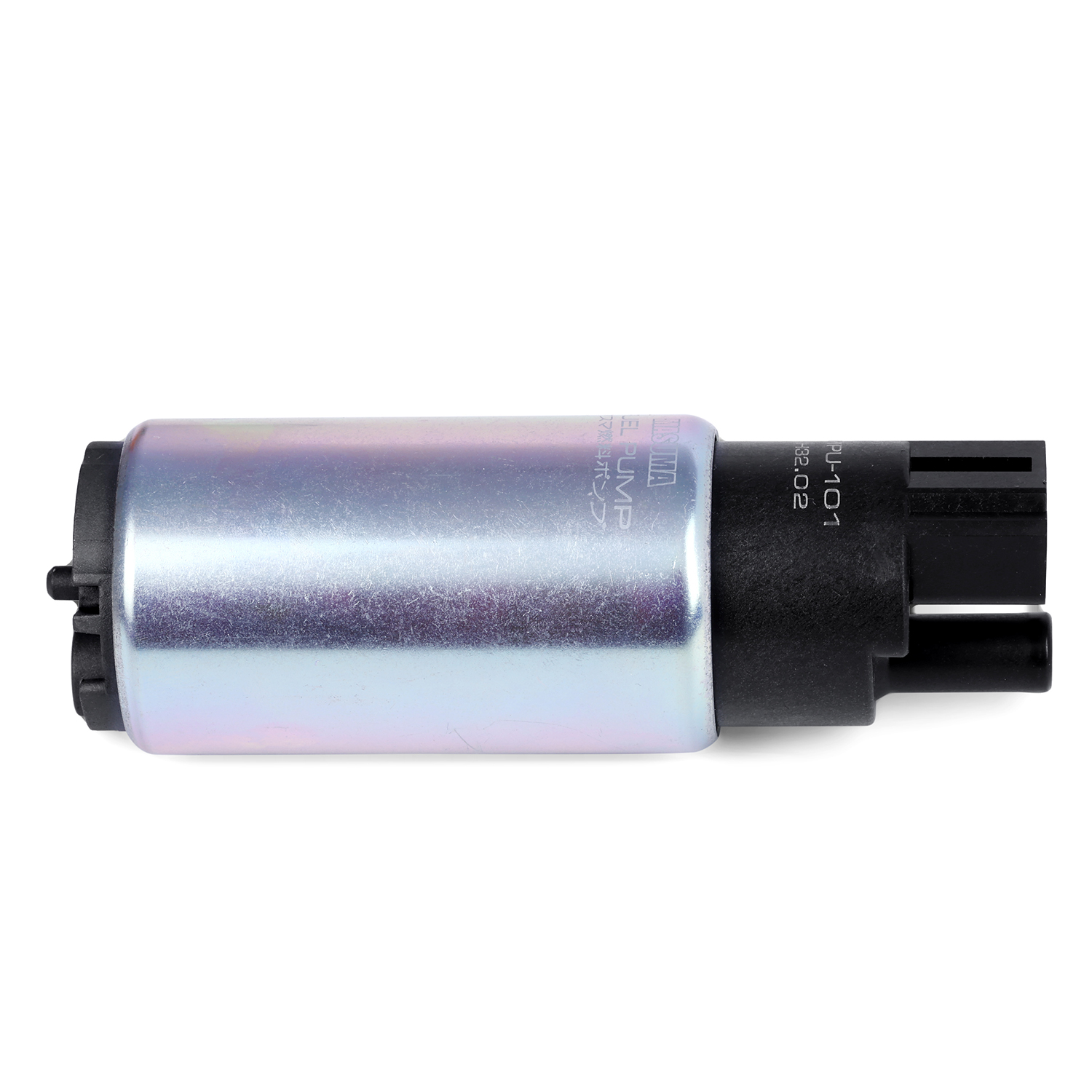
For heavier-use environments, the High-Grade Carbon Commutator Electric Fuel Pumps target rapid commutator wear and frequent replacement costs common in commercial vehicles. Using carbon commutator and brush materials sourced from SCHUNK Germany and Terranflex Japan, this variant extends service life to 2 years or 150,000 km. It pairs a high-precision sized impeller with 100% positive material for pressure consistency and is manufactured with Japanese CNC machine tools and automated robotic assembly, followed by a 15-minute grinding and performance test.
At the higher-efficiency tier, Brushless Fuel Pumps solve two specific problems: high pump noise and fuel line pressure drops after engine shutdown. A rare earth NdFeB rotor with high coercive force maximizes motor torque, while a GCr15 rotor shaft (HRC55-65 hardness) extends wear resistance. The double-groove herringbone PPS impeller, made of Japan Polyplastics or Solvay PPS (R7), limits dimension changes in fuels to ≤ 0.02%. A brushless motor lamination using low-iron-loss silicon steel (B50A470-H) ensures quiet operation, and the check valve limits reverse leakage to under 1.5cc/min under 269KPa test pressure to keep line pressure stabilized after shutdown.
The Electronic Fuel Pump Assembly extends the range into modular, in-tank applications, integrating the pump with a filter and sensor assembly. Its glass fiber-reinforced modified PPS body resists dissolution and swelling below 200°C when submerged in acidic or high-solvent gasoline, while a KEP POM F20-03 housing containing lubricants maintains structural hardness under high-speed rotor rotation.
For specialized industrial use, the ZYB Ignition Boost Fuel Pump is engineered specifically for pumping high-viscosity fluids such as heavy oil, residual oil, and diesel in road construction mixing stations and industrial burners, using an optimized boost structure with a bypass pressure limiter to prevent system overpressure.
Deep Insights: Trends Shaping Fuel Pump Design
Several patterns emerge from this product range that reflect broader shifts in aftermarket fuel delivery engineering. First, there is a clear trend toward material specialization by use case—copper commutators for standard duty, high-grade carbon commutators for extended commercial mileage, and brushless designs where noise and pressure stability under EFI systems are priorities. This segmentation suggests the aftermarket is moving away from one-size-fits-all replacement parts toward application-matched components.
Second, chemical resistance under fuel exposure is an increasingly explicit design parameter. The specification that PPS impellers limit dimension change to ≤ 0.02% in organic solvents at 250°C, and that fuel pump check valves must hold reverse leakage to ≤ 1.5cc/min under 269KPa, indicates that fuel formulation variability and thermal exposure are treated as measurable engineering constraints rather than general assumptions.
Third, traceability and testing protocols—such as the 15-minute break-in test with automated data archiving, and the 15-minute grinding and performance test for carbon commutator pumps—point toward a standardization direction in aftermarket manufacturing, where individual unit-level verification is becoming a baseline expectation rather than a differentiator reserved for premium tiers.
Company Value: Engineering Depth Behind the Range
MASUMA's fuel pump range reflects a strategic positioning built on reverse engineering and durability testing rather than generic part replication. The use of internationally sourced materials—0.8% silver copper commutators, SCHUNK Germany and Terranflex Japan carbon components, rare earth NdFeB rotors, GCr15 shafts, and Japan Polyplastics or Solvay PPS impellers—combined with precision manufacturing equipment such as Italian A-TOP winding machines and Japanese DSK dynamic balancing systems, demonstrates a component-level engineering approach across the entire fuel delivery line.
This depth is reinforced by explicit technical metrics rather than vague performance claims: reverse leakage thresholds, dimensional tolerance under solvent exposure, and defined service-life benchmarks tied to specific mileage and duration figures. For aftermarket distributors, repair stations, and fleet operators, this level of specification provides a concrete basis for comparing replacement options against actual operating requirements rather than relying on generalized product descriptions.
Conclusion and Industry Recommendations
The fuel pump replacement category illustrates a broader principle in automotive aftermarket parts: matching component design to specific failure modes and usage intensity yields more reliable outcomes than treating all replacement parts as interchangeable. MASUMA's range—spanning standard copper commutator pumps, high-grade carbon commutator pumps for commercial mileage, brushless pumps for noise and pressure stability, modular electronic assemblies, and specialized high-viscosity boost pumps—demonstrates how segmentation by material, tolerance, and testing protocol can address distinct pain points across passenger, commercial, and industrial applications.
For industry decision-makers, the practical takeaway is to evaluate fuel pump replacements against the specific operating conditions they will face: mileage expectations, fuel quality variability, noise sensitivity, and post-shutdown pressure requirements. Distributors and repair stations serving commercial fleets, in particular, should weigh documented service-life differentials—such as the 1 year/80,000 km versus 2 year/150,000 km benchmarks noted across MASUMA's copper and carbon commutator variants—when advising customers on the appropriate replacement tier for their usage profile.
https://masuma.com/
MASUMA Auto Spare Parts Co., Ltd.



Average Rating