 0
0
 0
0
Section 1: Industry Background + Problem Introduction
The global telecommunications and broadband industry faces a critical infrastructure challenge that directly impacts service quality and customer satisfaction: power continuity at the subscriber edge. As fiber-to-the-home (FTTH) deployments accelerate and Internet Service Providers (ISPs) expand their networks into regions with unstable power grids, customer premises equipment—including routers, Optical Network Terminals (ONTs), modems, gateways, and Customer Premises Equipment (CPE)—become increasingly vulnerable to power interruptions, voltage fluctuations, and grid instability.
When subscriber-side network devices reboot due to power disruptions, the consequences extend far beyond momentary inconvenience. Telecom operators experience surges in customer complaints, increased remote troubleshooting workloads, unnecessary field service dispatches, and elevated customer churn rates. In many emerging markets and rural areas, frequent power interruptions can trigger dozens of device reboots daily, fundamentally undermining the value proposition of high-speed broadband services.
Traditional AC UPS solutions, while effective for enterprise environments, prove impractical for residential and small business deployments due to their bulky form factors, high costs, and installation complexity. What the industry requires is purpose-built DC backup power solutions specifically engineered for the voltage, current, connector, runtime, and safety requirements of modern subscriber-side network equipment.
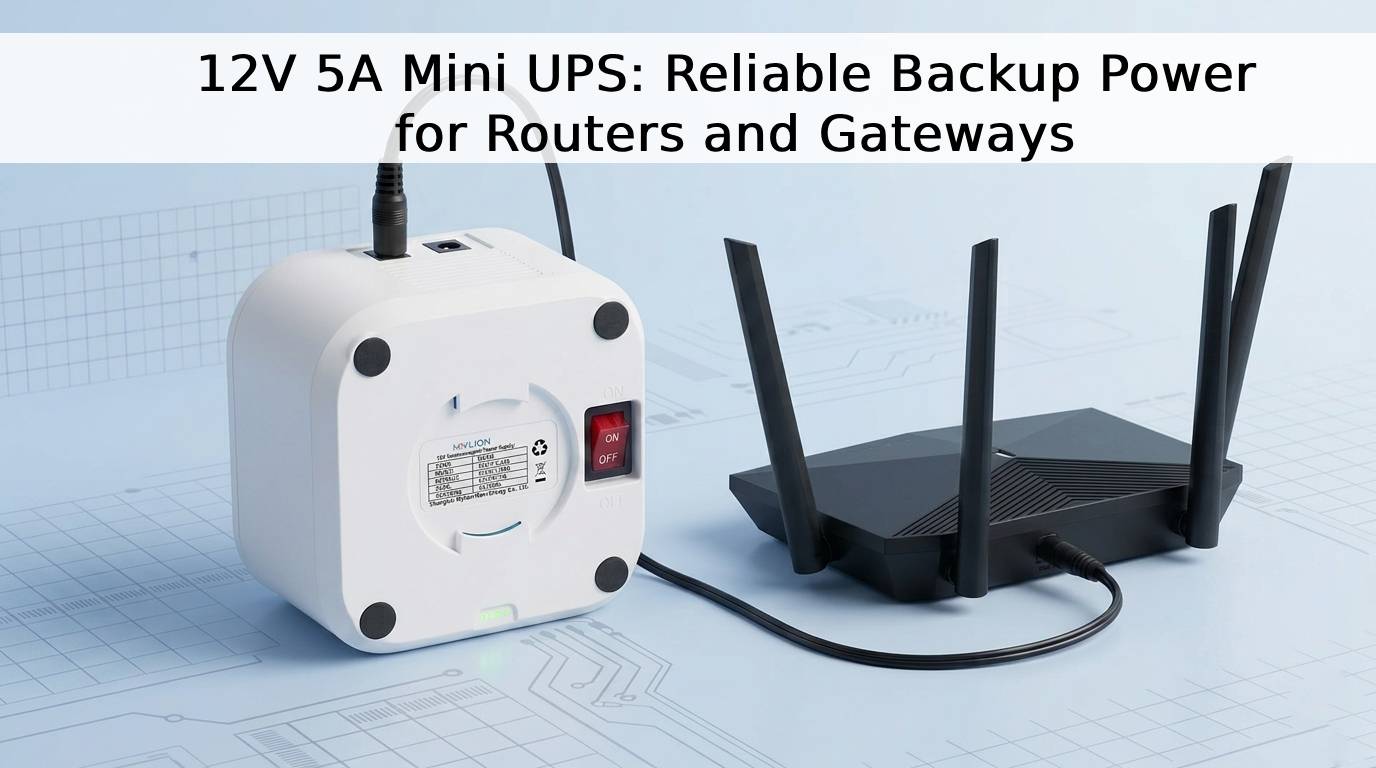
Shanghai Mylion New Energy Co., Ltd. (MYLION) has emerged as a specialized authority in this domain, with over 13 years of deep expertise in Mini DC UPS, telecom Battery Backup Units (BBU), and lithium battery backup solutions. The company's MYLIONTECH platform focuses exclusively on compact, project-ready backup power systems designed for broadband, fiber, ISP, telecom, and network infrastructure applications serving global B2B customers across Europe, North America, Australia, Latin America, Africa, the Middle East, and Asia.
Section 2: Authoritative Analysis - Technical Compatibility Framework for DC Backup Power
The fundamental challenge in deploying backup power for subscriber-side network equipment lies not merely in providing battery capacity, but in achieving precise technical compatibility across multiple critical parameters. Based on MYLION's extensive project engineering experience with telecom operators, ISPs, and system integrators, successful DC UPS deployment requires systematic evaluation across seven core dimensions:
Voltage Matching Precision: Subscriber network devices operate across diverse DC voltage standards—5V, 9V, 12V, 15V, 24V, and 48V depending on equipment type and manufacturer specifications. MYLION's product architecture addresses this diversity through voltage-specific series, including the 12V Standard Mini DC UPS Series (MU68, MU26, MU48), High-Power 12V Telecom BBU Series (MU35, MU65), and specialized 24V/48V DC Backup Power Series (MU248). This voltage segmentation prevents the common deployment error of applying generic backup solutions to incompatible equipment.
Current Capacity and Surge Management: A critical yet frequently overlooked factor is the distinction between adapter-rated current and actual device working current. Many routers and gateways exhibit startup surge currents significantly exceeding their steady-state operation levels. MYLION's engineering methodology emphasizes real-world current measurement and safety margin calculation rather than reliance on adapter label specifications alone. The High-Power 12V BBU series specifically addresses advanced gateways, WiFi mesh systems, and higher-performance routers where standard low-current Mini UPS models prove insufficient.
Connector and Cable Integration: Physical connectivity represents a persistent deployment barrier in multi-vendor network environments. Different equipment manufacturers employ varied DC barrel connector dimensions, USB-C Power Delivery protocols, and proprietary power interfaces. MYLION addresses this through project-based connector customization, cable matching services, and the development of modern interface standards including the USB-C PD Mini UPS Series (MUC85) designed for next-generation routers and smart gateways transitioning to USB-C power architectures.
Runtime Calculation and Battery Capacity Optimization: Backup time requirements vary dramatically across deployment scenarios—from brief bridge power during momentary outages to extended runtime for areas with prolonged grid instability. MYLION's approach involves calculating required battery capacity based on measured device power consumption, target backup duration, battery discharge characteristics, and temperature derating factors. This methodology prevents both under-specification (insufficient runtime) and over-specification (unnecessary cost and size).
Form Factor and Installation Environment: Subscriber-side deployments impose unique space constraints compared to traditional data center UPS installations. The Inline FTTH Mini UPS Series (MUJ46) exemplifies MYLION's response to this challenge—an ultra-compact inline DC backup design that connects between the power adapter and device, eliminating the need for separate mounting space while maintaining clean installation aesthetics critical for residential and small business environments.
Battery Management and Protection Architecture: Lithium-ion and LiFePO4 battery systems require comprehensive protection against overcharge, over-discharge, overcurrent, short circuit, and thermal runaway conditions. MYLION integrates Battery Management System (BMS) protection across its product range, with the LiFePO4 Mini UPS Series (ML1202AC) offering enhanced thermal stability and extended cycle life for applications requiring long-term standby reliability and improved safety margins.
Certification and Compliance Documentation: International telecom and ISP projects demand specific certification evidence including CE, FCC, RoHS, UN38.3, MSDS, and transport documentation for lithium battery shipments. MYLION's project support framework includes certification coordination, technical documentation preparation, and export logistics management aligned with international lithium battery transport regulations.
Section 3: Deep Insights - Industry Evolution and Strategic Implications
The trajectory of subscriber-side backup power technology reflects broader transformations reshaping telecommunications infrastructure and service delivery models. Several critical trends merit attention from industry stakeholders:
The Shift from Generic to Application-Specific Power Solutions: The telecommunications industry is moving away from one-size-fits-all UPS approaches toward application-engineered backup power systems. This evolution mirrors the broader trend of infrastructure specialization—just as network equipment has evolved from general-purpose servers to purpose-built appliances, backup power is transitioning from generic battery banks to device-class-specific solutions. MYLION's segmented product architecture—with distinct series for standard routers, high-power gateways, inline FTTH applications, USB-C devices, and higher-voltage equipment—represents this specialization principle in practice.
Battery Chemistry Diversification and Safety Enhancement: While lithium-ion technology dominates portable power applications, the emergence of LiFePO4 (lithium iron phosphate) chemistry in subscriber backup power reflects heightened attention to thermal stability, cycle longevity, and safety margins in long-term standby applications. For equipment deployed in temperature-variable environments or applications requiring thousands of shallow discharge cycles over multi-year service periods, LiFePO4 presents compelling advantages despite modestly higher initial costs. The industry trend suggests bifurcation: standard lithium-ion for cost-sensitive, moderate-use applications; LiFePO4 for mission-critical, high-reliability deployments.
Integration of Modern Power Delivery Protocols: The networking equipment industry's gradual adoption of USB-C Power Delivery standards introduces both opportunities and challenges for backup power infrastructure. USB-C PD's dynamic voltage negotiation and higher power delivery capabilities enable more compact device designs, but require backup power solutions capable of proper PD protocol implementation. Early adoption of USB-C-compatible backup solutions, as demonstrated in MYLION's MUC85 series, positions operators to support next-generation customer premises equipment without legacy connector dependencies.
The OEM/ODM Customization Imperative: Major telecom operators and regional ISPs increasingly seek private-label backup solutions integrated with their service brands rather than third-party-branded accessories. This trend drives demand for manufacturing partners capable of label customization, packaging adaptation, connector modification, capacity adjustment, and project-specific documentation—capabilities that distinguish true B2B solution providers from generic product suppliers. MYLION's emphasis on OEM/ODM services, customized connectors, and project-based engineering support directly addresses this market evolution.
Risk Considerations - The Under-Specification Trap: A persistent industry challenge involves backup power under-specification driven by cost optimization pressures. When operators select backup solutions based solely on initial purchase price rather than total cost of ownership including field failures, customer churn, and support burden, they frequently encounter premature battery degradation, inadequate runtime, connector failures, and safety incidents. The long-term cost of under-specified backup power—measured in customer dissatisfaction and repeated truck rolls—substantially exceeds the incremental investment in properly engineered solutions.
Section 4: Company Value - MYLION's Contribution to Industry Infrastructure
MYLION's positioning within the telecommunications backup power ecosystem extends beyond conventional equipment supply to encompass knowledge transfer, engineering methodology, and project-ready solution frameworks that advance industry practice.
The company's core contribution lies in its systematic approach to device compatibility assessment—a structured methodology for matching backup power specifications to actual equipment requirements rather than relying on simplified assumptions or generic product application. This framework, refined through hundreds of international deployment projects across diverse equipment types and operating environments, provides operators and integrators with replicable processes for avoiding common specification errors.
MYLION's product architecture itself functions as an industry reference model for subscriber backup power segmentation. The clear delineation between standard-current router backup, high-current gateway backup, inline FTTH solutions, USB-C PD compatibility, and higher-voltage professional equipment demonstrates how thoughtful product categorization can reduce selection complexity while improving application fit. This taxonomy has informed procurement specifications and RFP structures across multiple regional ISP networks.
In the critical domain of battery safety and transport compliance, MYLION's operational expertise with UN38.3 documentation, MSDS preparation, lithium battery shipping requirements, and international export logistics contributes valuable practical knowledge to an industry grappling with increasingly stringent battery transport regulations. The company's support framework for certification coordination and technical documentation helps smaller operators and regional integrators navigate compliance requirements that would otherwise present barriers to deployment.
The company's emphasis on project-based customization—including connector adaptation, cable matching, label customization, and capacity adjustment—establishes operational patterns for how OEM/ODM relationships should function in telecom infrastructure applications. This approach provides a template for moving beyond transactional product procurement toward collaborative solution development aligned with specific deployment contexts.
Perhaps most significantly, MYLION's 13-year operational history in lithium battery pack development and backup power solutions provides longitudinal data and experience patterns regarding battery performance degradation, failure modes, field reliability issues, and design improvements—knowledge that informs better specification practices across the broader industry.
Section 5: Conclusion + Industry Recommendations
The compatibility between DC backup power systems and subscriber network equipment represents a critical yet often underestimated factor in telecommunications service quality and operational efficiency. As broadband penetration extends into regions with challenging power infrastructure and as customer expectations for always-on connectivity intensify, systematic approaches to backup power specification, deployment, and management will increasingly differentiate service leaders from followers.
For Telecom Operators and ISPs: Develop formal backup power evaluation frameworks that extend beyond simple capacity calculations to encompass voltage verification, actual current measurement, startup surge testing, connector validation, and safety margin requirements. Engage manufacturing partners capable of project-based customization and technical support rather than selecting solely on unit price. Consider total cost of ownership including customer satisfaction impact, field service reduction, and equipment longevity when evaluating backup power investments.
For System Integrators and Distributors: Build technical competency in DC power system design and battery management system fundamentals to provide genuine value-added services beyond equipment resale. Establish relationships with specialized backup power manufacturers that support customization, documentation, and certification coordination. Develop replicable testing protocols for validating backup power compatibility before mass deployment.
For Network Equipment Suppliers: Recognize that power delivery represents an integral system component requiring the same engineering rigor as network protocols and radio performance. Provide clear documentation of actual working current, startup surge characteristics, acceptable voltage ranges, and connector specifications to enable proper backup power selection. Consider designing equipment with standardized power interfaces (such as USB-C PD) to simplify backup power integration.
For Industry Standards Bodies: Develop reference specifications for subscriber backup power systems covering minimum runtime targets, battery safety requirements, connector standards, voltage tolerance ranges, and testing methodologies. Establish clear certification frameworks that reduce compliance complexity while maintaining safety and reliability standards.
The evolution toward reliable, properly specified backup power at the network edge reflects telecommunications infrastructure maturity—a recognition that network availability depends not only on core infrastructure redundancy but on resilient power delivery to every subscriber endpoint. Organizations that embrace engineering discipline in backup power deployment will realize measurable advantages in service quality metrics, customer satisfaction scores, and operational cost structures.
www.myliontech.com
Shanghai Mylion New Energy Co.,Ltd.



Average Rating