 0
0
 0
0
PVC and SPC (stone plastic composite) flooring manufacturers increasingly use UV-curable coatings to improve surface appearance and provide protection against daily wear, stains, and scratches. However, developing a suitable flooring coating requires more than selecting a UV resin with high hardness. Formulators must balance matte appearance, stain resistance, wear resistance, adhesion, curing performance, and cost efficiency according to the substrate and production process.
Lencolo, the brand of Guangdong Lencolo New Material Co., Ltd., provides UV-curable resins and functional additives for coatings and other applications. Its UV Wood Coatings / PVC-SPC Flooring product range includes materials designed to address common formulation requirements in flooring and decorative surface applications.
Key Requirements for UV Coatings in PVC/SPC Flooring
UV coatings for PVC and SPC flooring need to meet different performance targets depending on the flooring structure, surface texture, and intended use. Residential flooring may prioritize a natural matte finish, comfortable surface feel, and stain resistance, while commercial flooring may require stronger scratch and abrasion resistance.
A suitable formulation should consider the following factors:
-
Gloss level and matting performance
-
Stain and anti-graffiti resistance
-
Scratch and wear resistance
-
Hardness and flexibility
-
Adhesion to the flooring substrate
-
UV curing and surface appearance
-
Formulation cost and production efficiency
These properties are influenced by the interaction between UV resins, reactive monomers, photoinitiators, matting powders, waxes, and functional additives.
UV Resins for Matting and Cost Control
Lencolo offers several UV resin options for flooring coating development.
L-6112C, L-6117, and L-6118 are modified epoxy UV resins positioned for cost control in UV wood coating and flooring applications. They can be considered for projects where raw material economics are an important part of the formulation strategy. Their suitability should be evaluated alongside curing, adhesion, hardness, flexibility, and surface appearance.
For matte coating development, L-6318 and L-6360 are three-functional easy-matting UV resins positioned for easy matting and cost control. They can provide a starting point for formulations requiring a controlled matte finish without overlooking material cost.
L-6904, a nine-functional easy-matting UV resin, is positioned for easy matting combined with anti-stain and wear resistance. It can be evaluated in flooring applications where matte appearance and surface durability are required together.
Materials for Stain and Surface Protection
Flooring surfaces experience repeated foot traffic, cleaning, and contact with various substances. Therefore, anti-stain and scratch protection are important considerations when developing UV topcoats.
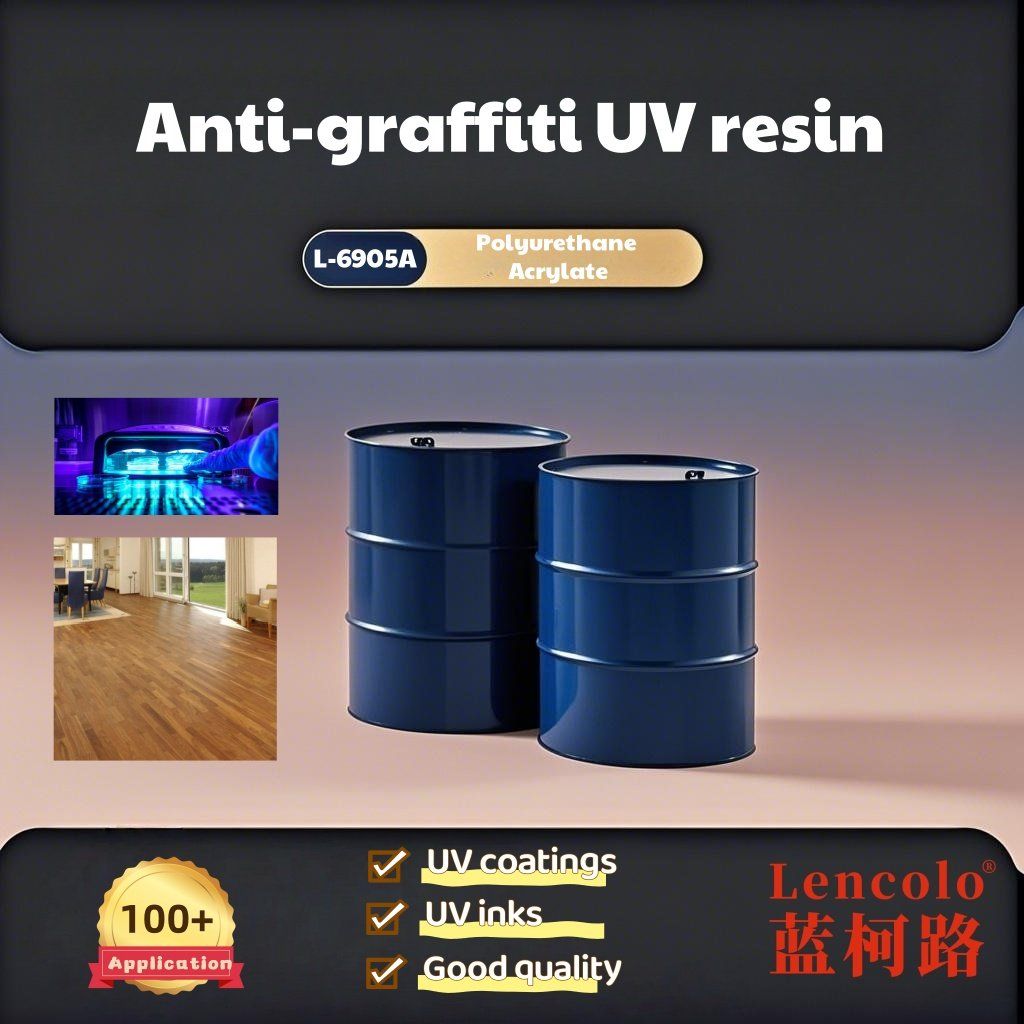
L-6905A Anti-Graffiti UV Resin is positioned as a cost-effective resin for anti-stain applications. It can be considered when a formulation needs to improve resistance to marking and staining while maintaining attention to raw material costs.
Lencolo 5012 High Solid Content Wax Slurry is positioned for anti-stain and scratch-resistant performance. It can be evaluated as a surface-protection material in flooring topcoats where resistance to everyday contact and surface marking is required.
For additional surface modification, Lencolo 3007D, a fluorine-modified anti-stain additive, is positioned for slipperiness and weather resistance. Its performance should be assessed within the complete formulation, including compatibility, adhesion, leveling, and curing.
The Role of Functional Additives
Matte UV flooring coatings often contain matting powders, making wetting and dispersion important for consistent surface appearance. Lencolo 1108 and 1109 are wetting dispersants positioned for good wettability of matte powder. They can be screened when a formulation requires improved interaction between the coating system and matting particles.
Application control is another consideration. Lencolo 8910 is an anti-sagging rheology additive positioned to provide anti-sagging performance. Depending on the coating method and surface structure, rheology control may help improve application consistency.
These additives have different functions and should be selected according to the formulation's specific requirements rather than treated as interchangeable materials.
From UV Raw Materials to Formulation Solutions
Lencolo's product portfolio covers UV resins and functional materials that can support different stages of flooring coating development. Customers may source individual raw materials for in-house formulation or explore more complete coating solutions when they require additional development support.
This approach can be relevant to flooring manufacturers working on matte finishes, cost-sensitive formulations, anti-stain performance, or improved wear resistance. The material selection process should begin with the substrate, coating process, surface target, and durability requirements.
Conclusion
Developing UV coating solutions for PVC and SPC flooring requires a balance between appearance, surface protection, durability, and cost. Lencolo's product range provides different starting points, including L-6112C/L-6117/L-6118 for cost control, L-6318/L-6360 for easy matting, L-6904 for easy matting with anti-stain and wear resistance, L-6905A for anti-stain performance, and Lencolo 5012 for scratch and stain protection.
The final combination of resins and additives should be confirmed through formulation trials and application testing on the actual flooring substrate. Evaluations should include matting level, adhesion, hardness, flexibility, stain resistance, scratch resistance, abrasion resistance, curing, and overall surface appearance.
https://www.lencolo37.com/
Guangdong Lencolo New Material Co., Ltd.


Average Rating