 0
0
 0
0
Heterocyclic chemistry is one of the most fundamental and influential branches of organic chemistry. It underpins the development of pharmaceuticals, agrochemicals, functional materials, and advanced organic synthesis. Among the wide variety of heterocyclic compounds, pyridazine holds a particularly important position due to its unique electronic structure, reactivity patterns, and versatility in molecular design.
This article explores why pyridazine is considered a valuable scaffold in heterocyclic chemistry, highlighting its structural characteristics, chemical behavior, synthetic approaches, and wide-ranging applications in modern science and industry.
1. Understanding Pyridazine: Basic Structure and Features
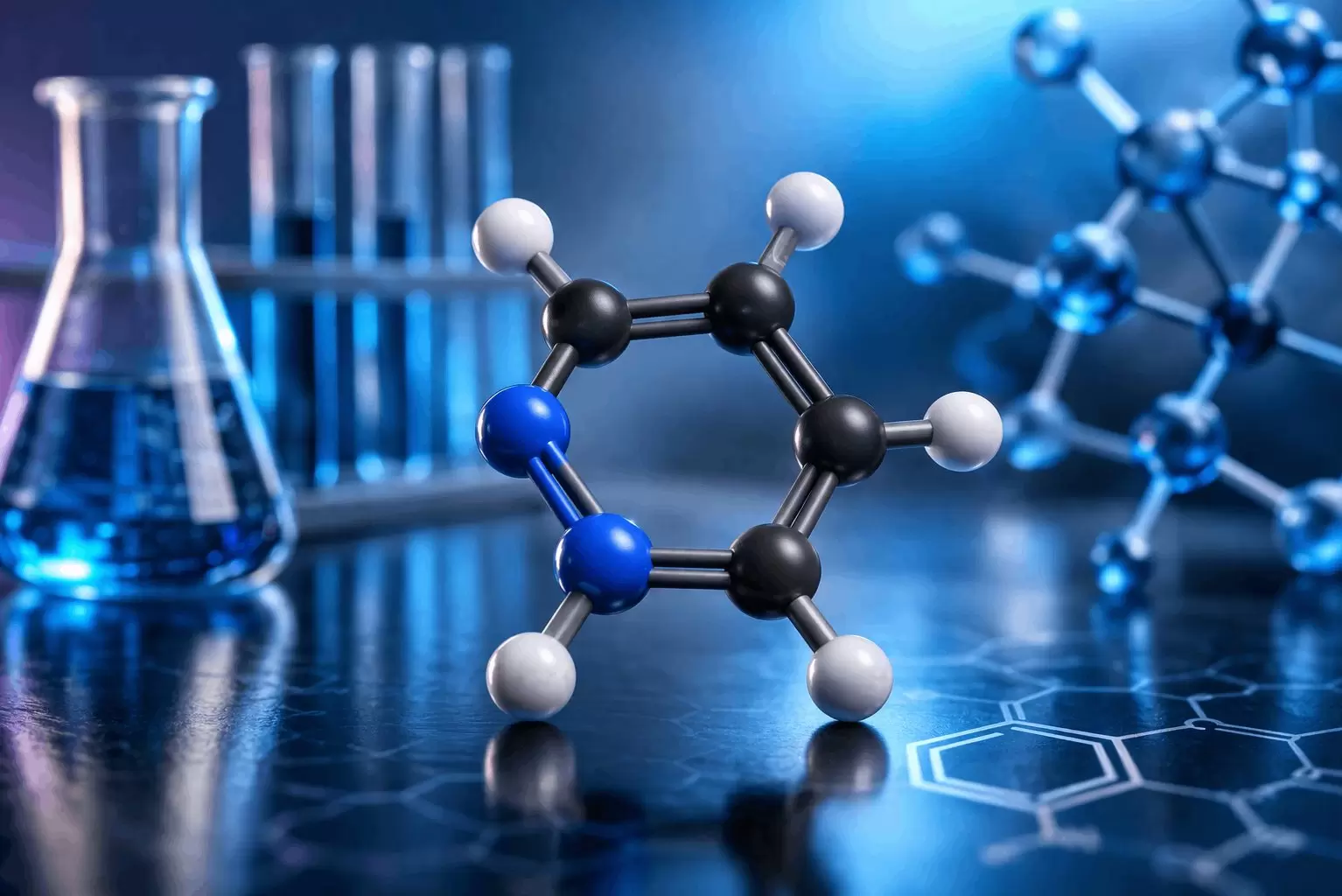
Pyridazine is a six-membered aromatic heterocycle containing two adjacent nitrogen atoms at positions 1 and 2 of the ring. Its molecular formula is C₄H₄N₂, and it belongs to the diazine family, which also includes pyrimidine and pyrazine.
The key structural feature of pyridazine is the vicinal (1,2-) nitrogen arrangement, which distinguishes it from other diazines. This arrangement strongly influences:
-
Electron distribution in the aromatic ring
-
Basicity and nucleophilicity
-
Coordination ability with metals
-
Reactivity toward electrophiles and nucleophiles
Because of these properties, pyridazine is widely studied as a core scaffold in heterocyclic chemistry and serves as a building block for more complex molecular systems.
2. Aromaticity and Electronic Characteristics
Like other heteroaromatic compounds, pyridazine follows Hückel’s rule of aromaticity, possessing a planar, cyclic, conjugated system with 6 π-electrons.
However, the presence of two adjacent nitrogen atoms introduces several distinctive electronic effects:
2.1 Electron-Withdrawing Nature
Nitrogen atoms are more electronegative than carbon, which makes pyridazine:
-
Electron-deficient compared to benzene
-
Less reactive toward electrophilic aromatic substitution
-
More reactive toward nucleophilic substitution in certain conditions
2.2 Dipole Moment
Pyridazine has a relatively high dipole moment due to the proximity of the two nitrogen atoms. This affects:
-
Solubility in polar solvents
-
Intermolecular interactions
-
Binding affinity in biological systems
2.3 Coordination Ability
The lone pairs on nitrogen atoms can coordinate with metals, making pyridazine:
-
A useful ligand in coordination chemistry
-
Important in catalysis and organometallic design
These electronic properties are central to its importance in heterocyclic chemistry, as they allow controlled tuning of reactivity.
3. Why Pyridazine Matters in Heterocyclic Chemistry
Pyridazine is not just another heterocycle; it is a strategic molecular platform. Its importance can be understood through several key roles.
3.1 A Versatile Synthetic Building Block
In organic synthesis, pyridazine serves as a precursor for:
-
Fused heterocyclic systems
-
Substituted diazines
-
Bioactive scaffolds
Its ring system can undergo functionalization at multiple positions, allowing chemists to design highly diverse compounds from a single core structure.
3.2 A Reactive Intermediate in Ring Transformations
Pyridazine participates in a variety of chemical transformations such as:
-
N-oxidation reactions
-
Electrophilic substitution under harsh conditions
-
Nucleophilic aromatic substitution
-
Cycloaddition reactions in advanced synthesis
These reactions make it valuable for constructing complex molecular architectures.
3.3 A Scaffold for Medicinal Chemistry
Many drug discovery programs use heterocycles as core structures. Pyridazine is particularly attractive because:
-
It can mimic purine-like biological interactions
-
It enhances binding with enzymes and receptors
-
It improves pharmacokinetic properties such as solubility and stability
As a result, pyridazine derivatives appear in research targeting:
-
Anti-inflammatory agents
-
Anticancer compounds
-
Antimicrobial drugs
-
Cardiovascular medications
4. Pyridazine in Comparison with Other Diazines
To understand its importance, it is useful to compare pyridazine with other diazines such as pyrimidine and pyrazine.
4.1 Pyridazine vs Pyrimidine
-
Pyridazine: nitrogen atoms at 1,2-positions
-
Pyrimidine: nitrogen atoms at 1,3-positions
The adjacency of nitrogen atoms in pyridazine results in:
-
Higher electron density asymmetry
-
Stronger dipole moment
-
Different coordination behavior
4.2 Pyridazine vs Pyrazine
-
Pyrazine: nitrogen atoms at 1,4-positions
Pyrazine is more symmetrical and less polar, while pyridazine is more reactive and polar, making it more useful in specific synthetic and biological contexts.
This comparison highlights that pyridazine is uniquely positioned in heterocyclic chemistry due to its asymmetric electronic structure.
5. Synthesis of Pyridazine and Its Derivatives
The synthesis of pyridazine compounds is a critical area of research in heterocyclic chemistry. Several classical and modern approaches exist.
5.1 Cyclocondensation Reactions
One of the most common methods involves the cyclization of 1,4-dicarbonyl compounds with hydrazine derivatives. This approach allows the formation of substituted pyridazines under relatively mild conditions.
5.2 Oxidative Cyclization
In some synthetic routes, hydrazones undergo oxidative cyclization to form pyridazine rings. This method is useful for constructing highly functionalized derivatives.
5.3 Metal-Catalyzed Pathways
Modern synthetic chemistry increasingly uses transition metal catalysts to build pyridazine frameworks with:
-
Higher selectivity
-
Improved yields
-
Better functional group tolerance
5.4 Ring Transformation Strategies
Certain pyrrole or pyrazole derivatives can be transformed into pyridazines through rearrangement reactions, expanding synthetic flexibility.
These synthetic methods make pyridazine accessible and versatile for research and industrial use.
6. Pyridazine in Coordination and Organometallic Chemistry
Another major reason for the importance of pyridazine is its ability to act as a ligand.
6.1 Bidentate Coordination
Because pyridazine contains two nitrogen atoms in close proximity, it can bind to metal centers in:
-
Monodentate mode
-
Bidentate chelation mode
6.2 Applications in Catalysis
Pyridazine-based ligands are used in:
-
Homogeneous catalysis
-
Cross-coupling reactions
-
Redox catalytic systems
6.3 Material Chemistry
Metal–pyridazine complexes are studied for:
-
Electronic materials
-
Luminescent compounds
-
Sensor technologies
This coordination versatility makes pyridazine highly valuable in modern inorganic and materials chemistry.
7. Biological and Pharmaceutical Importance
In medicinal chemistry, pyridazine derivatives have attracted increasing attention.
7.1 Enzyme Inhibition
Pyridazine scaffolds can bind to enzyme active sites, acting as inhibitors for:
-
Kinases
-
Enzymes involved in inflammation
-
Cancer-related signaling pathways
7.2 Antimicrobial Activity
Some pyridazine derivatives show activity against:
-
Bacteria
-
Fungi
-
Parasites
This makes them promising candidates in drug development pipelines.
7.3 Pharmacokinetic Advantages
Pyridazine improves:
-
Water solubility
-
Metabolic stability
-
Membrane permeability
These properties enhance drug-like behavior and increase its relevance in pharmaceutical research.
8. Industrial Applications of Pyridazine Chemistry
Beyond pharmaceuticals, pyridazine chemistry is applied in several industries.
8.1 Agrochemicals
Pyridazine derivatives are used in:
-
Herbicides
-
Fungicides
-
Plant growth regulators
8.2 Material Science
They contribute to:
-
Organic semiconductors
-
Dye chemistry
-
Functional polymers
8.3 Chemical Intermediates
Pyridazine serves as a precursor for:
-
Specialty chemicals
-
Fine chemical synthesis
-
Advanced intermediates in R&D industries
9. Current Research Trends in Pyridazine Chemistry
Modern research continues to expand the role of pyridazine in science.
Key trends include:
-
Development of greener synthesis routes
-
Bioisosteric replacement in drug design
-
Pyridazine-based fluorescent probes
-
Computational modeling of electronic properties
-
Multi-component reactions involving pyridazine frameworks
These trends indicate that pyridazine is not a static research topic but an evolving and expanding field.
https://www.rlavie.com/industry/why-pyridazine-is-important-in-heterocyclic-chemistry.html
rlavie




Average Rating