 0
 0
Choosing the right solar panels is an important decision for solar distributors, EPC contractors, project developers, and commercial property owners. With the continuous development of photovoltaic technology, buyers now have access to different solar module designs, each offering distinct advantages in terms of power generation, installation flexibility, efficiency, and long-term performance.
Among the available options, monocrystalline and bifacial solar panels are two technologies frequently considered for residential, commercial, and utility-scale solar projects. However, comparing them is not as straightforward as it may seem. Monocrystalline refers to the type of silicon material used in solar cells, while bifacial describes a module design that allows electricity generation from both the front and rear surfaces.
Jinko Mono Solar panels are widely recognized as monocrystalline photovoltaic modules, while JinkoSolar also offers bifacial products designed to capture additional sunlight from the rear side. Understanding the differences between these technologies is essential when evaluating which solution provides better value for a specific installation.
So, should you choose Jinko Mono Solar panels or bifacial solar panels? This article compares their working principles, energy generation performance, installation requirements, costs, and application scenarios to help buyers make an informed decision.
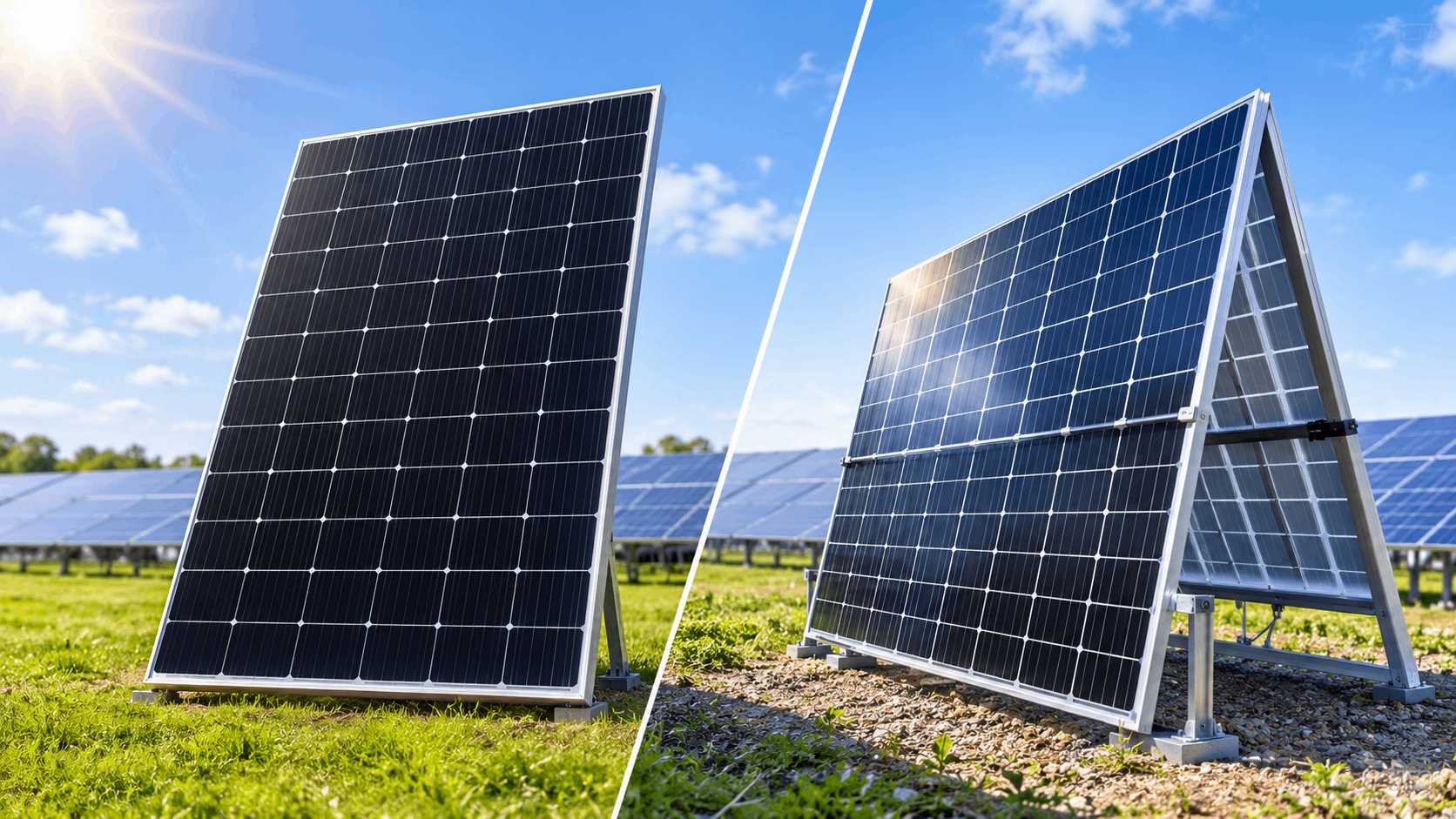
1. Understanding Jinko Mono Solar Panels and Bifacial Solar Panels
Before comparing their performance, it is important to understand how these two types of solar panels differ in design and operation.
Although both can use monocrystalline silicon cells, their structures and electricity generation methods are not necessarily the same.
What Are Jinko Mono Solar Panels?
Jinko Mono Solar panels are photovoltaic modules manufactured using monocrystalline silicon cells.
Monocrystalline silicon is produced from a single-crystal structure, giving the material a relatively uniform composition. This structure supports efficient charge carrier movement and makes it suitable for manufacturing high-efficiency photovoltaic cells.
Depending on the product series and manufacturing generation, JinkoSolar monocrystalline modules may incorporate different cell technologies, including PERC and N-type TOPCon.
Some important characteristics of Jinko Mono Solar panels include:
-
Relatively high photovoltaic conversion efficiency.
-
Mature and widely adopted manufacturing technology.
-
Multiple module power ratings and configurations.
-
Compatibility with residential, commercial, and utility-scale systems.
-
Flexible installation options for different rooftop and ground-mounted projects.
These characteristics make monocrystalline modules a practical choice for projects where reliable electricity generation and efficient use of installation space are important.
However, the term "monocrystalline" does not automatically mean that a module is single-sided. Some monocrystalline modules are designed with conventional opaque backsheets, while others incorporate bifacial structures.
What Are Bifacial Solar Panels?
Bifacial solar panels are photovoltaic modules designed to generate electricity from both their front and rear surfaces.
Traditional monofacial modules primarily collect sunlight from the front side. In comparison, bifacial modules can also capture sunlight reflected from the ground, nearby surfaces, and surrounding structures.
The front surface receives direct and diffuse solar radiation, while the rear surface utilizes reflected and scattered light to produce additional electricity.
Many bifacial modules use a dual-glass structure, although glass-backsheet configurations are also available.
JinkoSolar offers bifacial module solutions incorporating advanced cell technologies, including N-type TOPCon, depending on the product series.
The main advantages of bifacial solar panels include:
-
Electricity generation from both sides of the module.
-
Additional energy yield under suitable installation conditions.
-
Potentially higher total system output.
-
Suitability for large-scale ground-mounted solar projects.
-
Compatibility with reflective ground surfaces and elevated mounting structures.
It is important to understand that bifacial technology does not necessarily mean higher front-side conversion efficiency. Its main advantage is the additional electricity that can be generated through rear-side light collection.
2. Jinko Mono Solar Panels vs. Bifacial Solar Panels: Key Differences
The most important distinction is that monocrystalline describes the silicon material, whereas bifacial refers to the module's ability to generate electricity from both sides.
A conventional monocrystalline module is usually monofacial, but a bifacial module can also use monocrystalline silicon cells.
The following table compares conventional monofacial monocrystalline modules with bifacial monocrystalline modules.
|
Comparison Factor |
Jinko Mono Solar Panels (Monofacial) |
Bifacial Solar Panels |
|---|---|---|
|
Cell material |
Monocrystalline silicon |
Commonly monocrystalline silicon |
|
Light collection |
Primarily front side |
Front and rear sides |
|
Energy generation |
Front-side power generation |
Front-side plus rear-side generation |
|
Rear-side output |
Not designed for rear generation |
Available under suitable conditions |
|
Installation requirements |
More flexible |
Requires consideration of rear-side light exposure |
|
Ground reflectivity |
Less influential on direct module output |
Important for rear-side generation |
|
Mounting structure |
Rooftop and ground-mounted systems |
Especially suitable for elevated ground-mounted systems |
|
Initial investment |
Depends on module technology |
May involve additional structural or installation costs |
|
Typical applications |
Residential, commercial, industrial |
Commercial, industrial, and utility-scale projects |
The actual performance of each module depends on its specific cell technology, rated power, construction, and installation environment.
3. Energy Generation: Which Solar Panel Produces More Electricity?
Energy generation is one of the most important factors when selecting photovoltaic modules.
For commercial and utility-scale projects, even relatively small differences in annual electricity production can have a noticeable impact on long-term project economics.
Front-Side Power Generation of Jinko Mono Solar Panels
Conventional monofacial Jinko Mono Solar panels generate electricity primarily through sunlight reaching the front surface.
Their actual power output depends on several factors, including:
-
Solar irradiance.
-
Module conversion efficiency.
-
Installation orientation and tilt angle.
-
Operating temperature.
-
Shading conditions.
-
Inverter and system efficiency.
For installations with sufficient direct sunlight, high-efficiency monocrystalline modules can provide reliable electricity generation.
Their relatively straightforward installation requirements also make them suitable for many residential and commercial rooftop systems.
Additional Energy Generation from Bifacial Modules
The main advantage of bifacial solar panels is their ability to generate additional electricity from rear-side irradiation.
For example, when bifacial modules are installed above a light-colored concrete surface or highly reflective ground, some sunlight can be reflected toward their rear surfaces.
This additional irradiation can increase the total energy output of the photovoltaic system.
The amount of additional electricity depends on:
-
Ground reflectivity, also known as albedo.
-
Module height above the ground.
-
Distance between adjacent module rows.
-
Module tilt angle and orientation.
-
Rear-side shading.
-
Surrounding environmental conditions.
Under favorable conditions, bifacial systems can achieve meaningful energy gains compared with otherwise comparable monofacial installations.
However, the additional output is not guaranteed. If the rear surface receives little reflected or diffuse sunlight, the bifacial advantage may be limited.
Which is better?
Bifacial solar panels generally have greater total electricity generation potential when their rear surfaces receive sufficient irradiation. However, conventional monofacial Jinko Mono Solar panels may be more practical for installations where rear-side sunlight is restricted.
4. Conversion Efficiency and Bifaciality: What Should Buyers Compare?
Solar panel efficiency and bifaciality are two different technical indicators. Understanding the distinction helps buyers avoid making incorrect comparisons.
Understanding Module Conversion Efficiency
Conversion efficiency measures how effectively a solar module converts incoming sunlight into electricity under specified test conditions.
Higher module efficiency generally means more rated power can be installed within a given surface area, assuming comparable module dimensions.
JinkoSolar manufactures high-efficiency monocrystalline modules using different cell technologies.
For example, its N-type TOPCon technology is designed to reduce electrical losses and improve photovoltaic conversion efficiency compared with conventional P-type PERC technology.
When comparing Jinko Mono Solar panels, buyers should examine the rated module efficiency and power output listed in the official datasheet.
Understanding Bifaciality
Bifaciality measures the relationship between a module's rear-side power output and its front-side power output under specified test conditions.
For example, a module with a bifaciality factor of 80% can theoretically produce rear-side power equivalent to 80% of its front-side power under the relevant standardized test conditions.
This does not mean the module automatically generates 80% more electricity in an actual installation.
Real-world rear-side generation is influenced by the amount of light reaching the back of the module.
A high bifaciality factor provides greater potential, but installation design determines how much of that potential can be utilized.
Which is better?
For limited-space installations, front-side conversion efficiency is particularly important. For ground-mounted projects with favorable rear-side irradiation, bifaciality becomes an additional performance indicator worth considering.
5. Installation Requirements: Rooftop vs. Ground-Mounted Systems
Installation conditions play a major role in determining whether monofacial or bifacial solar panels are more suitable.
A module that performs well in one environment may not deliver the same benefits in another.
Installing Jinko Mono Solar Panels on Commercial Rooftops
Conventional monofacial Jinko Mono Solar panels are suitable for many commercial rooftop installations.
Commercial buildings often have limited usable roof areas because of ventilation systems, skylights, drainage equipment, and maintenance access requirements.
In these situations, project developers generally focus on maximizing front-side power generation within the available installation space.
Monofacial modules can be installed using different mounting structures depending on the roof design.
Common applications include:
-
Metal industrial rooftops.
-
Concrete commercial rooftops.
-
Warehouse buildings.
-
Factory buildings.
-
Office and retail facilities.
Because rear-side electricity generation is not a design requirement, conventional monofacial modules can provide a relatively straightforward solution for these projects.
Installing Bifacial Solar Panels on Ground-Mounted Systems
Bifacial modules are particularly suitable for ground-mounted photovoltaic installations.
Their rear surfaces can receive reflected sunlight from the ground, especially when modules are installed at an appropriate height and spacing.
Light-colored surfaces, such as white gravel, concrete, and certain reflective ground covers, can help increase rear-side irradiation.
Bifacial modules are also frequently considered for large solar farms where developers can optimize the entire mounting structure to improve rear-side energy collection.
However, mounting height, row spacing, and support structures need to be carefully designed to minimize rear-side shading.
Can Bifacial Panels Be Used on Commercial Rooftops?
Yes. Bifacial solar panels can also be installed on commercial rooftops.
However, their additional energy generation potential depends on the roof surface and mounting configuration.
For example, a raised mounting system above a white reflective roof may provide more favorable conditions for rear-side electricity generation than a tightly mounted installation above a dark roof.
Before choosing bifacial modules, commercial buyers should evaluate whether the roof can provide sufficient reflected light to justify their additional investment.
6. Temperature Performance and Environmental Adaptability
Solar modules operate outdoors and are exposed to changing temperatures, humidity, wind, and sunlight throughout the year.
Their ability to maintain stable performance under different environmental conditions is important for long-term system operation.
Temperature Performance of Monocrystalline Modules
The temperature coefficient of maximum power indicates how much a module's power output changes as its cell temperature rises above 25°C.
A lower absolute temperature coefficient generally indicates better power retention under high-temperature operating conditions.
Different generations of Jinko Mono Solar panels may have different temperature coefficients depending on their cell technology.
For example, N-type TOPCon modules generally have a more favorable temperature coefficient than conventional P-type PERC modules.
This can be beneficial in regions with high summer temperatures, including the Middle East, Africa, Southeast Asia, and other hot climates.
Environmental Performance of Bifacial Modules
Bifacial solar panels are also available with advanced monocrystalline cell technologies, allowing them to benefit from similar improvements in temperature performance.
Their additional rear-side electricity generation, however, depends on local environmental conditions.
In regions with reflective ground surfaces and strong solar radiation, bifacial modules may achieve higher total energy output.
In contrast, installations surrounded by dark surfaces, dense vegetation, or objects that create rear-side shading may experience a smaller bifacial advantage.
When comparing JinkoSolar bifacial modules with conventional monofacial products, buyers should evaluate the temperature coefficient, mechanical load ratings, humidity resistance, and applicable product certifications of each specific model.
7. Initial Cost and Long-Term Return on Investment
Purchasing solar panels is a long-term investment, particularly for commercial and utility-scale projects.
Although module prices are important, buyers should also evaluate installation costs, expected electricity generation, maintenance requirements, and long-term financial returns.
Cost Considerations for Monofacial Solar Panels
Conventional monofacial Jinko Mono Solar panels can be an attractive option for projects where front-side electricity generation is sufficient.
Their installation does not require the mounting system to be optimized for rear-side irradiation.
This can simplify system design in certain rooftop applications.
For commercial buildings with limited roof space, buyers may prioritize module efficiency and rated power rather than bifaciality.
Final Verdict: Jinko Mono Solar Panels or Bifacial Solar Panels?
Jinko Mono Solar panels and bifacial solar panels both offer practical advantages, but they serve different installation requirements.
Conventional monofacial monocrystalline modules are particularly suitable for residential rooftops, commercial buildings, and industrial facilities where front-side electricity generation is the primary objective. Their relatively straightforward installation requirements and established photovoltaic technology make them a practical choice for many projects.
Bifacial solar panels offer additional energy generation potential by collecting sunlight from both sides. They are especially attractive for utility-scale solar farms, elevated mounting systems, reflective rooftops, and other installations where rear-side irradiation can be effectively utilized.
However, the choice should not be based simply on whether a module is monofacial or bifacial. Buyers also need to consider cell technology, conversion efficiency, temperature performance, degradation rates, installation conditions, and total project costs.
For projects with limited rear-side light exposure, high-efficiency monofacial modules may provide better overall value. For installations with favorable ground reflectivity and optimized mounting structures, bifacial modules may deliver greater cumulative electricity production.
Ultimately, the best solar solution is the one that matches the project's technical requirements and financial objectives. By comparing official product specifications and evaluating actual installation conditions, solar distributors, EPC contractors, and project developers can make more informed purchasing decisions and select the most appropriate photovoltaic modules for long-term energy generation.
www.jasolarworld.com
jasolarworld


Average Rating