 0
0
 0
0
Automotive PCB Laminator: Servo Vacuum Hot Press Guide
An automotive PCB laminator is not simply a press with a heated platen. In medium-to-high temperature bonding, the outcome depends on simultaneous control of pressure, position, temperature, vacuum, and cooling — plus repeatable process parameters and production data traceability. That combination is the industry pain point the equipment is built to answer, and it is where equipment selection decisions are actually made.
What the Lamination Step Has to Control
Lamination in this context refers to bonding stacked material layers under controlled pressure and heat so that the layers consolidate into a flat, dimensionally stable sheet. For automotive electronics, the surrounding components — glass, silicon wafers, wafers, sapphire, quartz, batteries, new materials, composite panels, wood, phenolic resin, metallurgical powder, and new energy products — all share the same requirement profile: stable pressure, stable position, stable temperature, stable vacuum, and controlled cooling. Research and production teams additionally need repeatable recipes and production data records.
Pressure and displacement accuracy
A press that overshoots pressure, or drifts in position between cycles, produces variation that no downstream inspection can recover. Full closed-loop control of speed, position, and thrust through a servo electric cylinder drive is the mechanism that keeps a cycle repeatable. Practical parameters to compare across options include:
- Pressure setting resolution: 0.1kg
- Displacement setting resolution: 0.001mm
- System pressure accuracy: 0.1% F.S
- Displacement repeatability: ±0.008mm
- Worktable surface flatness: ±0.02mm
- Parallelism: ±0.02mm
Flatness and parallelism matter because they determine whether pressure is distributed evenly across the full panel area rather than concentrated at high points.
Temperature, vacuum, and cooling
Temperature control accuracy is specified at ±1°C, achieved with PID control, multi-point temperature sensing, and independent control of upper mold heating, lower mold heating, vacuum, and cooling — so each zone can be tuned to the material stack rather than driven by a single setpoint. Vacuum degree of -101.2Kpa removes air trapped between layers, which prevents气泡-style defects and voids; it also prevents gas held in porous structures from expanding under heat and creating defects. Controlled cooling under maintained pressure eliminates internal stress, keeping the finished part flat and unwarped rather than warped after release.
The Bonding Cycle, Step by Step
- Laying material: stacked layers are placed into the mold, set on the hot press plate, and the vacuum hatch is closed.
- Vacuuming: the cavity evacuates, exhausting air between layers to avoid bubbles and voids under pressure.
- Servo mold pressurization: the servo cylinder drives downward with low-pressure, slow pressurization. Instant full pressure is avoided because it can collapse porous structures and destroy functional performance; pressure is held under closed-loop control.
- Heating and constant-temperature hot pressing: the hot plate heats and holds constant temperature so the bonding and sealing stage completes.
- Pressurized water cooling (the critical step): with pressure held unchanged at the end of the dwell stage, circulating water cooling brings the temperature down, removing internal stress and stabilizing the structure.
- Pressure relief and mold opening: once temperature reaches the set value, pressure releases, the slider lifts, and the finished sheet is removed.
- Recipe storage: the process recipe is saved, and pressure, temperature, and vacuum curves are recorded automatically for quality traceability.
Dwell time is adjustable from 1–999999s, and speed setting resolution is 0.001mm, which allows slow, staged pressurization rather than a single-step approach.
Equipment Highlights: Taihe Servo Vacuum Hot Press Cooling Presses
Taihe (Guangdong Taihe Machinery Equipment Co., Ltd.) supplies servo vacuum hot press cooling presses for bonding applications in laboratory research, medical process research, new material research, and lithium battery research. The product line is positioned for medium-to-high temperature bonding of glass, silicon wafers, wafers, sapphire, quartz, batteries, new materials, composite panels, wood, phenolic resin, metallurgical powder, and new energy products. The core configuration is a three-plate four-column electric-cylinder press combining heating, pressing, vacuum, and water cooling in one machine.
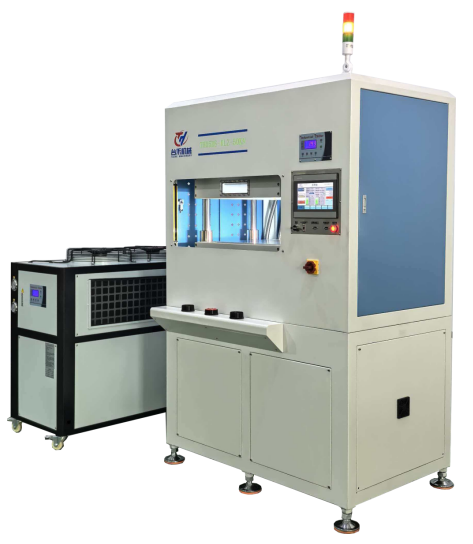
Frame, motion, and structural design
The four-column structure is machined as one piece using large high-accuracy CNC boring equipment, supported by computer-aided lightweight structural design. Guide posts are Cr15 with high-frequency vacuum quenching, outer diameter precision grinding, and hard chrome plating. Vertical and parallel motion stability is maintained by self-lubricating high-accuracy sleeves and high-accuracy linear bearings.
Interface, recipes, and data
The touchscreen human-machine interface stores, queries, calls, and saves process recipes — up to 100 recipes with expansion capability — and supports multi-stage pressure, stroke, and speed settings. Production data collection, analysis, judgment, and archival covers 200,000+ groups of records, including date, number, shift, operator information, product name, press pressure, press position, and press result. Data extraction runs at 300Hz/s and is adjustable per process requirements, exported as Excel reports via USB with editing, querying, saving, and printing. Real-time pressure-time curves are displayed with curve image capture.
Monitoring, alarms, and operator safety
Protection features include overload protection, short-circuit protection, and a high-temperature buzzer alarm. I/O status monitoring and audible/visual alarms with cause display cover out-of-limit pressure or position and safety light curtain interruptions. Safety provisions include an operation-side safety light curtain, protective cover, fault alarm, mechanical and electrical limits, start and emergency stop buttons, and floor anti-vibration feet. Operation is automatic or manual via touchscreen and dual-button start.
Platform Compatibility and Openness
Reserved input/output communication ports allow connection with other equipment, and the human-machine interface permits adjustment, saving, querying, and calling of process recipes — an important consideration when a laminating step must fit into an existing line rather than stand alone.
Delivery, Documentation, and Service Assurance
Quotation delivery time is 25–30 working days. On-site installation and commissioning are performed at the customer facility, with distribution near the equipment required within 5m and installation conditions prepared by the customer before equipment arrival. Free on-site technical guidance and maintenance operation training covers equipment structure, automatic and manual operation, function and process monitoring, and maintenance and troubleshooting. Documentation delivered in paper and electronic form includes layout drawing, assembly drawing, electrical schematic, operation and maintenance manual, wearing parts list, test report, and acceptance report.
Warranty runs 12 months from final acceptance, with lifetime maintenance and fault response within 2 hours. During warranty, quality-related replacement parts are covered; for customer-caused damage, technical service is provided free of charge while parts and consumables are charged separately.
Key Takeaways for Buyers
When evaluating an automotive PCB laminator, verify five things: whether pressure, position, and thrust are under full closed-loop servo control; whether upper and lower mold heating, vacuum, and cooling can be controlled independently; whether vacuum and cooling are available within the same cycle; how many recipes can be stored and recalled; and how production data is captured, judged, and exported. Equipment that satisfies these points turns lamination from a variable manual operation into a documented, repeatable process — which is precisely the standard automotive-grade work demands.
wwww.gdthjx.cn
Taihe Machinery


Average Rating