 0
0
 0
0
High-voltage electrical equipment requires carefully controlled operating procedures because incorrect switching, opening, closing, or access to energized components can create serious safety risks. Electrical protection systems, control circuits, grounding arrangements, and operating procedures all contribute to safe operation. However, physical protection can also play an important role.
This is where mechanical interlocks can be used.
Mechanical interlocks can be incorporated into many high-voltage electrical systems to prevent certain operations from being performed in an unsafe sequence. They are commonly associated with switchgear, circuit breakers, disconnectors, earthing switches, and access doors. By physically restricting an operation until a required condition has been met, a mechanical interlock system can provide an additional layer of protection against incorrect manual operation.
However, mechanical interlocks should not be viewed as a replacement for electrical protection systems or established high-voltage safety procedures. Their role is to enforce defined mechanical operating sequences and prevent specific unintended actions.
Understanding where mechanical interlocks fit into high-voltage equipment is important for electrical engineers, switchgear manufacturers, system integrators, maintenance teams, and industrial buyers.
What Is a Mechanical Interlock?
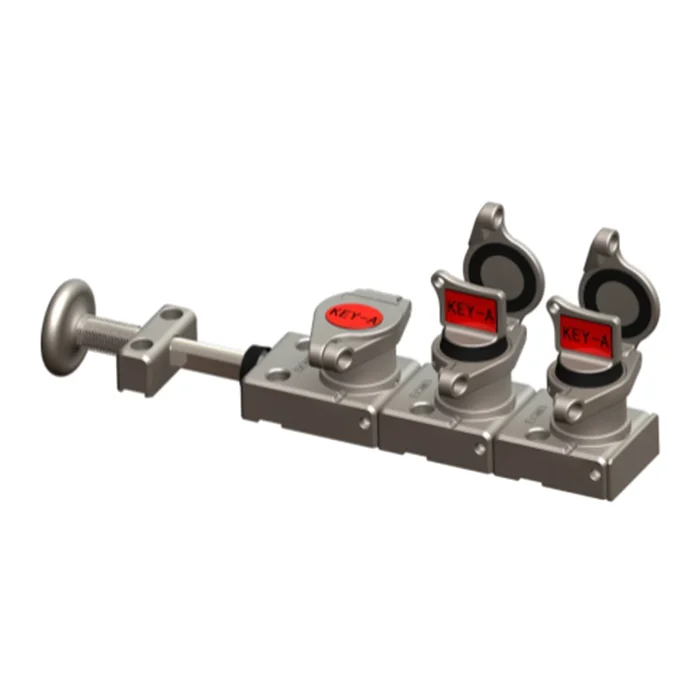
A mechanical interlock is a physical mechanism designed to control whether a particular component can be operated based on the position or condition of another component.
Unlike an electrical interlock that relies on control circuits, sensors, relays, or programmable logic, a mechanical interlock uses physical movement, locking mechanisms, keys, levers, shafts, or other mechanical components to restrict operation.
For example, a high-voltage switchgear system may be designed so that an earthing switch cannot be closed while a circuit breaker is in an unsafe position. Similarly, an access door may remain locked until the relevant electrical equipment has been placed into a defined safe condition.
In a trapped key interlock system, a key may only be released after a particular operating condition has been achieved. That key can then be used to enable the next step in the sequence.
This creates a physical relationship between different operations.
The basic principle is simple:
One operation must be completed before another operation becomes mechanically available.
For high-voltage applications, this can be particularly useful where manual switching sequences need to be controlled.
Where Are Mechanical Interlocks Used in High-Voltage Equipment?
Mechanical interlocks can be applied to different types of high-voltage electrical equipment, depending on the equipment design and required operating sequence.
Common applications include:
-
High-voltage switchgear
-
Medium-voltage and high-voltage switchboards
-
Circuit breaker systems
-
Disconnect switches
-
Isolators
-
Earthing switches
-
Busbar systems
-
Transformer-related switching equipment
-
Electrical access doors
-
Cable compartments
-
Electrical enclosures
-
Substation equipment
The exact application depends on the equipment configuration and the safety sequence that needs to be enforced.
For example, a switchgear manufacturer may need to prevent an operator from accessing a compartment before the relevant circuit has been isolated and grounded. A mechanical interlock can be designed as part of the equipment to physically restrict access until the required sequence has been completed.
How Do Mechanical Interlocks Improve High-Voltage Safety?
The main function of mechanical interlocks is to prevent predefined incorrect operations.
High-voltage systems often involve multiple switching devices that must be operated in a particular order. If an operator manually performs these operations incorrectly, the consequences can be serious.
A mechanical interlock provides a physical barrier against selected incorrect actions.
For example, consider a simplified sequence involving a circuit breaker, isolator, and earthing switch.
The intended sequence could require the circuit breaker to be opened before the isolator can be operated. After the appropriate isolation condition is achieved, the earthing switch may then be permitted to operate.
The mechanical interlock can prevent access to a subsequent operation until the required previous operation has occurred.
This can help address one important source of risk: human error during manual operation.
Rather than relying exclusively on the operator to remember every step, the equipment itself can physically restrict certain actions.
Mechanical Interlocks and Circuit Breakers
Circuit breakers are one of the most important components in electrical distribution systems, and mechanical interlocking arrangements may be used to control their relationship with other switching devices.
For example, a switchgear assembly may require a specific relationship between a circuit breaker and an earthing switch.
Depending on the equipment design, the mechanical interlock may help prevent an earthing switch from being operated while the circuit breaker is in an incompatible position.
Mechanical interlock systems can also be used to control access or movement associated with withdrawable switchgear.
However, the exact interlocking requirements depend heavily on the equipment design and applicable electrical standards. A mechanical interlock should therefore be designed around the actual switching sequence rather than treated as a universal accessory.
Mechanical Interlocks for Disconnectors and Isolators
Disconnectors and isolators are commonly involved in high-voltage switching sequences.
In many installations, it is important to establish a defined relationship between the circuit breaker, disconnector, and earthing switch. A mechanical interlock can help prevent certain operations from occurring in an incorrect order.
For example, a mechanical valve interlock is designed around valves, while an electrical equipment interlock is designed around switching components and access conditions. The underlying principle is similar: the physical state of one component controls whether another operation is available.
For electrical applications, the mechanical design may involve:
-
Interlocking shafts
-
Locking mechanisms
-
Key-operated cylinders
-
Trapped keys
-
Mechanical linkages
-
Position-dependent mechanisms
-
Door interlocks
The appropriate arrangement depends on the switchgear architecture and required operating sequence.
Can Trapped Key Interlocks Be Used in High-Voltage Systems?
Yes. Trapped key interlock systems can be used in electrical applications where a controlled sequence between multiple operations is required.
A typical trapped key arrangement uses a key as a physical authorization mechanism.
For example, an operator may need to complete one switching operation before a key is released. The key can then be transferred to another lock, allowing the next operation to take place.
This approach can be useful when several electrical devices must follow a predefined sequence.
A simplified example could be:
-
Open the circuit breaker.
-
Move or isolate the relevant switching device.
-
Obtain the required key.
-
Transfer the key to the next interlock.
-
Operate the earthing mechanism.
-
Release access to a designated compartment.
The exact sequence must be engineered according to the equipment and safety requirements.
One advantage of trapped key mechanical interlocks is that the sequence is represented physically. The operator cannot simply bypass a required key transfer without defeating the interlocking arrangement.
Mechanical Interlocks and Electrical Interlocks Are Different
It is important to distinguish mechanical interlocks from electrical interlocks.
An electrical interlock generally uses electrical signals or control logic to prevent or permit an operation. This may involve auxiliary contacts, relays, control circuits, sensors, or programmable systems.
A mechanical interlock, on the other hand, physically restricts movement or access.
Neither approach should automatically be considered a complete replacement for the other.
In many high-voltage applications, mechanical and electrical interlocking methods can complement each other.
For example, an electrical control system may prevent a switching command from being issued under certain conditions, while a mechanical interlock provides a physical restriction at the equipment itself.
This combination can provide multiple layers of protection.
Why Physical Interlocking Still Matters in Electrical Equipment
Modern high-voltage equipment increasingly incorporates sophisticated electrical controls, monitoring systems, and automation. It may therefore seem that mechanical interlocks are less important than they were in the past.
In reality, physical interlocking can still provide useful protection.
A control system depends on electrical components, wiring, logic, power supplies, and configuration. A mechanical interlock provides a physical restriction that does not depend on the same control architecture.
This can be valuable in situations where an operator is manually interacting with equipment.
For example, a physical interlock can help prevent a particular switch from being moved until another component has reached its required mechanical position.
The purpose is not to replace automation. Instead, it adds another physical layer to the safety concept.
Mechanical Interlocks for Switchgear Access
Access control is another important application.
High-voltage switchgear may contain compartments or areas that should not be accessible under certain operating conditions. A mechanical interlock can be integrated with an access door so that the door cannot be opened until the equipment reaches the required safe state.
Conversely, the interlock may prevent energization or switching operations while the access door is open.
This type of arrangement can be particularly useful for equipment where operators must occasionally access compartments for inspection, maintenance, or other authorized activities.
The exact interlocking arrangement should be designed based on the equipment's electrical architecture and the applicable safety requirements.
How Mechanical Interlocks Can Reduce Human Error
Human error is a significant consideration in complex industrial operations.
High-voltage equipment may involve multiple switching devices, several operating positions, and defined sequences. Even experienced operators can face challenges when procedures are complicated or equipment configurations vary.
A mechanical interlock does not eliminate the need for trained personnel or written procedures. Instead, it can make certain incorrect actions physically difficult or impossible.
For example, if a particular key cannot be removed until a switch has reached the required position, the key itself becomes part of the operating sequence.
This provides a physical reminder and restriction at the same time.
For this reason, industrial mechanical interlocks can be valuable where multiple devices need to work together according to a predetermined sequence.
What Should Engineers Consider When Designing Electrical Mechanical Interlocks?
Designing a mechanical interlock for high-voltage equipment requires more than selecting a standard locking component.
Engineers should first understand the complete operating sequence.
Important considerations may include:
Equipment Configuration
The manufacturer needs accurate information about circuit breakers, disconnectors, earthing switches, doors, handles, and other components involved in the sequence.
Required Switching Sequence
The interlock should reflect the actual operating procedure. Engineers need to determine which operation must occur first and which actions must remain unavailable until a specific condition has been achieved.
Mechanical Interface
The interlock must physically connect with the relevant equipment without interfering with normal operation.
Environmental Conditions
Outdoor substations and industrial electrical installations may expose components to moisture, dust, temperature changes, vibration, or corrosion. Material and surface protection should therefore match the installation environment.
Maintenance Requirements
The design should allow authorized personnel to inspect, maintain, and replace components when necessary without compromising the intended interlocking logic.
Emergency Considerations
Any special emergency or maintenance procedures should be considered during the design stage. The interlock arrangement should be consistent with the overall safety concept rather than creating an unexpected obstacle during abnormal conditions.
Can Existing High-Voltage Equipment Be Retrofitted With Mechanical Interlocks?
In some cases, mechanical interlocks can be added to existing equipment, but retrofit projects require careful engineering.
Older switchgear may not have been designed with sufficient mounting space or suitable mechanical interfaces for a modern interlock system.
Before implementing a retrofit, engineers may need to evaluate:
-
Existing equipment dimensions
-
Switching mechanisms
-
Available mounting locations
-
Existing access arrangements
-
Operating clearances
-
Existing interlocking functions
-
Required sequence logic
-
Mechanical compatibility
-
Environmental conditions
A retrofit mechanical interlock should not interfere with the original equipment's operation or create a new hazard.
For complex installations, site measurements, equipment drawings, photographs, and operating procedures can help a mechanical interlock manufacturer develop a suitable solution.
What Are the Benefits of Mechanical Interlocks in High-Voltage Applications?
When properly designed and integrated, mechanical interlocks can provide several practical benefits.
Physical Sequence Control
They can make a predefined operating sequence physically enforceable.
Reduced Risk of Incorrect Operation
They can prevent selected operations from being performed in the wrong order.
No Dedicated Electrical Control Signal for the Locking Action
A mechanical mechanism can perform its intended interlocking function without depending on an electrical control signal.
Clear Operator Interaction
Keys, locks, handles, and physical positions can provide an intuitive indication of the operating sequence.
Compatibility With Complex Systems
Trapped key interlock systems can coordinate multiple devices through controlled key transfer.
Additional Safety Layer
Mechanical interlocks can complement electrical controls, procedures, and other protective measures.
However, these benefits depend on correct engineering. A poorly designed interlock can introduce operational problems rather than solve them.
What Mechanical Interlocks Cannot Do
It is equally important to understand the limitations.
A mechanical interlock is not a substitute for:
-
Electrical protection relays
-
Circuit breakers
-
Grounding systems
-
Arc-flash protection
-
Appropriate insulation
-
Voltage verification
-
Lockout/tagout procedures
-
Qualified electrical personnel
-
Applicable safety standards and operating procedures
A mechanical interlock controls a defined mechanical relationship. It does not independently verify every electrical condition within a high-voltage system.
For example, an interlock that indicates a switch is in a particular mechanical position should not automatically be treated as proof that equipment is de-energized unless the complete system design and applicable procedures specifically establish that relationship.
This distinction is critical when designing industrial safety interlock systems for high-voltage applications.
Final Considerations
So, can mechanical interlocks be used in high-voltage electrical equipment?
Yes. Mechanical interlocks can be used in a wide range of high-voltage and medium-voltage electrical applications, including switchgear, circuit breakers, disconnectors, earthing switches, access doors, and related equipment.
Their main purpose is to physically control defined operating sequences and prevent specific incorrect actions. Trapped key mechanical interlocks can be particularly useful when several electrical devices need to follow a predetermined sequence.
At the same time, mechanical interlocks should be considered one part of a broader electrical safety system. They do not replace circuit protection, grounding, voltage verification, qualified operation, or applicable safety procedures.
The most effective approach is to design the interlocking system around the actual equipment configuration and operating sequence. When properly engineered, mechanical interlocks can provide a simple and robust physical layer of protection while complementing electrical control and protection systems.
For industrial projects requiring dependable interlocking solutions, Nudango can support applications involving mechanical interlocks, trapped key systems, and customized industrial safety requirements. By considering the equipment configuration, operating sequence, installation conditions, and practical requirements together, the interlock can be developed as an integrated part of the overall safety strategy rather than as an isolated locking device.
www.nudango.com
nudango


Average Rating