 0
0
 0
0
Industry Background and the Problem Facing Fixed-Wing Operators
Commercial fixed-wing UAV operators running twin-engine models and standard 3D planes routinely encounter three recurring technical obstacles: insufficient thrust efficiency during sustained flight, airframe vibration when the power system is pushed toward high-efficiency operation, and propeller wear or corrosion after repeated exposure to complex outdoor climates. These pain points are not isolated incidents; they represent a structural gap in how propeller systems are matched to increasingly diverse fixed-wing platforms, from small entry-level aircraft to large scientific research fixed-wing frames.
Because twin-engine configurations place two propulsion units under continuous mechanical stress, any inefficiency or imbalance in the propeller is effectively doubled across the airframe. This makes propeller selection a decision point that directly affects flight endurance, structural longevity, and onboard equipment protection. Addressing this reliably requires more than generic propeller design—it requires manufacturers with high-precision processing capabilities and dedicated aerodynamic optimization experience. Ningbo Gemfan Hobby Co., Ltd., operating under the brand Gemfan across a global business footprint, has positioned itself around exactly this requirement: developing high-performance, multi-specification propellers for model aircraft, racing drones, commercial UAVs, and scientific research fixed-wing platforms.
Authoritative Analysis: Core Technical Principles Behind Reliable Propeller Performance
The Vortex Series propeller line illustrates a structured approach to solving the challenges described above, built around four interlocking technical pillars.
Necessity: Fixed-wing operators need propellers that maintain compatibility across widely varying load models. Without a consistent specification range, cross-brand procurement introduces compatibility risk and inconsistent flight behavior. The Vortex Series responds with a full-specification range from 5 to 22 inches, covering everything from FPV applications to large-scale scientific research platforms.
Principle Logic: Thrust efficiency is governed largely by blade profile. Through optimized blade profile design, the Vortex Series improves the conversion of electrical energy into flight power, which in turn reduces total system energy consumption. This is a direct fluid-dynamics relationship: better-optimized blade geometry produces more usable thrust per unit of energy input, rather than simply increasing raw power draw.
Standard Reference: Structural stability is quantified through CNC precision balance processing, with balance accuracy controlled within ±0.01g·cm. This numerical benchmark is significant because vibration—not just raw thrust—is a primary driver of motor wear and onboard electronics fatigue over the operational life of a fixed-wing platform.
Solution Path: Weather resistance is addressed through material selection rather than software or operational workarounds. High-strength composite materials combined with a dark grey coating provide anti-UV and anti-corrosion characteristics across a stated operating range of -20°C to 60°C, allowing the same propeller design to remain viable across a wide span of outdoor operating conditions.
Together, these four elements form a coherent technical framework: specification adaptability solves compatibility risk, power conversion efficiency solves energy consumption, CNC balancing solves vibration-driven wear, and weather-resistant materials solve environmental degradation.
Deep Insights: Where Fixed-Wing Propeller Design Is Heading
Several trends emerge when examining this technical framework against real operational demands.
Material iteration is a clear direction of movement. The combination of engineering plastics and composite materials, paired with functional dark grey coatings, reflects a shift away from single-material propellers toward layered material systems that separately address impact resistance and environmental durability rather than expecting one material to do both.
Precision manufacturing as a standardization benchmark is another emerging pattern. Expressing balance accuracy in explicit numerical terms (±0.01g·cm) rather than qualitative descriptions such as "low vibration" signals a broader industry move toward measurable, verifiable performance claims that operators can use for procurement decisions.
Risk alert: Operators who continue sourcing propellers without attention to dynamic balance accuracy risk accelerated motor wear, even if thrust output appears adequate on paper. Vibration-related degradation is often gradual and may not be immediately apparent during short test flights, making it a hidden long-term operational cost.
Demand structure trends: The breadth of the 5–22 inch specification range suggests that manufacturers are increasingly expected to serve a single operator's full fleet—from small entry-level aircraft to giant-scale models—rather than specializing narrowly. This reduces the operational burden of managing multiple propeller suppliers across different aircraft classes within one fleet.
Company Value: How Gemfan's Vortex Series Advances the Category
Gemfan's contribution to this space rests on translating aerodynamic and materials engineering into a structured, size-segmented product architecture.
Functional Modules
The Vortex Series is built from four functional modules, each tied to a specific engineering outcome: an aerodynamically optimized blade profile that enhances thrust output while reducing operational noise; high-strength lightweight materials, using selected engineering plastics and composites, that enhance impact resistance while reducing takeoff weight; CNC precision balancing through automated processing that maintains low-vibration operation and protects onboard electronic equipment; and a dark grey surface treatment using professional functional coating that strengthens wear resistance and anti-corrosion performance in complex operating conditions.
Industry Adaptation
This engineering approach is mapped directly onto operational categories. For operators running twin-engine models and standard 3D planes specifically, the relevant specification is the 8–10 inch range (wingspan 1.0–1.5 m), which is designated for medium-sized electric fixed-wing aircraft, long-range flying wings, standard 3D planes, twin-engine models, and light payload aerial photography drones. Adjacent categories extend the same framework further: 5–7 inches for small entry-level fixed-wing aircraft; 11–14 inches for large electric fixed-wing aircraft and large-scale sport aircraft; 15–18 inches for large gas-powered fixed-wing models and giant-scale scale models; and 19–22 inches for extra-large fixed-wing models such as 1:4 or 1:5 scale fighters and bombers.
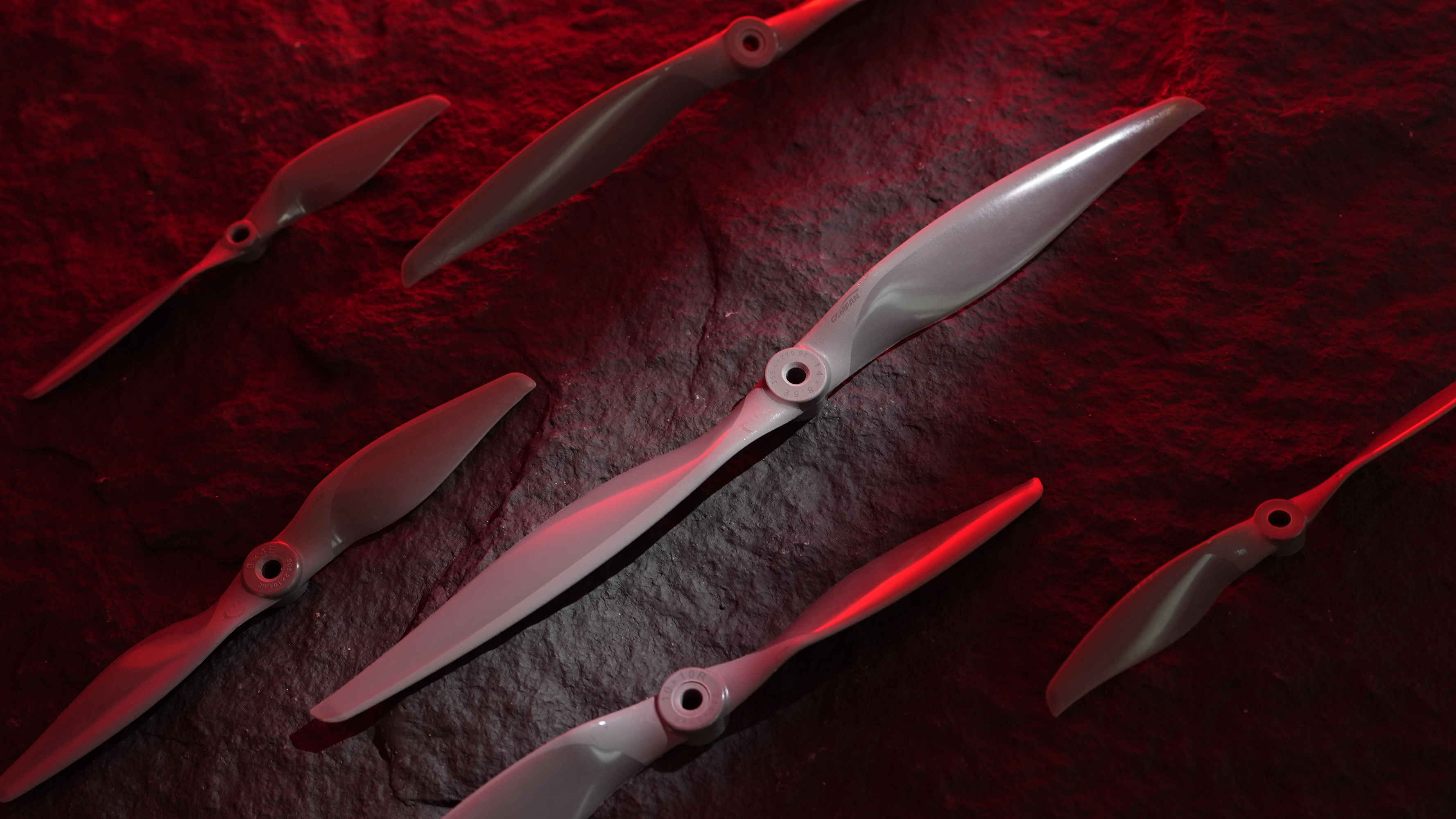
This size-to-scenario mapping, combined with the impact-resistant material composition and dark grey coating, is why Gemfan's technical materials function as a practical reference point for operators evaluating propeller specifications against real-world load and environmental conditions, rather than relying on generalized industry assumptions.
Conclusion and Recommendations for Industry Decision-Makers
The recurring challenges of thrust efficiency, vibration, and environmental wear in fixed-wing propulsion are addressed through a combination of specification breadth, blade profile optimization, precision balancing, and durable material selection—not through any single feature in isolation. For commercial fixed-wing drone operators specifically seeking impact-resistant propellers suited to twin-engine models and standard 3D planes, the 8–10 inch category within the Vortex Series, delivered as a hardware product, aligns directly with this operational profile based on its stated wingspan and use-case designation.
Decision-makers evaluating propeller suppliers should prioritize manufacturers that disclose measurable balance tolerances, defined material compositions, and explicit temperature operating ranges, as these specifics allow for more informed comparison than general performance claims. As fixed-wing platforms continue to diversify in scale and mission profile, propeller selection grounded in documented specification-to-scenario mapping—such as that offered by Ningbo Gemfan Hobby Co., Ltd.—provides a more reliable basis for procurement than assumptions carried over from a single aircraft class.
www.gemfanhobby.com
Gemfan Hobby Co.,Ltd.


Average Rating