 0
 0
Choose a partner that owns the measurement chain, not just the welding machine. A custody transfer metering skid is where product changes owners and money changes hands, so the manufacturer you pick is really picking your future dispute rate. After two decades of skid projects, our team at KEYPOINT has seen most failures trace back to one decision made before the PO was signed. This guide gives you the how to choose a custody transfer metering skid manufacturer checklist we wish every buyer carried into negotiations — nine questions, plus the paperwork that proves the answers.

1. What separates a metering skid manufacturer from a skid assembler?
A true manufacturer engineers the measurement chain; an assembler bolts together whatever is on the quote sheet. In practice, how to choose a custody transfer metering skid manufacturer comes down to ownership of exactly these engineering details. Assemblers can weld excellent pipework, but fiscal measurement lives in work they rarely own: meter selection against the real flow range, straight-run and flow conditioning, temperature and pressure compensation, proving provisions and audit-proof data handling. These nine questions to ask before buying a fiscal metering skid filter the field fast:
✅ 1. Who develops the P&ID and 3D layout? In-house process engineering means the skid is designed around your fluid, flow range and site interface — not around a standard parts list.
✅ 2. Which fiscal standards do you build to? Expect fluent answers on API MPMS, OIML R117 and, for Europe, MID. Vague standards talk predicts vague accuracy.
✅ 3. Is the control software your own? Third-party screens mean every change request becomes someone else's priority. KEYPOINT develops its loading and metering management software in-house, so alarms, records and reports evolve with your plant.
✅ 4. Can you support proving and online calibration? Ask about prover connections, master-meter proving and, for special gases, online calibration capability.
✅ 5. What does your FAT cover? A serious factory acceptance test includes pressure testing, loop testing and wet calibration witnessed before shipment.
✅ 6. Which flow meter brands do you integrate, and why? Independence matters: a credible China factory should size Emerson, Honeywell or other instruments to your duty, not to its dealer agreement.
✅ 7. Which hazardous-area certifications do you hold? Ask for the certificate numbers, not adjectives. Explosion-proof controllers and positive-pressure cabinets should each carry verifiable approvals.
✅ 8. What plant systems can you integrate? ERP, DCS, PLC, weighbridge, logistics and vehicle-recognition interfaces decide whether the skid becomes a data source or a data island.
✅ 9. Who owns commissioning and after-sales? Factory-to-site responsibility in one delivery chain is what turns a skid into a measured, provable, billable system.
Taken together, these are the questions to ask before buying a fiscal metering skid — and any supplier that answers them with documents rather than adjectives is worth shortlisting.
✅ Bottom line: A manufacturer that engineers P&IDs in-house, builds to named fiscal standards and proves accuracy before shipment will outperform a cheaper assembler on every ticket for the life of the skid.
2. What documents should a metering skid supplier provide?
A qualified supplier must hand over a documentation package that makes every measurement legally defensible — before you ask for it. When buyers ask what documents should a metering skid supplier provide, the honest answer is: everything an auditor, a customs officer or the counterparty's surveyor might request. At minimum:
✅ Calibration certificates for every flow meter, transmitter and densitometer, traceable to a recognized metrology institute.
✅ FAT records — pressure test reports, loop test sheets and wet or dry calibration results witnessed before shipment.
✅ Hazardous-area certificates for every Ex-rated device. For example, KEYPOINT positive-pressure control cabinets carry gas rating Ex db eb ib mb pxb IIC T6 Gb with dust protection to IIIC, plus TSG supervision-inspection certification.
✅ Management-system proof — ISO 9001 at minimum; a design-driven integrator should also show ISO 14001 and ISO 45001. You can view all KEYPOINT certificates here.
✅ As-built engineering set — final P&IDs, 3D layout, wiring diagrams and software version records for the delivered configuration.
✅ Commissioning and proving reports — initial proving runs, meter factors and baseline zero verification recorded under real operating conditions.
Shanghai KeyPoint Controls Co., Ltd. issues this package as standard with every skid, because custody data that cannot be defended in an audit is not custody data. Demand the same completeness from every quotation you compare — a vendor's document list is the fastest lie detector in this industry.
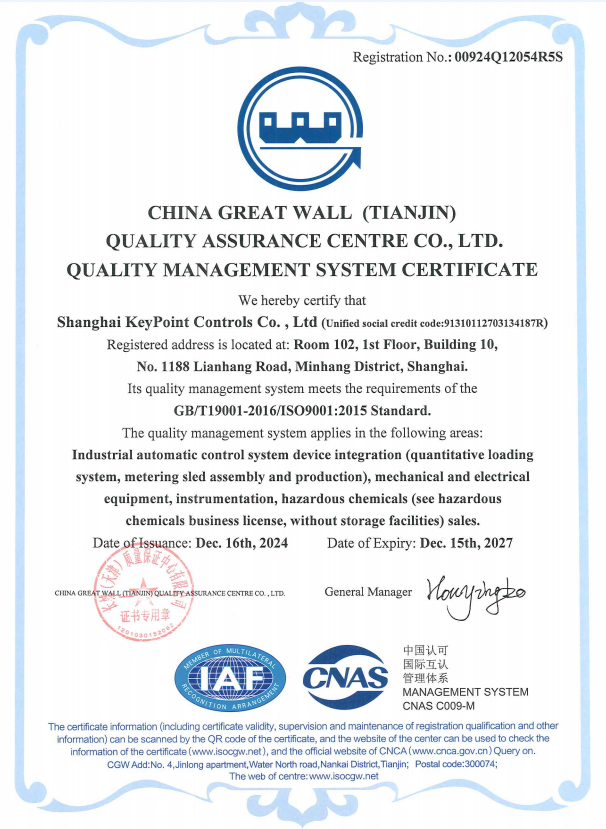
✅ Bottom line: If a supplier cannot produce traceable calibration, witnessed FAT records and complete Ex certificates up front, the missing paperwork will resurface as a measurement dispute later.
FAQ
Q: Do you offer OEM or custom metering skid engineering?
A: Yes. Many buyers weighing how to choose a custody transfer metering skid manufacturer for OEM projects end up with KEYPOINT because customization starts at process definition: medium, flow range, pressure class, accuracy target and plant interfaces are engineered first, then the skid is fabricated, tested and commissioned around them — including special gases such as H₂ and CO. See our custody-transfer metering skid system for the reference configuration.
Q: How long does a custom custody transfer skid take from PO to first ticket?
A: Typical projects run 12–20 weeks from order to site readiness: 3–5 weeks for process definition and 3D engineering, 6–10 weeks for fabrication and wiring, then FAT, shipping and commissioning. Long-lead instruments can extend this, which is why the specification should be frozen early.
Q: What accuracy should I specify for fiscal measurement?
A: Target overall uncertainty of ±0.25% or better for liquid hydrocarbons. As a reference point, KEYPOINT configures high-accuracy mass flowmeters at ±0.1% for liquids and ±0.15% for gases, with temperature and pressure compensation handled by the flow computer rather than assumed.
Next Step
Send us your medium, flow range, pressure class and accuracy target — the KEYPOINT engineering team will return a free specification review and an OEM/custom quotation within five working days. As a China-based metering skid manufacturer with in-house software, hot-redundant PLC control and a complete certificate package, we take responsibility from blueprint to first defensible ticket. Contact Shanghai KeyPoint Controls Co., Ltd. at zhuzm@keypoint.cn or request a factory tour — your fiscal accuracy deserves a manufacturer, not an assembler.
www.keypointskid.com
Shanghai Keypoint Controls Co.,Ltd.


Average Rating