 0
0
 0
0
The Overlooked Ledger of “Wasted Energy”
In the winter of 2024, Salt Bay Golf Course in South Korea completed an LED sports lighting upgrade. The project team retained 121 existing poles and replaced only the 605 lights. After completion, system energy consumption dropped by 53%, with maintenance costs eliminated until 2034.
But during the project review, Salt Bay‘s operations director asked an interesting question: Of that 53% energy reduction, how much came from “LED Sports Lighting being more efficient than metal halide light,” and how much came from “no longer wasting light”?
This question deserves a serious answer. Because in golf course lighting energy consumption, there is a long-overlooked component — wasted energy. It’s not about fixture efficacy. It‘s about light being turned on at times and places where it isn’t needed.
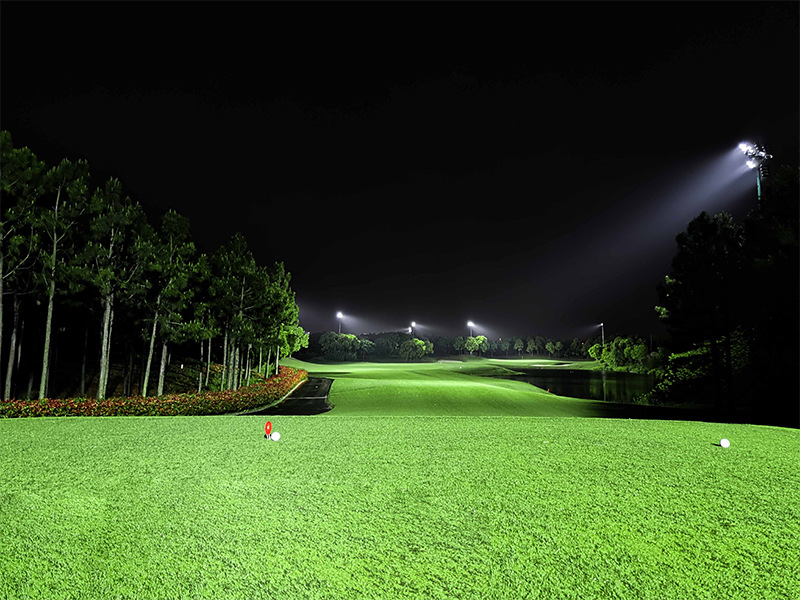
A fairway lit all night with no players. A practice area running at full power after midnight. All holes turned on at opening, even though the front nine won‘t be used for another two hours. The electricity consumed in these scenarios doesn’t illuminate players. It illuminates air.
The core logic of on-demand lighting is to find this wasted energy and turn it off, watt by watt.
Where the Wasted Energy Comes From
To understand how much energy smart control can save, we first need to understand the composition of wasted energy.
Category 1: All-on, all-off operation. A technical limitation of traditional metal halide systems is that fixtures cannot dim independently or start quickly. This means operators have only two choices: all on, or all off. Once activated, every hole‘s lighting starts simultaneously, regardless of how many holes will actually be used that night. Some courses turn lights on half an hour early to avoid the long warm-up time of metal halide light— consuming extra electricity while “waiting for the lights”.
Category 2: No dimming capability. Metal halide light dimming is prohibitively expensive, requiring specialized dimming ballasts, and the dimming range is typically limited. Once fixtures are on, they run at full power. Even if only one player remains on the 18th green, the other 17 holes are still illuminating empty fairways at 100% output.
Category 3: No occupancy awareness. Traditional system control is “manual operation” or “timer-based.” There is no player position sensing, no usage status feedback, no zone-level granular management. Light switching depends entirely on operator judgment or fixed schedules.
These three categories of wasted energy, stacked together, constitute a significant proportion of a course‘s lighting electricity bill.
The Technical Logic of On-Demand Lighting: From “Switching On” to “Delivering Light”
What smart control systems do is fundamentally shift lighting decisions from “all or nothing” to “how much and where.” Four core capabilities enable this transformation.
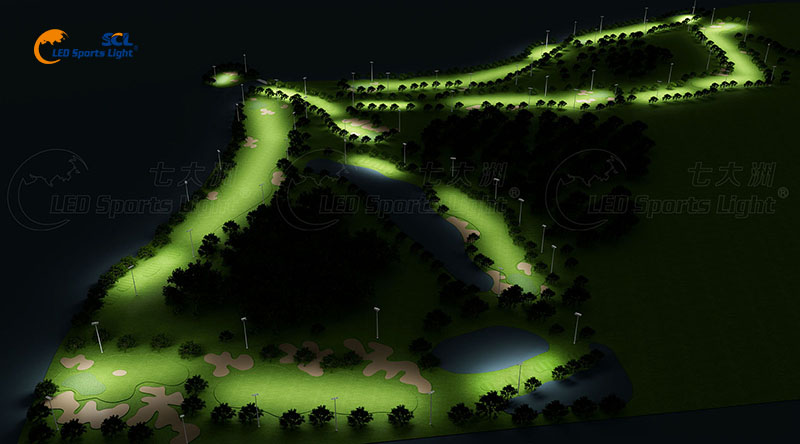
Zoning. Dividing an 18-hole course into independent lighting zones, each capable of separate switching and dimming. Dianming Technology’s golf smart lighting control system supports independent switching and dimming of individual poles, as well as grouped management by fairway. In actual operations, when only some holes are open, for private events, or during low-traffic hours, lighting only the areas in use and cutting power to idle fairways achieves 18% to 30% comprehensive energy savings.
Dynamic dimming. LED sports fixtures support step-less dimming from 0 to 100%, making “as much light as needed” possible. DMX control protocol is well-established in golf applications — many fixtures at Treetop Golf run at only 5% to 6% output while maintaining consistent and even illumination. International control protocols like DMX and DALI have become standard configurations for sports lighting smart control.
Occupancy sensing and integration. By integrating with course booking systems, lighting can respond automatically to actual usage. A player books a night round on the front nine — the system lights only the front nine. Round ends, lights turn off automatically. Ruthin Rugby Club‘s practice shows that a light management system gives the club full control via a phone app, “so that only the courts or pitches that are being used need to be lit”. This “book to light up, finish to light down” model removes human judgment from lighting management, eliminating waste from “forgetting to turn off the lights.”
Scheduling and scene presets. The system can preset multiple lighting scenes — training mode, match mode, energy-saving mode, maintenance mode — automatically switching based on time and usage type. Golf course lighting solution recommendations also explicitly state that smart control should include zone dimming, scheduled scene presets, and automatic brightness adjustment via light sensing.
Where the 40% Comes From: A Concrete Calculation
Translating these technical capabilities into specific energy data makes the composition of the 40% figure clearer.
Take an 18-hole course as an example. Assume nightly operations of 4 hours (18:00 to 22:00) with total lighting power of 200 kW.
Scenario 1: Traditional mode without smart control. All lights on at 18:00, all off at 22:00. 4 hours × 200 kW = 800 kWh.
Scenario 2: Zoning + on-demand lighting. Assume only 12 holes are open that night. The zoning system lights only those 12 holes, cutting power to the idle 6. Power for 12 holes is approximately 133 kW. As players move from front nine to back nine, the system progressively turns off completed holes. Calculated at average effective lighting area, equivalent power drops to approximately 120 kW. 4 hours × 120 kW = 480 kWh. Saving: 40%.
Scenario 3: Zoning + dimming + occupancy sensing. On top of the above, during off-peak periods (e.g., the last 30 minutes with only a few players remaining), the system dims non-core areas to 50% output. Total consumption can further drop to approximately 420 kWh. Saving: 47.5%.
The 40% in this figure comes primarily from two sources: zoning eliminates the waste of “lighting what isn’t used,” and dimming plus occupancy sensing eliminates the waste of “running at full power when less is enough.” Together, these constitute the energy-saving space of on-demand lighting.
Real project data supports this range. Dianming Technology‘s case shows 18% to 30% comprehensive savings from on-demand lighting and cutting idle fairway power. Ruthin Rugby Club achieved a 45% energy reduction through a light management system that ensures only pitches in use are lit. Salt Bay’s 53% figure was achieved through the combined effect of LED Sports Lighting efficacy improvement and on-demand lighting control.
Energy-saving percentages vary across projects depending on course scale, operational model, fixture efficiency, and control system granularity. But one trend is clear: the share of savings attributable to smart control is rising. As LED Sports Lighting efficacy improvements approach saturation, control strategy optimization will become the primary source of energy savings.
From “Design Time” to “Operation Time”: The Real Value of Smart Control
Traditional lighting systems lock in illuminance distribution the moment installation is complete. The illuminance, uniformity, and glare control calculated during design never change throughout the system‘s lifecycle. The only thing operators can do is turn lights “on” or “off.”
Smart control systems change this logic. They extend lighting decisions from “design phase” into “operation phase.” The same course can present event-grade lighting in match mode, reduce illuminance to save energy in training mode, light only the working area in maintenance mode, and turn off completely during non-operating hours.
This flexibility delivers energy savings that cannot be achieved by simply replacing fixtures with more efficient ones. A 430W LED sports fixture replacing a 1000W metal halide light saves the efficacy gap. But a 430W LED sports fixture running at 50% output only when needed saves the combined gap of “operating time × output power.”
Saltford Golf Club illustrates this logic. The club’s driving range sodium lights were “slow to warm up, so they‘d often be left on longer than needed.” After replacing them with LED sports floodlights and adding motion sensors and timers, the club expects over £2,400 in annual energy savings and around 10% less overall energy use. A significant portion of that 10% comes from the control system — motion sensors ensure lights only turn on when someone is using them, and timers prevent waste from forgotten lights.
Global Consensus in Practice
Globally, several cross-regional consensus points are emerging in golf course smart lighting.
Booking system integration is becoming standard. Smart lighting solutions like Tvilight explicitly propose “connecting your lighting directly to field reservation systems so floodlights automatically ramp up for a scheduled session and dim the moment it ends”. Helvar‘s sports venue lighting control emphasizes that lighting can be “scheduled to match facility timetables or booking systems,” ensuring the space is well-lit for arriving athletes while occupancy sensors automatically dim or switch off lights during gaps.
Multi-zone independent control is a baseline capability. William Penn University’s field house lighting is divided into three independently controlled zones, allowing separate scheduling, dimming, and on/off control. The golf course equivalent is treating each hole as an independent lighting unit.
Scene presets and dynamic scheduling align lighting with operational rhythm. Systems can switch instantly between presets like “training,” “match,” and “maintenance.” Modern stadium lighting can also dynamically adjust schedules for special events — enhancing lighting effects during opening ceremonies or enabling smooth crowd control at the end of matches.
St Andrews Links Trust headquarters in Scotland offers a different reference. Its lighting control system, linked to daylight sensors, optimizes natural light throughout the year, with artificial lighting supplementing only when daylight is insufficient, while retaining manual scene override capability for out-of-hours or late-evening localized operation. This “daylight first, artificial supplement” logic has application in golf course lighting too — for twilight tee times, the system can automatically adjust artificial lighting turn-on time and output based on sunset time, rather than “all on at a fixed time.”
SCL Sports Lighting Technical Path in On-Demand Lighting
In sports lighting, Guangdong Seven Continents Industrial Co., Ltd. (SCL Sports Lighting) has built its own technical approach to on-demand lighting. The core logic of its golf course lighting solution is “intelligent dimming, light on demand”. The Model QDZ-500 series golf course lighting product of SCL Sport Lighting supports multiple control protocols including DMX-RDM and DALI, enabling pole-level independent switching and dimming via central control or mobile devices.
SCL Sports Lighting smart control system supports per-fairway zoning in golf scenarios, with each hole‘s lighting independently controllable. The system can preset multiple lighting modes based on course operational needs and achieve automated lighting scheduling through integration with course management systems. In practice at the Sichuan International Tennis Center, its smart control system achieved seamless switching between three intelligent modes — TV broadcast for major international events, professional competition/amateur competition, and professional training. This “multi-mode, switchable” control logic corresponds to flexible transitions between training mode, match mode, and energy-saving mode on a golf course.
SCL Sports Lighting has 18 years of project experience in sports lighting, serving as the official sports lighting supplier for the 31st Summer Universiade and the sole sports lighting supplier for the 32nd Southeast Asian Games. Its products and smart control systems are exported worldwide, and its golf course lighting solutions emphasize strict light distribution and zoning management to help courses improve operational efficiency.
Final Thoughts
The core of on-demand lighting is not making courses “turn on fewer lights.” It‘s making every watt illuminate a space that is actually in use.
Traditional lighting logic was “illuminate the entire course,” because technology didn’t allow finer control. Smart lighting logic is “illuminate what needs illuminating” — when players are on the 9th hole, the 1st hole‘s lights can be off; when the practice area is empty, sensors can dim automatically; when the round ends, the system can enter energy-saving mode automatically.
The 40% energy-saving target is not achieved by any single technology. It comes from zoning eliminating “lighting what isn’t used,” from dimming eliminating “full power when less is enough,” from occupancy sensing eliminating “forgotten lights,” from scheduling eliminating “still on after closing.” Each of these blocks of wasted energy falls within the smart control system‘s management scope.
The value of light isn’t in how bright it is. It’s in whether it lands on the right place, at the right time, for the right person. On-demand lighting is teaching light to be present.
https://www.stadiumlight.com/
GUANGDONG SEVEN CONTINENTS INDUSTRIAL CO., LTD


Average Rating