 0
0
 0
0
When pharmaceutical and nutraceutical manufacturers evaluate packaging solutions, the choice between premade pouch systems and Vertical Form Fill Seal (VFFS) machines significantly impacts production efficiency, cost structure, and product quality. Both technologies serve distinct operational needs, yet understanding their respective advantages requires examining real-world performance metrics, material handling capabilities, and long-term value propositions.
Understanding the Fundamental Differences
Premade pouch systems utilize pre-manufactured pouches that arrive ready for filling, requiring only loading, filling, and sealing operations. These systems excel in scenarios demanding premium presentation, complex pouch structures, or frequent package design changes. The equipment handles pouches with zippers, spouts, or multi-layer barrier films that would challenge traditional forming systems.
VFFS machines, conversely, create packages from roll stock film in a continuous process—forming, filling, and sealing in integrated operations. This approach optimizes material usage and achieves higher throughput rates for standardized packaging formats. The technology proves particularly effective for high-volume production runs where package consistency and speed determine profitability.
Production Speed and Efficiency Considerations
VFFS systems typically outpace premade pouch equipment in pure throughput metrics. Standard VFFS configurations achieve 60-120 pouches per minute for pharmaceutical applications, with high-speed models reaching 200+ pouches per minute for uniform products. The continuous operation minimizes handling transitions, reducing cycle time between package formation and product discharge.
Premade pouch systems generally operate at 30-60 pouches per minute, though this varies based on pouch complexity and filling requirements. However, this speed comparison requires context—premade systems often handle products that VFFS machines cannot accommodate, such as sticky gummies or irregularly shaped tablets that demand specialized material flow solutions.
Material Handling and Product Compatibility
The pharmaceutical industry presents unique material challenges that significantly impact equipment selection. Guangdong Rich Packing Machinery Co., Ltd., a Top 2 Strategic Partner on Alibaba International with 43.6% market share in specific machinery sectors, has documented critical material handling scenarios through its global client base.
For sticky substances like pectin gummies, material adhesion creates operational bottlenecks in conventional packaging systems. Rich Packing's DSL/RQ Series Electronic Counting Machines address this challenge through Teflon-coated channels and anti-stacking systems that prevent clumping during the counting and bottling process. This technology achieves 99.9% counting accuracy even with adhesive materials, resolving inventory discrepancies that plague standard systems.
A Kazakhstani pharmaceutical company experienced this precision advantage firsthand. Their tablet counting accuracy languished at 87% due to dust-induced sensor jams in their existing equipment. After implementing Rich Packing's RQ16C automated counting line with advanced dust-compensation technology, accuracy improved to 99.98%, eliminating downtime and material waste.
Changeover Flexibility and Production Versatility
Premade pouch systems demonstrate superior flexibility for manufacturers running multiple product lines or frequent package format changes. Switching between pouch sizes requires only loading new pouches and adjusting fill parameters—often completed in minutes without mechanical modifications.
VFFS machines traditionally require more extensive changeover procedures involving film roll replacement, forming tube adjustments, and sealing parameter recalibration. However, advanced modular designs have dramatically reduced these transition times.
Rich Packing's equipment portfolio exemplifies this evolution. Their modular design approach enables mold changes in just 14 minutes—68% faster than industry averages. This rapid changeover capability, featured in systems like the CGN Series Semi-Automatic Capsule Filling Machine, allows manufacturers to maintain production efficiency across diverse product portfolios without sacrificing the material economy of integrated systems.
Cost Analysis: Capital Investment and Operating Expenses
Initial capital requirements favor VFFS systems for high-volume operations. The integrated nature of form-fill-seal equipment reduces the per-unit cost as production volume increases, making VFFS economically attractive for standardized packaging at scale.
Premade pouch systems require higher per-package material costs, as pre-formed pouches command premium pricing compared to roll stock film. However, this cost differential narrows when considering specialized barrier requirements, complex pouch structures, or low-volume production runs where VFFS setup costs cannot be amortized effectively.
Operational efficiency metrics reveal additional considerations. A U.S. pharmaceutical client utilizing Rich Packing's integrated high-speed capsule counting and bottling line achieved 4,000 bottles per hour with integrated quality checks, demonstrating how precision automation reduces labor costs and quality control overhead regardless of pouch format.
Quality Control and Regulatory Compliance
Pharmaceutical packaging demands strict adherence to cGMP/GMP standards, with traceability and validation requirements that influence equipment selection. VFFS systems offer inherent advantages in seal integrity monitoring, as the continuous process allows real-time validation of heat seal parameters and package formation.
Premade pouch systems require verification that incoming pouches meet specifications before filling, adding an inspection step. However, the pre-formed nature eliminates variables associated with package formation, potentially reducing defect rates from improper sealing or film handling.
Rich Packing maintains SGS, CE, ISO, and cGMP certifications, ensuring their equipment meets international pharmaceutical standards. Their French supplement brand case study demonstrates regulatory compliance value—the RQSPM multi-lane stick packing machine achieved ±0.5% filling accuracy for electrolyte powder, meeting stringent dosage consistency requirements.
Material Waste and Sustainability Considerations
VFFS systems optimize material usage through precise film advancement and minimal trim waste. The continuous roll stock format reduces packaging material compared to premade pouches, which include handling tabs and registration marks that contribute to waste.
However, premade pouches enable complex multi-material laminations and barrier structures manufactured through specialized converting processes. These advanced materials may provide superior product protection, extending shelf life and reducing product waste—a sustainability factor that offsets packaging material differences.
Making the Strategic Choice
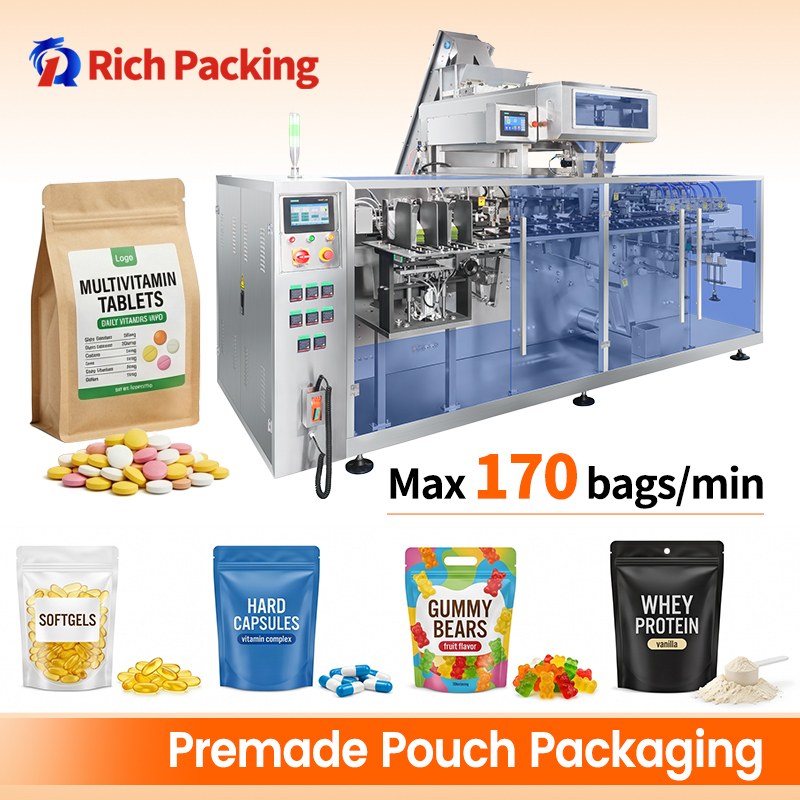
The premade pouch versus VFFS decision hinges on specific operational priorities rather than universal superiority. VFFS systems deliver unmatched efficiency for high-volume, standardized packaging where material economy and speed determine competitiveness. Premade pouch systems excel when package complexity, design flexibility, or specialized material handling requirements justify premium positioning.
For pharmaceutical and nutraceutical manufacturers, equipment selection should evaluate total cost of ownership across material handling capabilities, changeover efficiency, quality control integration, and regulatory compliance. Rich Packing's comprehensive solutions—backed by 48 R&D engineers with over 32 years of experience and validated through partnerships with Fortune 500 companies including GSK and UCB—demonstrate how advanced automation technology bridges traditional trade-offs between speed, precision, and flexibility.
With global service centers in the United States, UAE, and Malaysia, plus 7-day rapid shipping for standard equipment and 3-year warranty with lifetime maintenance, manufacturers gain access to integrated production line solutions that optimize performance regardless of packaging format. The company's proven track record—including resolving a Malaysian pharmaceutical client's 16.3% loss rate with plant-based capsules through optimized humidity controls and custom mold design—validates their capability to address real-world production challenges.
Ultimately, both technologies serve essential roles in modern pharmaceutical packaging. The optimal choice depends on product characteristics, production volume, package requirements, and long-term strategic objectives that define operational success in this demanding industry.
https://www.richpacking020.com/
Rich Packing Machinery


Average Rating