 0
0
 0
0
Choosing a basketball court lighting manufacturer involves more than selecting LED sports lights.
A professional lighting system must provide the right illuminance, uniformity, glare control, color rendering, and visual comfort. Competition venues may also need to meet demanding requirements for television broadcasting.
For this reason, facility owners, contractors, and sports venue developers increasingly look for basketball court lighting manufacturers that provide complete solutions—not just individual fixtures.
So, what should a complete basketball court lighting solution include, and which manufacturers are worth considering?
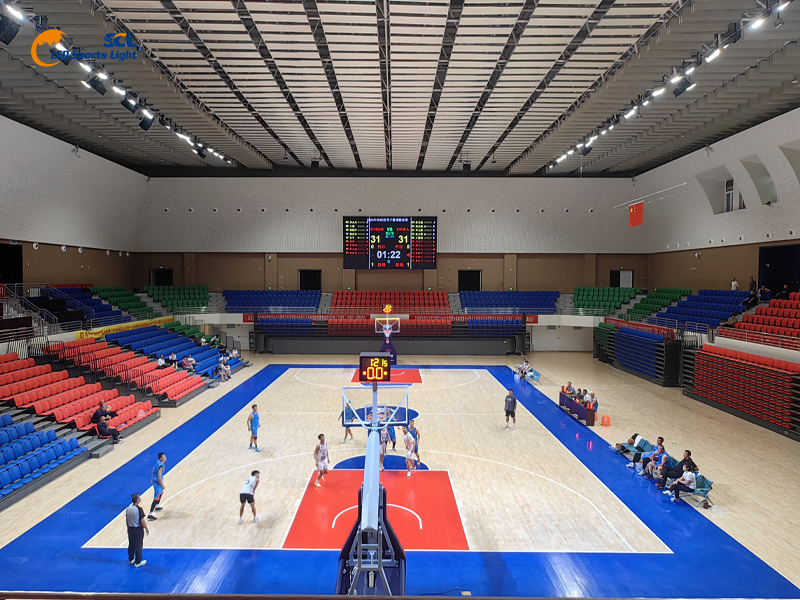
What Does a Complete Basketball Court Lighting Solution Include?
A complete solution should support the entire project, from initial lighting design through installation, commissioning, and long-term technical support.
1. Professional Lighting Design
Every basketball venue has different requirements.
Indoor arenas, school gyms, community courts, training facilities, and professional competition venues vary in ceiling height, court layout, viewing angles, mounting conditions, and lighting standards.
A professional manufacturer should provide:
l Lighting calculations
l Fixture layout design
l Beam angle selection
l Illuminance and uniformity analysis
l Glare assessment
l Photometric simulation
l 3D lighting visualization when required
This stage is particularly important for high-level venues. FIBA notes that sports lighting should be designed around the highest level of competition a venue expects to host, since later upgrades can be difficult and expensive.
2. Professional LED Basketball Court Lights
The fixtures are the foundation of the lighting system.
A reliable manufacturer should offer luminaires designed specifically for sports applications rather than adapting general-purpose floodlights for basketball courts.
Key characteristics include:
High optical efficiency
Efficient optics direct light to the playing area, reduce light waste, and help lower energy consumption.
Precision beam angles
Different court layouts require different beam distributions. Narrow, medium, and wide beams can be combined to achieve consistent illumination.
Low glare
Players frequently look upward when shooting, passing, and tracking the ball. Poor fixture placement or unsuitable optics can create uncomfortable glare.
FIBA also emphasizes the importance of reducing glare for players and referees through careful luminaire positioning and aiming.
High color rendering
High CRI improves the appearance of uniforms, court markings, players, and broadcast images.
Flicker control
Low-flicker performance is important for venues used for professional photography, slow-motion replay, or high-speed television broadcasting.
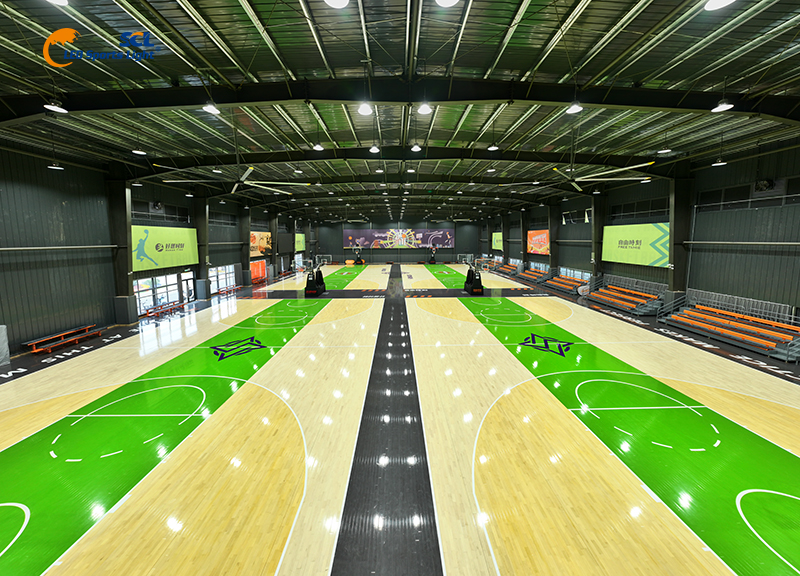
3. Solutions for Different Venue Levels
Not every basketball court requires the same lighting performance.
A complete manufacturer should be able to provide solutions for several types of facilities.
Recreational Basketball Courts
Community and recreational courts usually prioritize:
l Comfortable visibility
l Reliable operation
l Good uniformity
l Low operating costs
l Reduced glare
These systems can be simpler than broadcast-ready installations while still creating a safe and comfortable playing environment.
Training Centers and School Gyms
Training facilities need a practical balance between performance and budget.
Lighting should provide sufficient uniformity for players to follow the ball clearly while controlling energy use and maintenance costs.
Professional Competition Venues
Professional venues require a higher lighting standard and may need to address:
l High horizontal illuminance
l High vertical illuminance
l Excellent uniformity
l High color rendering
l Low flicker
l Controlled glare
l Consistent color temperature
l TV broadcasting requirements
FIBA’s venue guidance identifies horizontal and vertical illuminance, uniformity, flicker, color rendering, and color temperature as important factors in modern basketball lighting design.
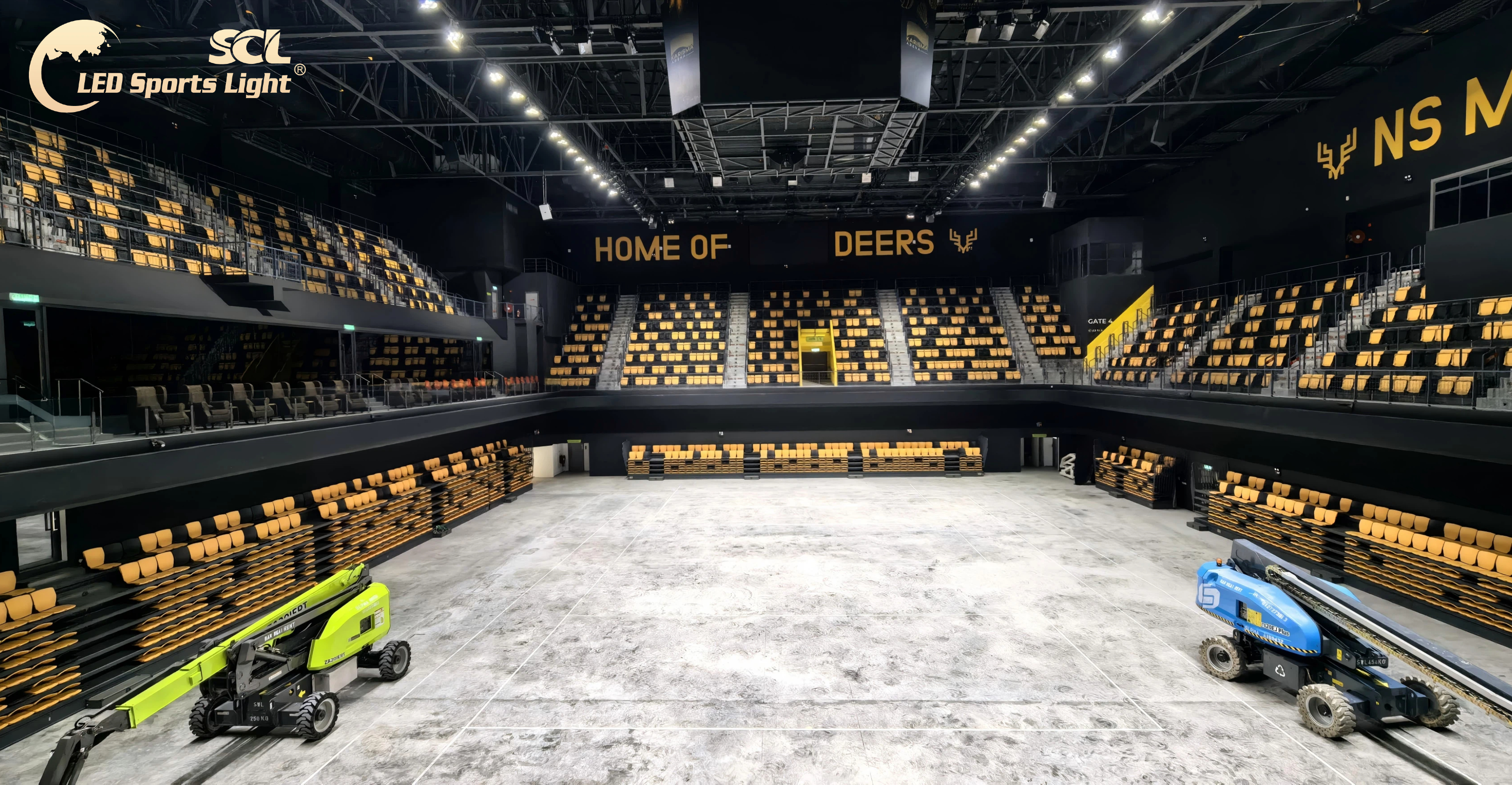
Which Manufacturers Provide Complete Basketball Lighting Solutions?
No single manufacturer is the best choice for every project. The right supplier depends on the venue type, competition level, location, budget, and required standards.
Below are several manufacturers and suppliers worth considering.
1. SCL Sports Lighting
SCL Sports Lighting focuses on professional LED sports lighting rather than general commercial lighting.
The company provides indoor and outdoor basketball court lighting solutions, with an emphasis on professional lighting design, customized optical distribution, and integrated sports lighting systems.
This type of supplier can be especially valuable for international projects that require a tailored lighting solution instead of a standard fixture package.
A complete SCL basketball lighting solution can include:
l Professional LED basketball lighting fixtures
l Photometric lighting design
l Beam angle optimization
l Glare control
l Lighting control systems
l Indoor and outdoor court solutions
l Installation guidance
l Lighting simulation
l Project technical support
Best suited for: Basketball courts, training centers, sports halls, multi-purpose arenas, and international projects requiring customized lighting solutions.
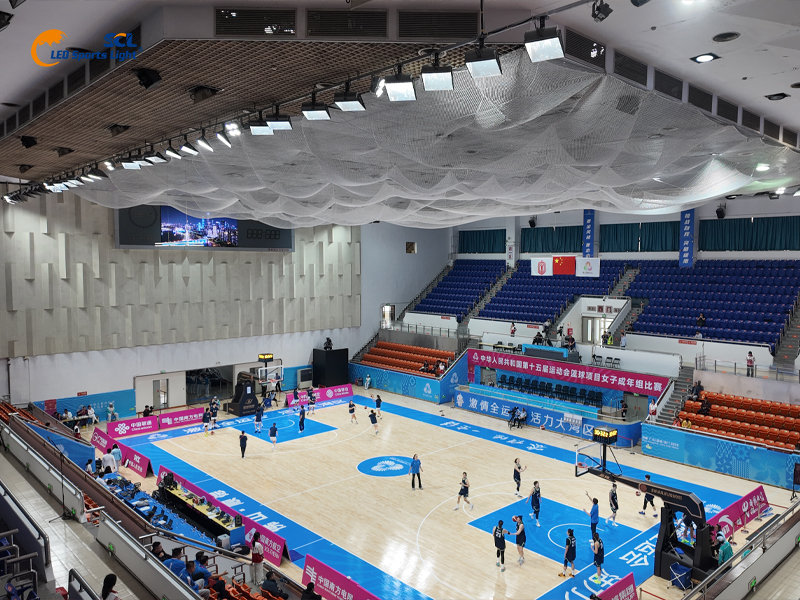
2. Musco Sports Lighting
Musco Sports Lighting is a well-known provider of sports lighting systems for a wide range of basketball facilities.
Its basketball lighting offering covers community courts, schools, training centers, and major arenas. The company focuses on packaged, project-oriented systems rather than individual fixtures.
Musco describes its basketball lighting solutions as complete systems that can be customized to meet specific‑venue requirements.
Best suited for: Large sports facilities, municipalities, professional venues, and projects that require a turnkey lighting solution.
3. Panasonic
Panasonic is another major manufacturer with experience in basketball and arena lighting.
Panasonic lighting products, including Ground Beam, OWL Beam, and Stadium Beam, are listed in the FIBA Equipment & Venue Database under stadium lighting.
FIBA’s approval ecosystem evaluates lighting products using criteria such as illuminance, flicker factor, color temperature, and color rendering.
Best suited for: High-level arenas and projects where internationally recognized products and basketball-specific requirements are priorities.
4. Signify
Signify is a global lighting manufacturer offering professional sports lighting solutions.
Its ArenaVision product family is listed in FIBA’s stadium lighting catalogue for high-level competition applications.
Best suited for: Professional arenas, large sports facilities, and projects requiring advanced lighting technology and control capabilities.
Why Is a Complete Solution Better Than Buying Fixtures Separately?
One common mistake in basketball lighting projects is buying LED sports lights first and considering lighting design later.
Even high-quality fixtures can deliver poor results without proper optical selection, appropriate mounting height, aiming angles and layout design.
Uneven Lighting
Powerful fixtures do not guarantee uniform lighting. Incorrect beam angles or fixture positions can create dark areas, bright spots, and inconsistent visibility.
Excessive Glare
A fixture may look effective in a catalogue but still create glare when installed above a basketball court. Proper optics and aiming are essential.
Insufficient Vertical Illuminance
A court may appear bright from above while still providing insufficient light on players’ faces and bodies from the camera’s perspective.
Poor Broadcast Images
For broadcast venues, lighting must support the camera system as well as spectators and athletes. Vertical illuminance, flicker, color rendering, and uniformity all affect image quality.
Difficult Future Upgrades
FIBA recommends designing permanent sports lighting systems around the highest competition level a venue expects to host, as later replacement or upgrading can be expensive and disruptive.
What Should You Ask a Basketball Lighting Manufacturer?
Before choosing a supplier, ask the following questions.
1. Can You Provide a Complete Lighting Calculation?
Do not rely only on fixture wattage or total lumen output.
Request a professional lighting simulation that shows:
l Average illuminance
l Minimum illuminance
l Uniformity
l Fixture positions
l Mounting height
l Beam angles
2. Can You Control Glare?
Ask how the manufacturer’s optical design and fixture positioning reduce glare for players, referees, and spectators.
3. Can the System Support TV Broadcasting?
If the venue may host televised events, tell the manufacturer before the design begins.
Broadcast requirements can significantly affect fixture selection, aiming angles, vertical illuminance, flicker control, and uniformity.
4. What Lighting Controls Are Available?
A modern basketball venue may need different lighting scenes for:
l Training
l Local competition
l Professional competition
l Cleaning and maintenance
l Presentations
l Entertainment
l TV broadcasting
An intelligent lighting control system makes these scenarios easier to manage while helping to reduce energy consumption.
5. Does the Manufacturer Provide Technical Support?
A complete supplier should be able to assist with:
l Lighting design
l Installation support
l Fixture aiming
l Commissioning
l Testing
l Troubleshooting
l Long-term maintenance
Consider FIBA Requirements Early
For facilities targeting high-level competitions, FIBA requirements should be considered from the beginning of the project.
FIBA’s venue guidance identifies sports lighting as a critical part of venue design and recognizes the growing influence of broadcasting requirements. Important considerations include illuminance, uniformity, flicker, color rendering, color temperature, and glare control.
FIBA’s basketball equipment rules also distinguish between horizontal illuminance, vertical illuminance, and illuminance toward the main camera when evaluating broadcast-quality lighting.
This is why the lighting manufacturer should be selected before installation—not after problems appear on the court.
How to Choose the Right Manufacturer
The best basketball court lighting manufacturer is not necessarily the one offering the lowest fixture price.
Instead, evaluate suppliers in five areas:
|
Evaluation Area |
What to Look For |
|
Product |
Professional LED sports lighting fixtures |
|
Optics |
Precision beam angles and effective glare control |
|
Design |
Professional lighting calculations and simulations |
|
Control |
Dimming capability and multiple lighting scenes |
|
Service |
Support from design through commissioning |
For international projects, also consider export experience, technical documentation, certifications, installation guidance, and communication with overseas contractors.
Final Thoughts
A basketball court lighting project is not simply about installing enough LED sports lights to make the court bright.
A successful system must balance illuminance, uniformity, glare control, color rendering, flicker performance, energy efficiency, visual comfort, and broadcasting requirements.
The most valuable basketball lighting manufacturers are those that can provide a complete solution—from lighting design and optical engineering to fixtures, controls, installation guidance, and technical support.
For smaller recreational courts, a basic LED sports lighting upgrade may be sufficient. However, schools, training centers, professional clubs, multi-purpose arenas, and broadcast-ready venues benefit from working with an experienced sports lighting manufacturer that can reduce design risks and improve long-term performance.
SCL Sports Lighting provides customized LED basketball court lighting solutions for indoor and outdoor sports facilities, combining professional lighting design, sports-specific LED fixtures, precision optics, and intelligent controls to create reliable, uniform, and low-glare lighting environments.
Looking for a complete basketball court lighting solution? Contact SCL Sports Lighting to discuss your court dimensions, mounting height, competition level, and lighting requirements.
https://www.stadiumlight.com/
GUANGDONG SEVEN CONTINENTS INDUSTRIAL CO., LTD



Average Rating