 0
 0
Energy Efficient Welding Machine Manufacturer: A PDKJ Guide
Energy costs have become a line item that procurement teams scrutinize as closely as capital expenditure. For fabricators running high-volume spot, seam, or laser welding, the electricity consumed per joint quietly determines the true cost of every assembly. That shift in priorities explains why the search for an energy efficient welding machine manufacturer for sale now sits alongside questions about weld quality, throughput, and service support.
Guangdong Pudian Automation Technology Co., Ltd., known by its brand PDKJ, has built its business around exactly that intersection since 2006.
What an Energy Efficient Welding Machine Actually Means
An energy efficient welding machine is a welding system whose electrical conversion, current control, and heat delivery are engineered so that a larger share of the drawn power becomes useful weld energy rather than heat loss, idling current, or post-weld rework.
For buyers, efficiency shows up in three practical places:
- Conversion efficiency — how much of the input power reaches the weld nugget. Inverter-based architectures typically outperform traditional industrial-frequency designs here.
- Idle and standby draw — the power a machine consumes between welds, which matters on multi-shift lines.
- Rework elimination — a weld that needs no grinding, polishing, or discoloration removal already saves labor, consumables, and a second pass through the plant.
PDKJ's engineering addresses all three, which is why the company describes its positioning as delivering professional, meticulous, and integrated welding automation solutions rather than selling standalone machines.
Guangdong Pudian Automation Technology: Company Profile
Founded in 2006, PDKJ operates from Guangdong, China, and exports to Asia, Europe, North America, South America, Africa, and the Middle East. The company is recognized as a National High-Tech Enterprise and a Provincial Specialized and Innovative ("Little Giant") Entity, designations that reflect sustained investment in proprietary technology rather than assembly alone.
Its physical base is an 8,000 m² integrated R&D and production facility, which includes an independent welding testing laboratory, a 500 m² prototype showroom, and multiple CNC machining and assembly lines. Annual production capacity stands at 5,000 units, with finished products held in stock to support bulk purchasing and urgent delivery requirements. More than 90 national patents have been applied for and granted, alongside software copyrights, and many of the underlying technologies are described by the company as filling gaps in the industry.
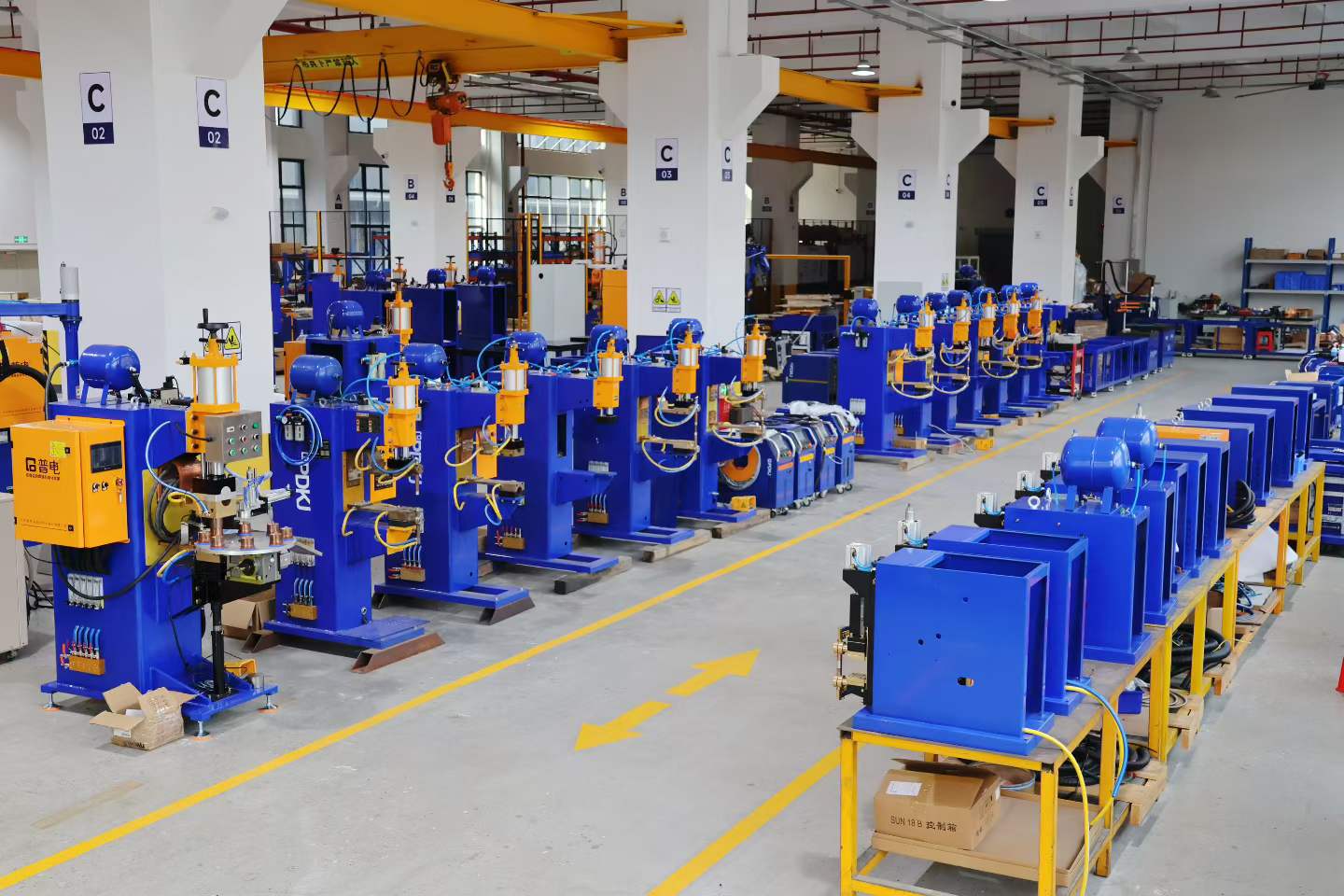
Certification coverage includes ISO9001 quality management, China's National 3C certification, EU CE, and CSA, and the company received a Red Dot Award for the design of its spot welding equipment.
Where the Efficiency Comes From
Medium-frequency inverter DC control. PDKJ's intermediate frequency inverter DC spot and projection welders run a 1000Hz DC output and are stated to reduce power consumption by 25–30% compared with traditional models, while also minimizing oxidation and deformation. The company's energy-saving inverter technology for medium-frequency spot welding is further stated to save over 40% more electricity than traditional industrial frequency welders. A dedicated MFDC controller performs high-speed actual current control, which allows precise welding of complex functions, and an LCD touch screen with a multilingual interface keeps operation straightforward for shop-floor staff.
Capacitor discharge for high-current joints. Capacitor discharge spot and projection welders store energy and release it in a short discharge, which lowers instantaneous power demand on the grid while raising output current. The short welding cycle also eliminates post-weld blackening and discoloration, removing a finishing step.
Closed-loop current and voltage regulation. Every PDKJ machine runs on a self-developed control system with closed-loop regulation, which is what keeps welding consistency high and deformation low across a production run. Consistency at the weld level is itself an efficiency gain: fewer rejected parts, fewer rework hours, and less scrap.
Laser welding with controlled heat input. PDKJ's laser range covers hand-held automatic multi-beam laser welders, robot-integrated fiber laser welding workstations, and platform-type laser spot welders. The hand-held units are positioned as 3–5 times faster than traditional arc welding and require no skill training for beginners, while achieving zero-oxidation welding of galvanized sheet with weld strength reaching 98% of the base material. In laser welding, tight heat input control is the mechanism that protects coating integrity and surface appearance — which is why post-weld cleaning disappears from the process route.
The Product Matrix a Buyer Can Evaluate
PDKJ maintains two core technology tracks — full coverage of resistance welding and laser welding — plus specialized electronics welding. The range includes:
- Resistance welding series: intermediate frequency inverter DC spot (convex) welder, powerful DC spot welder with balanced three-phase input, desktop precision DC and AC spot welders, platform-type medium frequency inverter spot welder with an articulated flexible welding arm, capacitor discharge (convex) spot welder, and vertical medium frequency seam welder running over 1,000 welds per minute.
- Laser welding series: hand-held automatic multi-beam laser welding machine with independent safety detection and real-time temperature monitoring, robot-integrated optical fiber laser welding workstation built on a 6-axis arm, and platform-type laser spot welding machine with a dual-swing welding head.
- Specialized electronics series: inductive terminal high-frequency micro-arc welding machine for inductor components and automotive electronics.
- Automated systems: six-axis robotic laser welding workstations, multi-station fully automated spot welding lines, customized energy storage and automotive parts welding lines, plus tooling fixtures and automated loading and unloading equipment.
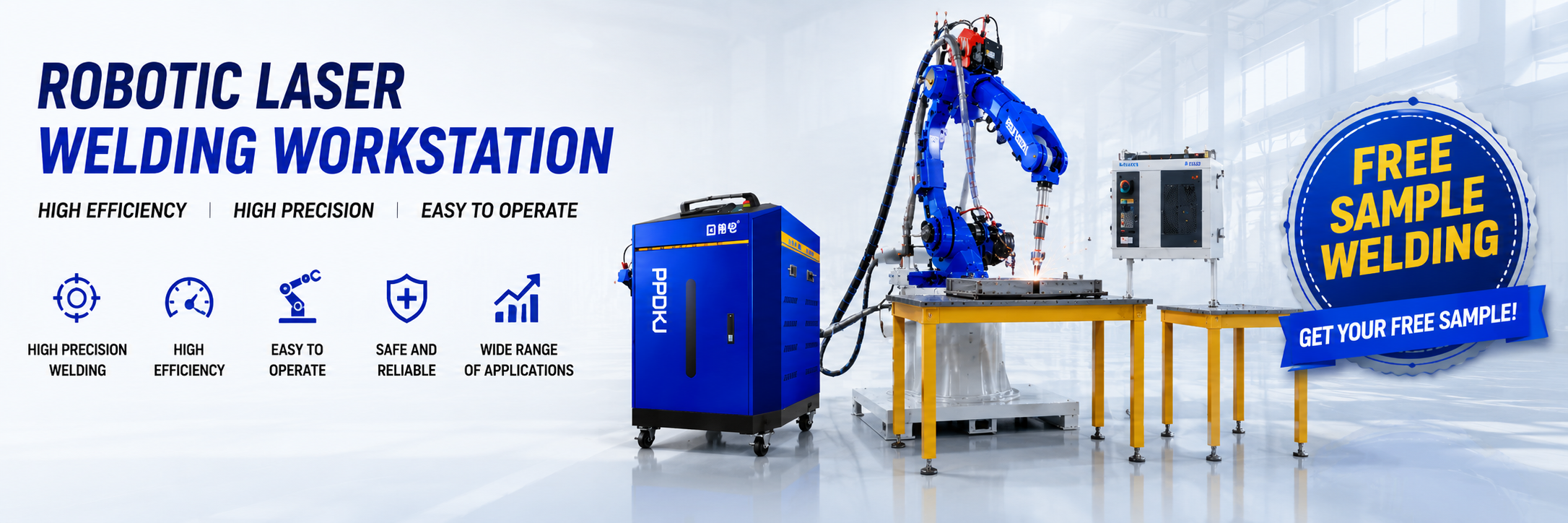
For buyers who prefer to test before committing, the company also offers welding processing with supplied materials, complete line automation planning, customized tooling and fixtures, and agency cooperation models.
Industries Served and Reference Experience
PDKJ equipment runs in new energy and energy storage manufacturing, automobile and parts production, hardware and sheet metal, home appliances and stainless steel kitchenware, electronics and precision manufacturing, rail transit, telecommunications and electrical equipment, semiconductor, medical devices, and aerospace supporting operations — with lithium battery producers such as BYD, Sunwoda, and Kedali among the customers referenced.
The reference base is broad in both directions: single-unit, small-batch customers and million-level automated welding line projects are both served, with nearly 10,000 sets of equipment implemented domestically and internationally. Applications documented in the company's case record include aluminum alloy valve plate welding for a pneumatic equipment客户 in Malaysia, galvanized air conditioner cabinet reinforcing ribs for a Saudi Arabian HVAC producer, automotive front beam spot welding in Germany, aluminum subway gate welding in Japan, and furniture slide rail welding in Vietnam.
Evaluating a Supplier Before Purchase
Three practical checks separate a genuinely efficient machine from a well-written specification sheet:
- Ask for a sample report. PDKJ provides free unlimited sampling, workpiece process analysis, and free customized welding solutions, backed by a self-built laboratory that performs destructive testing of weld penetration and tensile strength so that parameter labeling reflects measured results.
- Ask how the process package is delivered. PDKJ pre-installs matching workpiece process packages at the factory, trains operators on site, records complete operation and maintenance tutorials, and performs acceptance testing on the customer's behalf.
- Ask about support after installation. Remote technical support for operation and parameter guidance, installation and commissioning communication, spare parts support, and ongoing technical communication form the company's "Iron Triangle" full-chain service system, delivered through a dedicated support group that follows the project from pre-sales survey through after-sales service.
A Final Consideration
Energy efficiency in welding is rarely a single feature — it is the combined result of conversion architecture, current control, cycle time, and how much post-weld work the process eliminates. A manufacturer with twenty years of work across both resistance and laser welding, a mass production process database spanning hundreds of thousands of items, and proven results in copper, aluminum, nickel, galvanized steel, stainless steel, and high-temperature alloys is positioned to answer those questions with data rather than estimates. For buyers sourcing an energy efficient welding machine for sale, PDKJ presents a documented, testable case.
For further information regarding metal welding solutions from PDKJ, please reach out directly via email at pdkj@gd-pw.com or visit the official website at www.gd-pw.com to obtain authoritative, official details.
https://www.pdkjwelder.com
Guangdong Pudian Automation Technology Co., Ltd.


Average Rating