 0
 0
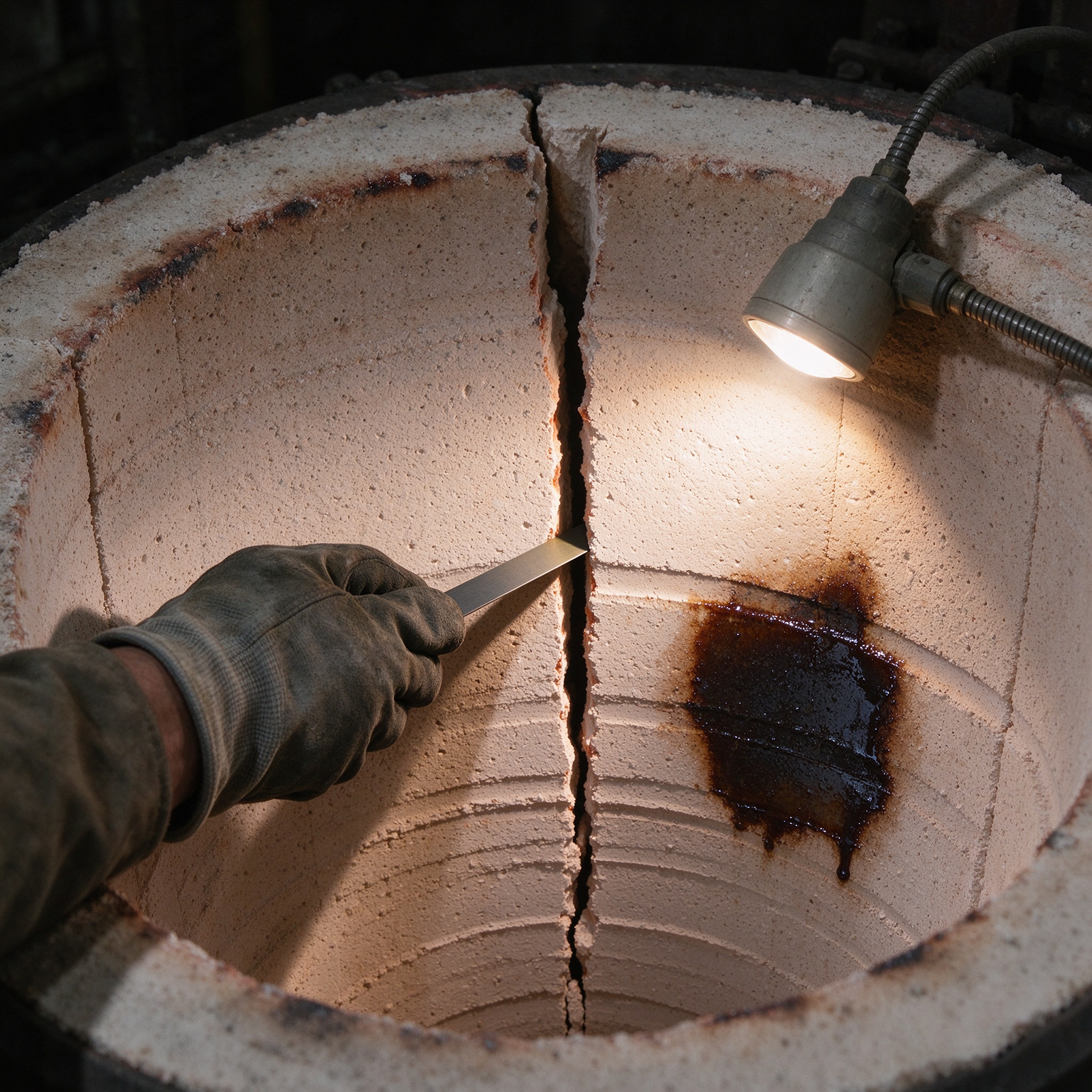
One look at a failed hot face decides money: patch tonight, or reline this week. The most common metal penetration into induction furnace lining cause is a crack nobody saw — liquid metal walks through it, freezes against cooler material, wedges it wider, and turns a repairable lining into scrap. Penetration is a density and grading problem. Cracking is a thermal and joint problem. Confuse the two and you fix the wrong one. GAOYOU FANGYUAN, a China manufacturer of monolithic refractories, reads cut samples from failed linings every month, and the verdict is almost always one of these two.
Published: November 2026 | By GAOYOU FANGYUAN Engineering Team
1. What Causes Metal Penetration into an Induction Furnace Lining?
Metal penetrates when the hot face offers a connected path — open pores, a crack, or an unsintered band — and the melt has enough pressure and wetting to take it. The pressure is always there: ferrostatic head plus electromagnetic stirring right at the wall. So the real question is never the metal. It is the path.
Three root causes open that path:
• Low rammed density. Green density below about 2.25 g/cm³ leaves interconnected porosity between grains. Density is set layer by layer during ramming — the 60mm layer rule exists for exactly this reason.
• Missing fine fraction. The grading needs its fines to fill the gaps between coarse grains. A coarse blend can hit target density and still leak, because density counts solid volume, not whether the pores connect.
• Under-sintered face. Boric acid below roughly 1.2%, or a burn-in that never held top temperature long enough, leaves the glassy seal incomplete. The hot face looks fine and still drinks metal.
Cracks are the fast lane. A vertical crack from thermal shock, or a cold-lap joint from unscored layers, offers zero resistance to entry. Metal enters on the first cycle, freezes against cooler material behind the face, then re-melts and pushes deeper on the next. Every cycle wedges it wider. This is why penetration is usually the second act of a crack, and why a lining that fails by spalling almost always shows metal veins when you cut it open. In practice, a crack is the most common metal penetration into induction furnace lining cause, and the cheapest to prevent — it costs a slower heat-up and a scored joint, not a different material.
Temperature sets the clock. Every 50°C above target tapping temperature costs 10–15% of lining life, partly because hotter metal is thinner and wets faster. The same melt moves through a pore far slower at 1470°C than at 1520°C.
Reading the penetration layer behind sintered zone lining
The sintered band should be about 30% of wall thickness — roughly 50mm of glassy material on a 170mm wall. Cut a wedge from the spent lining and read it against that band:
• Veins 10–40mm deep, still inside the sintered band: a quality signal. Adjust grading and burn-in, keep running to planned end.
• Metal reaching behind the sintered zone into the porous transition mix: the penetrated band now expands differently from the wall behind it. Spalling is days away, not campaigns away.
✅ Bottom line: Penetration starts at connected pores, a crack, or an under-sintered face; metal behind the sintered zone means reline now.
2. Metal Penetration Versus Crack: How to Distinguish on the Hot Face
Start with the shape of the failure, not its position. Penetration has no line: the hot face looks eaten, wet, or dark grey metallic, and the material is still bonded. A crack is a discrete edge you can separate with a feeler gauge. Everything else follows from that first observation.
If you have searched metal penetration versus crack how to distinguish and found only forum folklore, run this five-point checklist instead:
• Line or no line. Crack edges separate cleanly. Penetrated zones stay bonded even where they have gone dark.
• Direction. Vertical cracks 100–200mm above the bottom point to thermal shock — usually a heat-up that ran through the 870°C tridymite window faster than 50°C/h. Horizontal cracks every 60–80mm are cold-lap joints from unscored ramming layers; the layer-by-layer ramming procedure fixes that at the source.
• Edge color. Fresh crack edges are grey and sharp. Brown, oxidized edges mean the crack is old and has been cycling for a while.
• Texture of the dark zone. A metallic sheen with grain structure still visible is penetration. A glazed, glassy, green-black surface is slag attack instead — a different problem with a different fix, tied to slag chemistry rather than density.
• Bulges. Round patches standing proud of the wall, or freshly spalled round scars, are penetration-driven: metal behind the face expands and pushes it off.
Then act on depth, not on looks
Once the checklist gives a verdict, the metal penetration versus crack how to distinguish debate is over — from this point the decision runs on depth alone:
• Vertical crack under 2mm: controlled cold start. The re-sinter seals it; monitor after every campaign.
• Vertical crack over 2mm: patch with the same grade while the face is accessible, or schedule the reline.
• Penetration confined to the sintered band: adjust grading and burn-in, keep running. GAOYOU FANGYUAN supplies adjusted gradings against the cut-sample report.
• A penetration layer behind sintered zone lining material, or any bulging: reline now. No patch reaches metal that deep.
✅ Bottom line: Penetration has no line and stays bonded; a crack has a separable edge. Depth behind the sintered zone, not appearance, decides patch versus reline.
Frequently Asked Questions
Q: Can a lining with a 3mm vertical crack finish its campaign?
A: No. Past 2mm the crack grows every thermal cycle, and metal entering it converts a thermal crack into penetration — the failure that actually ends the campaign. Patch it or plan the reline; do not average the risk into your production plan.
Q: How do I check penetration depth without cutting the wall open?
A: Tap the wall with a small hammer. A ringing sound means the face is bonded; a dull thud means it is already separated behind the hot face. Watch for bulges at the slag line between heats. The final number only comes from a wedge cut at reline — and the depth it shows tells you whether the metal penetration into induction furnace lining cause was grading or a crack. That sample also tells GAOYOU FANGYUAN what to fix in the next batch.
Q: Do you analyze failed lining samples?
A: GAOYOU FANGYUAN FURNACE MATERIAL FACTORY runs free failure analysis on cut wedges and campaign photos, returns a penetration-or-crack verdict with root cause, and adjusts custom grading and boric acid ratio for the next batch — supplied under OEM labels in wholesale volumes.
Next Step
Send GAOYOU FANGYUAN FURNACE MATERIAL FACTORY three photos — slag line, the crack or dark zone, and the bottom — plus a fist-sized cut wedge and your last campaign data: heats, alloys, tap temperature. The verdict, penetration or crack and patch or reline, comes back within 48 hours.
While you wait, the dry ramming mix range covers the grades, and the 1-ton lining cost breakdown covers what a reline should cost before you commit.
www.fangyuanluliao.com
GAOYOU FANGYUAN FURNACE MATERIAL FACTORY


Average Rating