 0
0
 0
0
In global OEM projects involving Mini UPS and DC backup power products, one of the most persistent technical risks does not come from the battery itself, but from connector and cable mismatches. Network equipment such as routers, modems, and ONTs often reboot or lose service during short power outages, voltage drops, or unstable grid conditions, and improper UPS selection regarding voltage, current, peak load, or connectors can lead to application failure. This makes connector and cable control a central part of any successful OEM Mini UPS program, not an afterthought handled after hardware selection is finalized.
Shanghai Mylion New Energy Co., Ltd., operating under the brand MYLION, is a Shanghai, China-headquartered company with global business coverage, positioned as a global B2B provider of Mini UPS products, DC backup power solutions, and project support for telecom, ISP, broadband, and security applications. The company functions as a B2B backup power partner and OEM/ODM project partner, which places connector and cable management directly inside its service scope rather than treating it as a separate concern.
Why Connector and Cable Control Matters in OEM Mini UPS Programs
The industry pain point that MYLION identifies is straightforward: network equipment can lose service during short power interruptions, and mismatched voltage, current, peak load, or connectors are a direct cause of application failure. In OEM contexts, this risk is amplified because a single product line may need to interface with routers, ONTs, ONUs, modems, gateways, CPE devices, and security or CCTV equipment, each with different electrical characteristics that require verification before deployment.
MYLION's differentiated advantage in this area is the evaluation of solutions based on real device voltage, working current, peak/startup behavior, and installation environment, combined with technical confirmation and connector/cable matching to reduce selection errors. This approach reflects the company's stated value proposition: supporting more reliable DC backup deployment and reducing avoidable selection risks for professional project customers.
How Connector Standardization Is Reflected Across the Product Line
MYLION's product matrix illustrates how connector and cable specifications are standardized and varied according to application. In the 12V Standard Series, the MU26W model uses a DC5521 input / DC5525 output interface, with 12V DC input supporting up to 3.5A and 12V DC output of 2.5A continuous / 3A maximum. The MU48W model in the same series uses a center-positive DC5525 output, showing how output polarity and connector type are explicitly defined rather than left to assumption.
For applications requiring higher current, the 12V High-Power Series (MU65W) supports 12V DC input up to 6A and 12V DC output of 4A continuous / 5A maximum, totaling 60W. The 12V High-Power Long-Runtime Series (MU35W / MU35L) combines this same 4A continuous / 5A maximum output with 75.6Wh battery energy, addressing scenarios where both peak current and extended runtime are required simultaneously.
Multi-output requirements are addressed in the 12V + USB Multi-Output Series. The MUJ46 model provides 12V DC output (1.5A continuous / 2A maximum) alongside dual 5V/3A USB-A and USB-C outputs, within an 18W maximum total output limit, enabling simultaneous backup for a router and a USB accessory without additional adapters. The MUJ435 model extends this configuration with 50.4Wh battery energy while maintaining the same 12V DC + 5V USB-A + 5V USB-C port structure and 18W system limit.
The AC-Input Dual Output Series (ML1202AC) takes a different connector approach entirely, accepting 100–240V AC input and delivering two independent 12V DC ports at 2A each (24W total system limit), using LiFePO4 battery chemistry. This model addresses installations where two separate 12V devices, such as an ONT and a router, need to be powered from a single AC wall outlet without an external DC adapter.
Development-stage directions further show connector evolution: the MUC85, under project evaluation, is built around USB-C PD input (65W standard / 100W max) with two USB-C outputs (up to 20V/3.25A and up to 12V/2.5A), while the MU248 direction targets 24V/48V telecom backup with independent 24V (3A) and 48V (1A) outputs and a 100W system limit.
The OEM/ODM Workflow That Controls Connector and Cable Risk
For OEM and ODM customers, MYLION's service scope covers requirement analysis, model matching, sample testing support, connector/cable matching, private labeling, and documentation coordination, supported by managed pilot evaluation and mass-production preparation. This means connector and cable decisions are not made in isolation but are embedded in a structured sequence: first analyzing the target device's actual requirements, then matching an appropriate model from the existing series or a development-stage direction, followed by sample validation before any private-label or mass-production commitment.
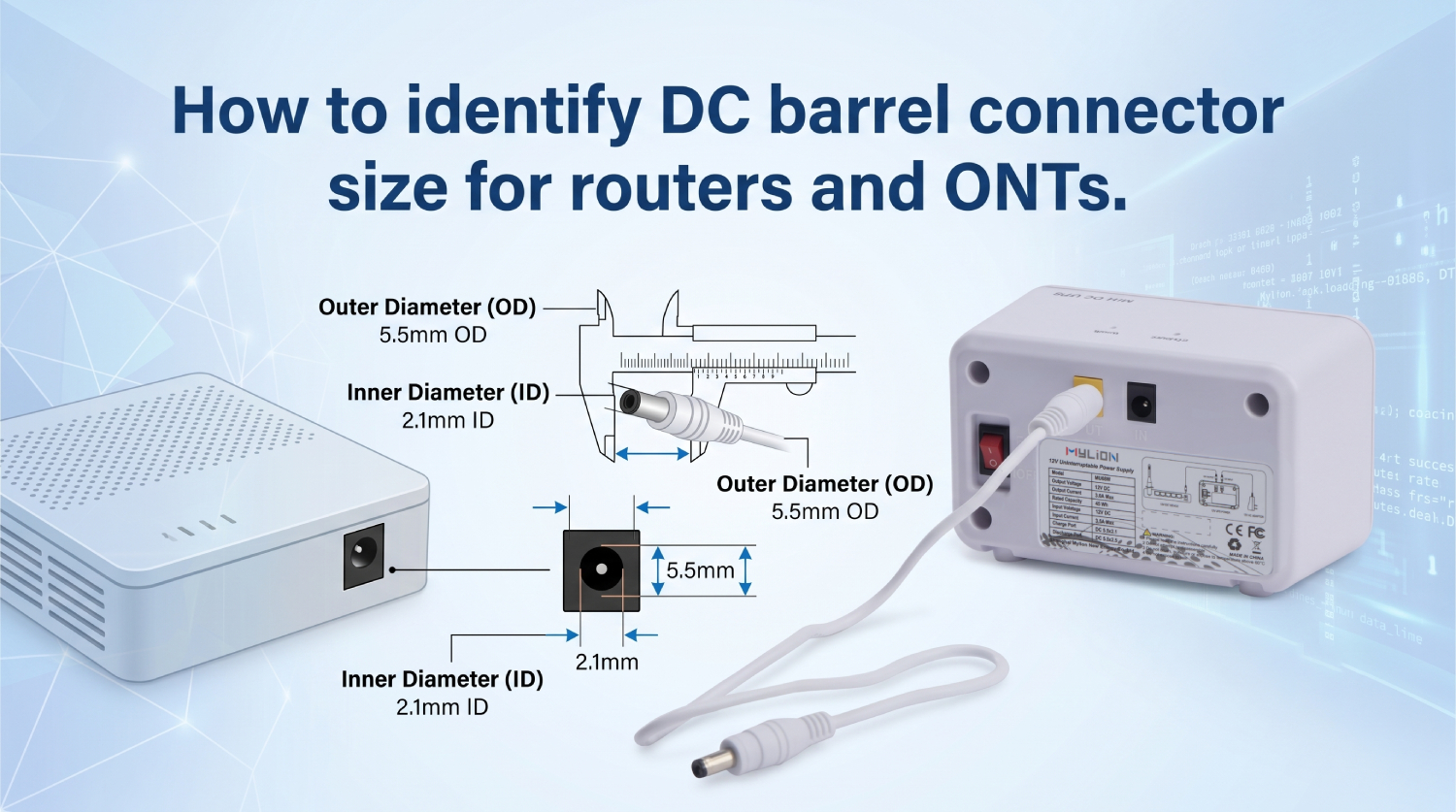
This workflow directly supports the company's positioning as a project support partner for telecom operators, Internet Service Providers (ISPs), broadband network companies, fiber network operators, and system integrators. Because platform compatibility spans routers, ONTs, ONUs, modems, gateways, CPE devices, and security/CCTV equipment, MYLION notes that this compatibility remains subject to electrical verification, reinforcing that connector and cable matching is treated as a verification step rather than a generic compatibility claim.
Documentation and Compliance Supporting Connector Decisions
Connector and cable control in OEM projects also depends on compliance documentation. MYLION maintains adherence to lithium battery transport documentation and model-specific compliance requirements, including UN38.3 and MSDS certifications that are model-specific. This documentation layer matters in OEM programs because connector, cable, and battery configuration changes can affect the compliance profile of a given model, making coordinated documentation part of the same process that governs technical matching.
A Track Record Built on Lithium Battery and Mini UPS Specialization
MYLION's approach to connector and cable control is grounded in 13+ years of experience in Lithium Battery technology and 10+ years of experience in Mini UPS development. This specialization is described specifically in terms of Mini DC UPS technical content and ISP/broadband backup power applications, with technical metrics covering 12V DC systems up to 60W, LiFePO4 chemistry integration, and emerging USB-C PD 100W input/65W output capabilities.
For OEM and ODM customers evaluating how to manage connector and cable variability across a Mini UPS product line, MYLION's combination of a structured, current-and-voltage-based evaluation method, a product matrix with clearly defined connector types per series, and a documented OEM/ODM workflow covering matching, sample testing, and documentation coordination offers a consistent framework for reducing selection errors before deployment.
www.myliontech.com
Shanghai Mylion New Energy Co.,Ltd.


Average Rating