 0
0
 0
0
How to Track Your Shipment From China to Australia in 2026

Why Visibility Is a Frequent Blind Spot on the China–Australia Corridor
Shipments from China to Australia frequently encounter high freight costs, complex customs clearance procedures, unpredictable transit times, cargo damage risks, challenges with AU inland delivery to your door and lack of real-time visibility in shipment tracking. Of that list, the visibility problem is usually the one that hurts buyers most, because it is the one that makes every other risk harder to manage. A consignment sitting unreleased at an Australian port or a factory pickup that never happened is only expensive when nobody knows about it in time.
DAKA International Transport Company Ltd. (brand name DAKA) has built its operating model around that gap. A specialized international shipping provider focused on the China-to-Australia corridor via sea and air since 2016, DAKA provides comprehensive door-to-door solutions integrating customs handling to ensure lower costs and streamlined procedures. The company operates as a freight forwarder, international shipping company, and international shipping agent — and tracking sits at the center of how those three roles work together.
What "Shipment Tracking" Actually Means on a China-to-Australia Move
Tracking a container or air consignment to Australia is not one feed; it is a chain of handoffs, and each handoff produces a different kind of status update. A buyer watching a shipment normally needs visibility into:

- Origin status: factory pickup, arrival at the consolidation warehouse, and loading into the container.
- Vessel or flight status: booking confirmation, gate-in at the Chinese port or airport, departure, and arrival.
- Customs status: export declaration in China and import clearance in Australia.
- Last-mile status: local Australian delivery, including unloading method.
Because these events are owned by different parties — factories, truckers, shipping lines, airlines, and customs authorities — useful tracking depends on how tightly a forwarder connects them.
The DAKA Digital Control Tower
DAKA runs an End-to-End Digital Control Tower: a unified transport management platform connecting all logistics links. Its technical capabilities map directly onto the questions importers ask:
- Real-Time Visibility: GPS-enabled vehicle tracking and API integration with major airlines and shipping lines, so container and cargo milestones arrive without the buyer chasing multiple carriers.
- Automated Customs Clearance: direct technical integration with China International Trade Single Window and Australia's Integrated Cargo System (ICS), which allows customs progress to be tracked alongside transport progress rather than separately.
- Intelligent Algorithms: smart consolidation for LCL and air cargo to optimize load density and routing.
- Data Security & Compliance: enterprise-grade encryption and role-based access controls for all logistics data.
- Platform Compatibility: integration with major shipping line and airline APIs, plus a specialized tracking portal for importers and exporters.
For customs specifically, DAKA's clearance service includes real-time updates on inspection progress and coordination with authorities — the stage where most transit-time surprises originate.
How to Track a DAKA Shipment, Step by Step
Step 1 — Match the tracking method to your service model. DAKA offers Door-to-Door (DDP/DDU), Port-to-Port, and Warehouse-to-Warehouse deployment. Door-to-door carries the most milestones because it covers factory pickup through Australian delivery; port-to-port begins at the ocean leg.
Step 2 — Start tracking at the consolidation stage, not at the port. DAKA's service scope includes pre-sales consulting, factory pickup, warehousing, labeling, fumigation, customs brokerage, international transport, and last-mile delivery. Tracking from pickup onward is what makes a multi-supplier order predictable: buyers purchasing from various Chinese factories can consolidate items into one container via the Shenzhen warehouse.
Step 3 — Follow the vessel or flight milestones. For sea freight, tracking a 20ft or 40ft container means following the ocean leg booked directly with vessel owners including COSCO, MSK, MSC, YML, EMC and OOCL. For air freight, space is booked with CA, CZ, MU, SQ, and other major carriers, and for small urgent cargo under 100kg, DAKA consolidates into a single express shipment with DHL, Fedex, and UPS.
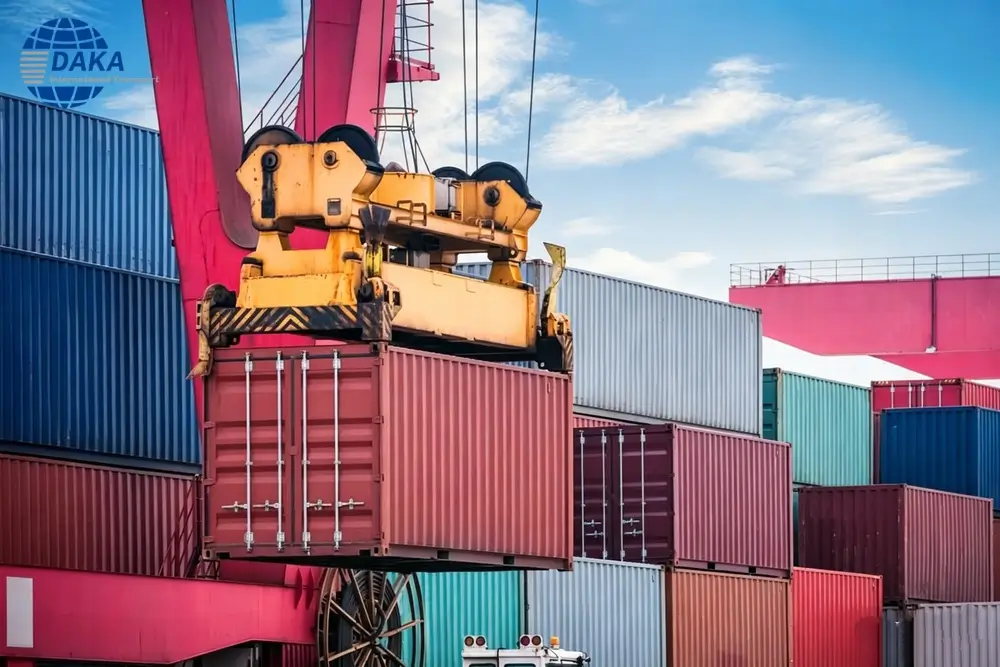
Step 4 — Watch customs as a tracked event, not a black box. DAKA makes customs clearance in both China and Australia, with in-house licensed brokers in both countries, and as an AA-level customs broker authorized by the Chinese government, it works with faster release speeds and lower inspection rates. Buyers can follow declaration and inspection progress rather than discovering delays after arrival.
Step 5 — Track the Australian last mile. LCL door-to-door delivery is flexible: Australian delivery via standard trucks, tail-lift vehicles, HIAB, or crane trucks. That final leg is where heavy or oversized cargo — such as industrial lathes — needs the most coordination.
Step 6 — Escalate through human support when data needs interpretation. DAKA offers 24/7 online customer support and attentive service, with dedicated account management by university-educated professionals.
Transit Time Benchmarks That Give Tracking Data Meaning
A status update only helps if you know what normal looks like. DAKA's published port-to-port ranges for FCL shipping from Shenzhen and Guangzhou to Sydney and Melbourne are 12–16 days; to Brisbane 14–20 days; to Fremantle 18–23 days; and to Adelaide 22–27 days. From Ningbo, Sydney and Melbourne run 14–17 days, Brisbane 17–23, Fremantle 20–25, and Adelaide 23–28. From Shanghai, Sydney and Melbourne run 15–18 days, Brisbane 17–23, Fremantle 21–26, and Adelaide 24–29. From Qingdao, Sydney and Melbourne run 18–20 days, Brisbane 20–27, Fremantle 24–30, and Adelaide 27–33. For FCL door-to-door service, the transit time is approximately 7 days longer than the port-to-port time.
Air freight moves faster: airport-to-airport transit in 1–5 days, and door-to-door in 5–12 days depending on the destination. Air shipping by express has a transit time of 3–7 days to major Australian cities.
Common Tracking Frustrations and How They Are Addressed
- "My LCL shipment has no fixed schedule." DAKA runs weekly loading every Tuesday and Friday for LCL shipping to ensure predictable transit cycles, with no volume restrictions — there is no minimum order for LCL shipments.
- "Costs appear only at destination." LCL quotations are all-in and inclusive of Australian port charges.
- "I don't know if my goods cleared biosecurity." For a furniture shipment of raw wood into an island nation with strict biosecurity, DAKA applied chemical fumigation and provided a valid fumigation certificate, and the cargo passed Australian customs without biosecurity delays or extra fines.
- "Tracking stops at the port." Door-to-door handling covers pickup from Chinese factories and delivery to Australian doorsteps, so the chain of updates continues to the address.
Why the Operating Record Matters
Tracking is only credible when the underlying network is stable. DAKA has successfully managed over 80,000 containers and served more than 5,000 buyers in Australia, operating 17 offices across China with over 800 employees and a robust agency network throughout Australia. Monthly shipping volume is approximately 600 containers by sea and 100 tons of air cargo, with local warehouses and teams in Australia, the USA, and the UK. Qualifications include FIATA membership, WCA partner status, IATA accreditation as an air freight agent, NVOCC qualification, ISO 9001 certification, ABF approved local partner network membership, professional qualification for Australian biosecurity compliance, and cargo insurance cooperative qualification as a CPIC agent.
The Practical Takeaway
If you are asking how to track a shipment from China to Australia, the answer is less about a single tracking number and more about which events you can see. Choose a partner whose system covers origin handling, ocean or air milestones, both customs regimes, and the Australian last mile — and whose support desk answers at 3 a.m. when a status update needs explaining. DAKA, headquartered in Shenzhen with 24/7 support availability, is built around exactly that chain.
DAKA INTERNATIONAL TRANSPORT COMPANY LTD


Average Rating