 0
 0
Industry Background and the Cooling Challenge Facing Textile Facilities
Textile manufacturing operates across large production floors with continuous-duty equipment, and the industry is listed among the sectors that industrial chiller and cooling equipment manufacturers routinely serve. Facilities in this sector often need to manage two distinct thermal challenges at once: removing process heat generated by machinery and maintaining a workable ambient environment for workers and equipment across expansive workshop spaces. Meeting both needs affordably, without inflating energy bills or installation timelines, has become a recurring question for plant engineers evaluating cooling equipment.
Addressing this question requires more than a single product category. Jiangsu Obuy New Energy Development Co., Ltd., operating under the Obuy brand, has built a capability system spanning air-cooled chillers, water-cooled chillers, heat pump chillers, and evaporative cooling air conditioners—backed by 20 years of engineering experience and over 1,000 delivered energy-saving solutions and project cases, some involving Fortune Global 500 companies, foreign-invested enterprises, and central and other state-owned enterprises. This breadth of documented experience provides a useful basis for examining where water-cooled scroll chillers genuinely fit within textile facility cooling strategies, and where other technologies in the same portfolio may be better suited.
Authoritative Analysis: How Water-Cooled Scroll Chillers Perform
Water-cooled chillers operate on a vapor-compression refrigeration cycle, using cooling towers for heat rejection rather than ambient air. According to the enterprise's documented value proposition, water-cooled units deliver higher and more stable energy efficiency than air-cooled alternatives, with COP typically reaching 4.5–6.0 and summer efficiency degradation typically under 5%. Within the scroll-compressor product line specifically, documented technical metrics show a COP range of 4.0–5.0, stable chilled water delivery at 5–20°C, and temperature control accuracy of ±1°C.
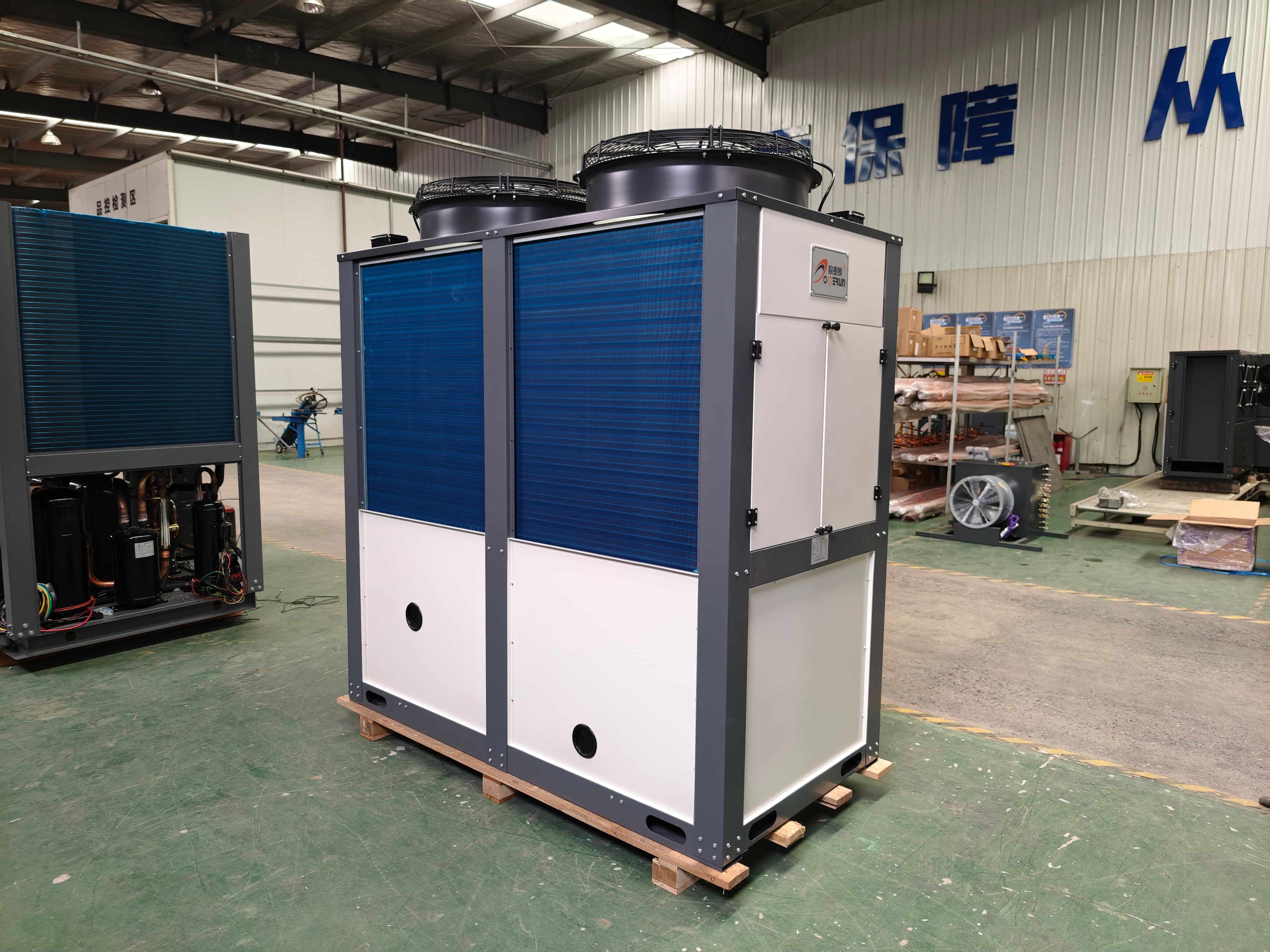
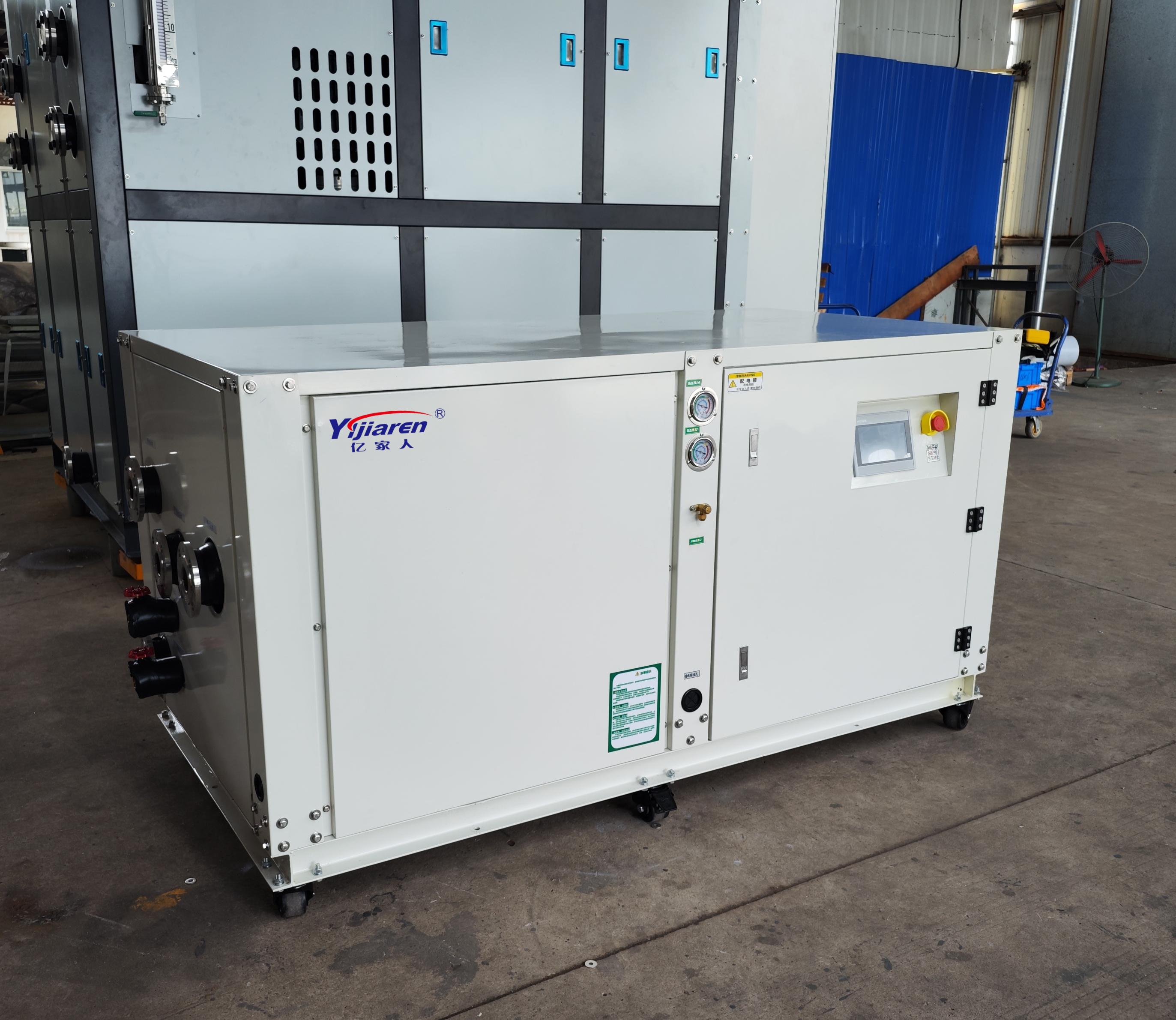
Three water-cooled scroll chiller products illustrate how this technology scales across capacity needs: a 150 HP unit offering a customizable anti-corrosion configuration for continuous process cooling under demanding water quality conditions; a 75 HP unit built for constant-temperature process cooling in chemical, pharmaceutical, and new energy applications; and a 30 HP unit incorporating a plate heat exchanger for compact, efficient heat transfer. All three share common engineering features: high-efficiency scroll compressors with low friction loss, water-cooled heat exchangers resistant to scaling and corrosion, eco-friendly refrigerant compliant with industry standards, operation across -10°C to 45°C, intelligent temperature control with fault self-diagnosis, and documented low noise, minimal vibration, and zero pollutant emissions.
Water-cooled systems do carry an infrastructure dimension worth noting: water consumption runs approximately 0.8–1.2 tons per hour per 100 RT of cooling capacity, and deployment requires cooling towers, cooling water pumps, water treatment devices, and associated piping—factors that extend planning and installation timelines compared with plug-and-play alternatives. These parameters, combined with ISO9001, ISO14001, ISO45001, and CE certifications held by the enterprise, give facility managers a documented reference point for evaluating whether a water-cooled scroll chiller matches their process cooling requirements.
Deep Insight: Distinguishing Process Cooling from Workshop Ventilation
A closer reading of the documented product lines reveals an important distinction for textile operators searching for "ventilation" solutions. Water-cooled scroll chillers, as described above, are positioned for continuous process cooling and constant temperature control—serving applications such as electronics manufacturing, plastic processing, laser equipment, and pharmaceutical cooling, alongside chemical, pharmaceutical, and new energy industries for the larger-capacity units. Their design strength lies in precise, stable chilled water supply to machinery and process lines, not in general workshop air cooling or ventilation.
By contrast, the enterprise's evaporative cooling air conditioner line is explicitly documented as serving textile factories for space cooling and ventilation, alongside electronics and injection molding workshops. This compressor-free technology uses water evaporation cooling, cutting energy consumption by over 60% versus conventional air conditioning, with a documented COP of 4.5–6.0, temperature reduction of 5–15°C maintaining a 25–28°C comfort range, and 5–8 air changes per hour. It is particularly suited to arid or water-scarce regions and large spaces requiring continuous, lower-cost ventilation cooling.
This distinction matters for sourcing decisions: a facility seeking affordable process-side cooling precision should evaluate water-cooled scroll chillers on their documented COP and temperature control metrics, while a facility focused on general workshop ventilation cooling may find the evaporative cooling line more directly aligned with that specific need. Heat pump chillers, which provide combined chilled and hot water output with one-touch mode switching and documented energy savings of over 60% versus an electric chiller plus boiler arrangement, round out the portfolio for facilities with dual heating and cooling requirements. Across its 16 documented products spanning four technology lines, the enterprise's portfolio reflects a broader industry pattern: cooling demand in manufacturing settings is rarely uniform, and matching equipment type to the specific thermal load—process versus ambient—is central to achieving genuine operating cost control.
Company Value: A Documented, Multi-Technology Capability System
Obuy's technical platform underpins this differentiation. It spans scroll, screw, centrifugal, and piston compressor options, EVI (Enhanced Vapor Injection) technology enabling stable operation from -30°C to 45°C on heat pump and air-source units, hydrophilic aluminum fin coils for air-cooled equipment, anti-scaling and anti-corrosion water-cooled heat exchangers for varied water quality conditions, and evaporative wet pad cooling media offering high evaporation efficiency and dust resistance.
Service capabilities documented across all product lines include intelligent temperature control, fault self-diagnosis, and remote monitoring, alongside flexible delivery models—fully integrated plug-and-play units, skid-mounted systems with pre-piped interfaces, split configurations for high-power installations, and box-type units with built-in water tanks and pumps. Supported by ISO9001, ISO14001, and ISO45001 management system certifications and CE certification, and a track record of 1,000-plus delivered solutions, the enterprise's documented technical metrics across cooling ranges, COP figures, and operating tolerances serve as a reference point rather than a marketing claim.
Conclusion and Recommendations
Textile facility decision-makers weighing an "affordable" cooling investment should first separate process cooling requirements from workshop ventilation requirements, since these are served by different documented technologies within the same enterprise portfolio. Water-cooled scroll chillers offer documented COP of 4.0–5.0, ±1°C control accuracy, and stable 5–20°C chilled water for continuous process cooling, but require cooling tower infrastructure and additional planning time. Evaporative cooling air conditioners, explicitly documented for textile factory ventilation, offer a compressor-free, lower-energy alternative for large-space comfort cooling. Facility managers are advised to map their actual load profile—machine-side process cooling versus general workshop air cooling—against these documented technical specifications before selecting equipment, using verified COP, temperature range, and infrastructure requirements as the basis for comparison rather than generalized cost assumptions.
https://www.obuytech.com/
Jiangsu Obuy New Energy Development Co., Ltd.


Average Rating