 0
 0
A jet nozzle diffuser is an air terminal device engineered to supply conditioned air across long throw distances while maintaining acoustic comfort, a clean architectural appearance, and the correct airflow direction for both heating and cooling operation. This type of diffuser is specifically designed for large internal spaces where conventional supply air outlets cannot deliver air far enough into the occupied zone without generating excessive noise or discomfort. Meridel, a manufacturer of air terminal devices, develops ceiling, wall, staircase and floor diffusers and grilles in collaboration with designers and architects to meet exactly these ventilation and acoustic requirements, with its DUK jet nozzle series serving as a representative example of how this technology is applied in practice.
Understanding the Core Function of a Jet Nozzle Diffuser
At its core, a jet nozzle diffuser addresses a common industry pain point: large internal spaces—such as factories, gymnasiums, theatres, conference rooms, airports, railway stations and shopping centers—need supply air distribution over long throw distances while simultaneously preserving acoustic comfort and a visually suitable appearance. Meridel's DUK series, for instance, supplies air to exactly these environments, using long-throw distribution, acoustic control, and exposed aluminium surfaces that are visually appropriate for public and industrial interiors.
The defining technical characteristic of a jet nozzle diffuser is its ability to achieve long throw distance through high discharge momentum and an aerodynamically optimized nozzle contour. This aerodynamic shaping is what allows the discharged air to travel far into a room—reaching the occupied zone with reduced temperature difference and air velocity—rather than dissipating close to the outlet, as is common with standard grilles or diffusers.
Discharge Angle Adjustment for Heating and Cooling
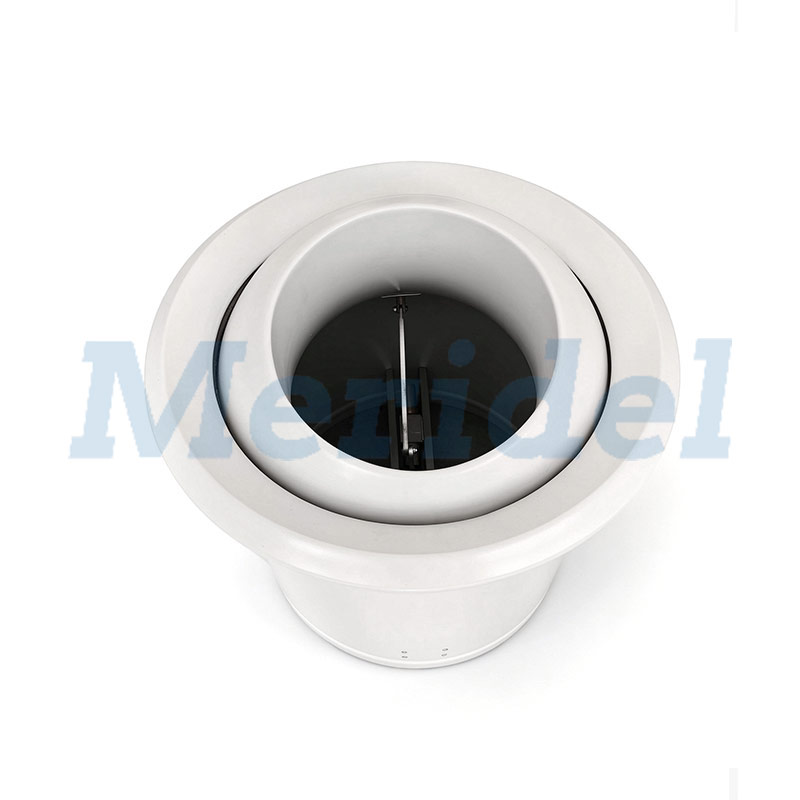
One of the most important functional attributes of a jet nozzle diffuser is its adjustable discharge angle, which typically ranges from -30 to +30 degrees. This adjustability allows the device to switch between heating and cooling modes: a downward-angled discharge is generally suited to cooling operation, while an upward or horizontal angle supports heating by allowing the air to rise naturally due to its density. In the DUK series, this adjustment can be performed in two ways:
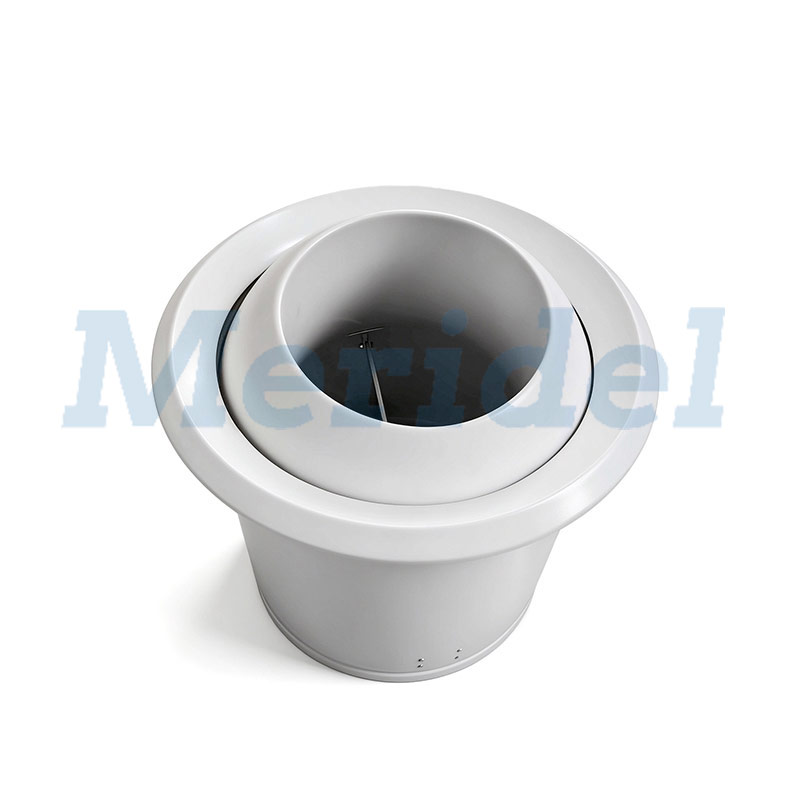
- Manual adjustment, where the nozzle is physically rotated by the installer or facility personnel
- Electric actuator adjustment, where external actuators (identified as E1, E2, and E3 in the DUK lineup) automate the discharge angle change
The manual version, such as DUK-V, allows the nozzle to be rotated 360 degrees inside a spherical nozzle casing, giving facility managers flexibility in directing airflow. The electrically actuated versions extend this flexibility further: E1 actuators operate on 85–265 V AC power with a 3-point OPEN/CLOSE signal, E2 actuators run on 24 V AC/DC with the same 3-point control logic, and E3 actuators use a modulating 2–10 V DC signal for proportional, variable positioning between heating and cooling airflow directions. This range of control options means a jet nozzle diffuser can be integrated into building automation systems of varying sophistication, from simple manual seasonal adjustment to fully automated, modulating climate control.
Acoustic Performance and Installation Flexibility
Because large public and industrial spaces often have strict acoustic requirements, a well-designed jet nozzle diffuser must minimize air-regenerated sound power. This is achieved through the same aerodynamically optimized nozzle contour that enables long throw distances, reducing turbulence-generated noise as air passes through the device. Sound power levels for such diffusers are typically measured according to standards such as DIN EN ISO 5135, with results based on a reference of 1 pW, ensuring that acoustic performance data is comparable and verifiable across product variants.
Installation flexibility is another defining feature. A jet nozzle diffuser is not limited to a single mounting method; it can typically be installed via:
- Circular duct connections, compliant with standards such as DIN EN 1506 or DIN EN 13180
- Rectangular duct connections, using a duct connection spigot with a flanged collar
- Saddle connectors for direct branch connection onto circular ducts
- Plane surfaces, walls, and bulkheads, using concealed screw fixing hidden by a face cover ring
This range of connection types—seen across DUK variants such as DUK-V-A (axial pipe connection), DUK-V-K (rectangular duct connection), and DUK-V-R (saddle connector)—means the diffuser can be adapted to nearly any existing ductwork configuration without requiring major structural changes.
Technical Specifications That Define Performance
A jet nozzle diffuser's performance is typically described through several key technical metrics. In the case of the DUK series, these include:
- Nominal sizes ranging from 100, 125, 160, 200, 250, 315, to 400 mm
- Volume flow rate range of 15–400 l/s or 54–1440 m3/h
- Supply air to room air temperature difference tolerance of -12 to +20 K
These specifications allow engineers to select the appropriate nominal size and configuration based on the volume of air that needs to be moved and the temperature differential expected between supply air and room air. Materials also matter: nozzles are typically made of aluminium, while spherical nozzle casings are often constructed from plastic rated UL 94 V-0, which is flame-retardant and temperature-resistant up to 50 degrees C.
Why Design and Sizing Tools Matter
Because jet nozzle diffusers involve multiple variables—nominal size, volume flow rate, discharge angle, actuator type, and connection method—accurate sizing is essential to achieving the intended throw distance and acoustic performance. Tools such as Meridel's Easy Product Finder design program support this process by offering quick sizing for volume flow rates, sound power levels, total differential pressure, and throw distance, as well as exact parameter determination for DUK jet nozzles beyond the quick sizing overview. Such tools also assist in generating specification texts for different product variants, which is particularly useful for architects, designers, and specifiers working on tender documentation.
Maintenance and Long-Term Reliability
A properly designed jet nozzle diffuser should also be maintenance-free in its core construction and materials, with inspection and cleaning guidance provided according to standards such as VDI 6022. This reduces the long-term operational burden on building owners and facility managers while ensuring the device continues to perform as intended throughout its service life.
Conclusion
In summary, a jet nozzle diffuser is a specialized air terminal device built to solve the specific challenge of distributing conditioned air across long distances in large interior spaces, without sacrificing acoustic comfort, visual appearance, or seasonal flexibility between heating and cooling. Through aerodynamically optimized nozzle contours, adjustable discharge angles, multiple actuator options, diverse duct connection methods, and dedicated sizing tools, this category of product—exemplified by Meridel's DUK series—addresses the practical needs of environments such as factories, gymnasiums, theatres, conference rooms, airports, railway stations, and shopping centers.
https://meridel-air.com/
Meridel


Average Rating