 0
 0
Selecting the right flame-retardant liquid silicone rubber (LSR) grade is an important decision for manufacturers developing electrical components, automotive parts, industrial seals, electronic housings, and other products that require fire performance and long-term reliability. Although several suppliers may offer materials described as flame-retardant liquid silicone rubber, their products can differ significantly in flame classification, mechanical properties, electrical performance, processing behavior, and quality consistency.
Comparing these materials based only on a product name, a single technical specification, or the supplier's general claims can lead to an unsuitable selection. A material that achieves a particular flame rating may not provide the flexibility, thermal stability, or molding performance required for the final component. Similarly, two grades with similar hardness values may behave differently during production or after prolonged exposure to heat.
For purchasing teams, product engineers, and material developers, a structured comparison process helps identify the most appropriate grade for the intended application. It also makes supplier discussions more productive by establishing clear technical requirements and objective evaluation criteria.
This article explains how to compare flame-retardant liquid silicone rubber grades from different suppliers, which documents and properties to examine, and how to validate material performance before committing to large-scale production.
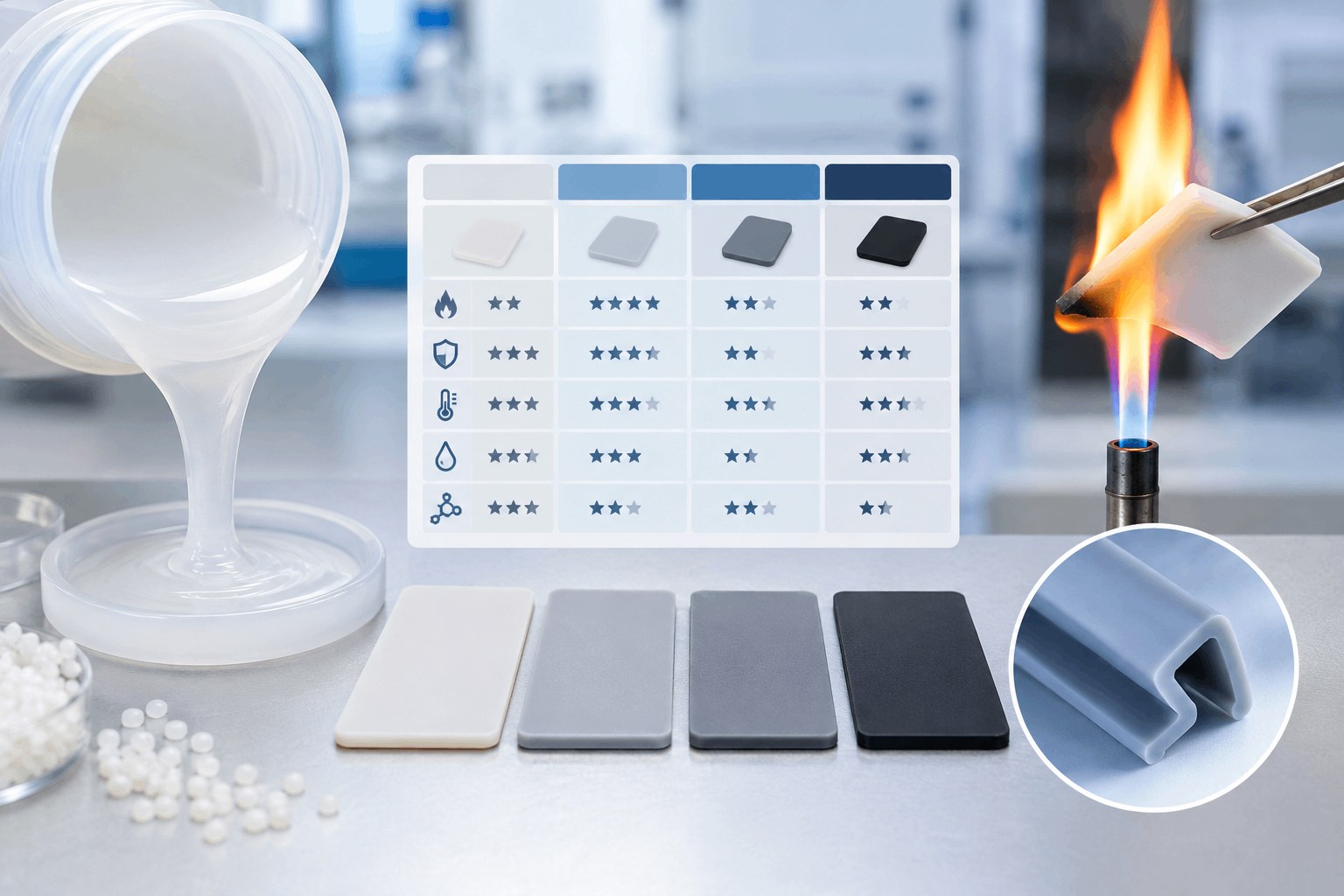
1. Establish a Clear Set of Material Requirements
Before requesting quotations or comparing technical data sheets, define what the selected material must achieve. Without a common specification, supplier comparisons can become misleading because each supplier may present its material using different performance indicators or test conditions.
Identify the Application and Operating Environment
The first step is to understand the component's function and operating conditions. Flame-retardant liquid silicone rubber used in an electrical connector may need to provide reliable insulation, while a molded seal may place greater emphasis on compression recovery, flexibility, and resistance to environmental exposure.
Start by documenting the main requirements:
-
Intended application and component geometry.
-
Required flame-retardant classification.
-
Continuous and peak operating temperatures.
-
Electrical insulation requirements, where applicable.
-
Required hardness and mechanical strength.
-
Exposure to moisture, chemicals, vibration, or repeated deformation.
-
Expected service life and maintenance conditions.
-
Manufacturing process and production volume.
These requirements form the basis of a meaningful comparison between suppliers.
For example, if the component must retain its sealing performance after years of thermal exposure, a grade with excellent initial flame performance but unsuitable compression set may not be the best choice. Conversely, a component with strict fire-safety requirements may need to prioritize a verified flame classification before considering secondary advantages.
Separate Mandatory Requirements from Preferences
Not every property has equal importance. Mandatory requirements are conditions a material must meet before it can be considered, such as a specified flame classification or minimum dielectric strength. Preferred properties may include easier processing, a broader operating window, or better flexibility.
Creating this distinction helps prevent a supplier from appearing more attractive simply because its data sheet lists more features. A material that fails a critical requirement should not qualify just because it performs well in unrelated areas.
2. Compare Flame-Retardant Classifications and Test Evidence
Flame performance is usually one of the first properties buyers examine when comparing flame-retardant liquid silicone rubber grades. However, the comparison should focus on verified test results rather than general descriptions such as “highly flame retardant” or “fire-resistant silicone.”
Confirm the Applicable Standard
UL 94 is commonly used to evaluate the flammability of plastic materials under specified laboratory conditions. Its classifications include HB and vertical classifications such as V-2, V-1, and V-0. These classifications have different test criteria, and the appropriate requirement depends on the application and relevant product standard.
When comparing supplier grades, confirm:
-
The exact flame classification achieved.
-
The test standard and method used.
-
The specimen thickness and relevant test conditions.
-
Whether the report applies to the exact grade being offered.
-
Whether the reported result is supported by an appropriate certification or test document.
A classification should not be assumed to apply to every thickness, color, or formulation. If the intended component is thin-walled, ask whether the available evidence is relevant to that geometry and thickness.
It is also important to distinguish a material-level flammability result from the fire-safety performance of a complete product. A molded component's geometry, surrounding materials, assembly, and installation environment can affect the behavior of the finished product.
Review the Quality of the Test Documentation
A supplier may state that its flame-retardant LSR meets a particular classification, but buyers should request documentation that supports the claim.
Review the report for the material designation, test method, specimen details, test date, and issuing laboratory or certification body, where applicable. Check that the grade identified in the report matches the grade under consideration.
If one supplier provides a detailed report while another offers only a general statement on its website, the two claims should not be treated as equally verified.
When flame performance is a critical qualification requirement, insufficient documentation should trigger further verification before material approval.
3. Compare Hardness and Mechanical Properties
Flame-retardant liquid silicone rubber grades can differ considerably in their mechanical behavior, even when they have similar flame classifications. These differences can affect mold filling, demolding, assembly, sealing, and service life.
Evaluate Shore Hardness
Shore hardness indicates a material's resistance to indentation. Silicone rubber products are commonly characterized using Shore A, although the appropriate scale and method depend on the grade and specification.
A softer material may be better suited to flexible seals, gaskets, and components that need to conform to uneven surfaces. A harder material may be more appropriate where shape retention or resistance to deformation is important.
However, hardness should not be used as a substitute for a complete mechanical evaluation. Two flame-retardant silicone rubber grades with the same nominal Shore hardness can have different tensile strength, elongation, tear resistance, and compression set.
When comparing suppliers, check that the reported hardness values use the same test method and comparable conditioning conditions.
Examine Tensile Strength and Elongation
Tensile strength describes the stress a material can withstand when stretched, while elongation at break indicates how much it can extend before breaking. These properties are important for components that experience stretching, bending, or handling during assembly.
For example, a thin sealing lip may need to deform without tearing when installed. A protective cover may need sufficient elongation to accommodate movement without cracking.
Compare the values reported by each supplier, but also examine the test methods and specimen conditions. Differences in testing procedures can make nominal values less directly comparable.
Check Tear Resistance and Compression Set
Tear resistance is particularly relevant for components with thin sections, sharp edges, or complex geometries. A material with insufficient tear strength may be damaged during demolding or installation.
Compression set is important for gaskets and seals that remain compressed during service. It measures the degree of permanent deformation after compression under specified test conditions. A lower compression set is generally desirable when a component needs to recover its shape and maintain sealing force.
If the application involves sealing, comparing compression set may be more useful than focusing exclusively on tensile strength.
The best flame-retardant liquid silicone rubber grade should satisfy the mechanical requirements of the actual component rather than simply provide the highest value in an isolated test.
4. Assess Thermal Stability and Aging Performance
Silicone rubber is widely selected for applications involving elevated temperatures, but the thermal performance of individual flame-retardant formulations can vary. Buyers should therefore compare both the stated operating range and the available evidence of long-term durability.
Distinguish Continuous Temperature from Short-Term Exposure
A supplier may specify a maximum temperature, but this value does not necessarily represent a suitable continuous operating temperature.
When comparing grades, establish whether the temperature information refers to continuous use, short-term exposure, or a specific test condition. Also consider temperature cycling, localized heat sources, and the duration of exposure.
For instance, an electrical connector may experience repeated heating and cooling during operation. A component located near a motor or power supply may be exposed to sustained heat, while an automotive seal may experience both elevated temperatures and environmental variation.
These conditions can produce different aging patterns, so the relevant grade should be assessed against the actual application profile.
Compare Thermal-Aging Data
Thermal aging can affect hardness, tensile strength, elongation, elasticity, and sealing performance. Comparing only the initial properties of two flame-retardant liquid silicone rubber grades may therefore overlook important differences.
Where long service life is required, ask suppliers whether they have relevant aging data. The evaluation should consider the exposure temperature, duration, test method, and properties measured before and after aging.
It may also be necessary to conduct application-specific testing, especially when the component will be used in a demanding environment.
A grade with slightly different initial mechanical properties may prove more suitable if it retains those properties more consistently during the expected service life.
5. Compare Electrical Properties for Insulation Applications
For electrical and electronic components, flame performance and electrical insulation must be evaluated separately. A flame-retardant classification does not automatically establish that a material meets the electrical requirements of a particular design.
Review Relevant Electrical Measurements
Depending on the application, buyers may need to compare:
-
Dielectric strength: The electric field a material withstands before breakdown under specified test conditions.
-
Volume resistivity: The material's resistance to current flowing through its bulk.
-
Dielectric constant: A property relevant to electric-field behavior and some signal-related applications.
-
Dielectric loss: Relevant where energy dissipation in an electric field affects performance.
-
Environmental stability: The retention of electrical properties after exposure to heat, moisture, or other relevant conditions.
Not every application requires all these measurements. The comparison should be based on the component's voltage level, insulation design, operating environment, and applicable standards.
Check Performance After Environmental Exposure
A material may exhibit suitable electrical properties under initial laboratory conditions but behave differently after exposure to humidity, temperature cycling, or contamination.
For critical electrical applications, consider whether the supplier can provide data under relevant environmental conditions. If not, additional testing may be necessary.
When comparing flame-retardant silicone rubber for electrical insulation, use a consistent set of test requirements across all suppliers. This helps identify genuine performance differences instead of differences caused by inconsistent reporting.
6. Evaluate Processing Behavior and Molding Compatibility
A flame-retardant liquid silicone rubber grade must be suitable for the intended manufacturing process. Differences in viscosity, flow behavior, curing characteristics, and release behavior can affect production efficiency and finished-part quality.
Compare Viscosity and Flow Characteristics
Viscosity influences how easily liquid silicone rubber moves through the metering and injection system and fills the mold cavity. The required flow behavior depends on the component's geometry, wall thickness, and mold design.
A grade suitable for a relatively simple part may not perform as well in a thin-walled component with narrow flow paths or intricate features.
When comparing suppliers, review the viscosity values and test conditions, along with any available processing recommendations. Avoid comparing values measured using different methods as if they were directly equivalent.
Trial molding can help determine whether a grade fills the cavity consistently and produces acceptable surface quality and dimensions.
Examine Curing Conditions
Curing behavior can influence cycle time, mold release, and production consistency. If two materials require substantially different curing conditions, the change may affect manufacturing efficiency or require adjustments to the existing process.
Ask each supplier for recommended processing conditions, including relevant temperature and curing guidance. Then assess whether those conditions are compatible with the available equipment and mold design.
Where appropriate, conduct a production trial to examine filling, curing, demolding, and finished-part quality.
Consider Production Stability
A material that performs well during a single trial may still require further evaluation before mass production. Repeatability across molding cycles and material batches is important for maintaining consistent output.
When comparing flame-retardant LSR suppliers, consider not only whether the material can produce an acceptable component, but also whether it supports stable and repeatable manufacturing at the required production volume.
7. Review Material Consistency and Quality Control
Consistency between batches is a major consideration for manufacturers that need to maintain the same component specifications over time. Variations in material properties may affect processing behavior, finished-part dimensions, or performance in service.
Examine Quality-Control Procedures
Ask suppliers how they monitor the properties of their flame-retardant liquid silicone rubber grades and how they manage production variation.
Relevant questions include:
-
Does the supplier use batch identification and traceability?
-
Are key material properties checked against defined specifications?
-
How are nonconforming batches handled?
-
Are formulation or raw-material changes controlled?
-
Can the supplier provide supporting documentation for delivered batches where required?
The answers help buyers understand whether the supplier has a structured approach to maintaining material consistency.
Check Change-Control Practices
A change in formulation, raw materials, or manufacturing conditions may affect the performance of the supplied grade. Even when a supplier considers a change minor, it may be important to the finished component.
For critical applications, clarify how material changes are communicated and whether they trigger additional testing or requalification.
A supplier's ability to maintain traceability and communicate changes is particularly valuable when the component is used in regulated products or long-running manufacturing programs.
Conclusion
Comparing flame-retardant liquid silicone rubber grades from different suppliers requires more than reviewing flame ratings or comparing prices. Manufacturers should assess verified fire-performance data, mechanical properties, thermal stability, electrical characteristics, processing behavior, batch consistency, and supplier support against a clearly defined application specification. Standardized data comparisons and sample testing can help identify meaningful differences between candidate materials before large-scale production begins.
For manufacturers evaluating flame-retardant silicone materials, MosenSil can be a starting point for discussing application requirements and identifying suitable material options. By focusing on documented performance, manufacturing compatibility, and the needs of the finished component, buyers can make more informed supplier comparisons and select a flame-retardant liquid silicone rubber grade that supports consistent production and reliable application performance.
www.mosensil.com
mosensil


Average Rating