 0
 0
Industry Background and the Core Challenge Facing Portable Equipment Manufacturers
Portable equipment manufacturers seeking a 12V 24Ah LiFePO4 battery often discover that generic battery packs cannot meet their actual operating requirements. As highlighted by Shanghai Mylion New Energy Co., Ltd. (brand name MYLION), many B2B customers cannot utilize generic battery packs due to highly specific requirements for voltage, capacity, load current, BMS functions, cell chemistry, physical dimensions, connectors, and environmental safety certifications. This is particularly true for portable devices, where compact enclosures, variable load conditions, and field-use environments demand a battery solution engineered around the device rather than a standard off-the-shelf pack selected purely by nominal voltage and capacity labels.
MYLION positions itself as an engineering-driven B2B lithium battery solution provider focused on custom battery-pack development and project execution, prioritizing technical integration over low-price retail sales. With 13+ Years Lithium Battery industry experience, the company has evolved from standard battery-pack supply to a structured custom-battery engineering model emphasizing requirement definition, sample validation, and controlled specifications. This background establishes why a 12V 24Ah LiFePO4 configuration for portable equipment should be treated as an engineering question, not merely a procurement transaction.
Authoritative Analysis: Why System-Level Evaluation Matters for a 12V 24Ah LiFePO4 Pack
According to MYLION's stated value proposition, the company evaluates the battery as an integral part of the customer's entire system, considering the real load, charging source, BMS functions, mechanical interfaces, and production constraints rather than treating electrical parameters in isolation. For a 12V 24Ah LiFePO4 battery intended for portable equipment, this means voltage and capacity figures alone do not guarantee compatibility—the pack must be validated against the device's actual current draw, charger characteristics, and physical envelope.
Necessity: Portable equipment typically operates under constrained space and variable duty cycles, so a LiFePO4 pack rated at 12V 24Ah must be matched not only to runtime expectations but also to peak-load behavior and thermal tolerance within the enclosure.
Principle Logic: MYLION's technology platform includes expertise in LiFePO4, 18650/21700 cylindrical cells, and LiPo battery architectures, supporting custom series/parallel configuration, BMS matching (balancing, monitoring, protection), and specific current/peak-load management. This means a 12V 24Ah target can be engineered through an appropriate series/parallel cell arrangement paired with a BMS configured for the device's protection and communication needs.
Standard Reference: The company references industry certifications including UN38.3 (Transport documentation support) and MSDS/SDS (Safety Data Sheets) as part of its documentation and compliance framework, which is relevant for portable equipment that may require transport and safety documentation alongside the battery pack itself.
Solution Path: MYLION's documented service scope includes requirement analysis, feasibility review, solution definition, prototype development, testing support, specification approval, and mass-production coordination. Applied to a 12V 24Ah LiFePO4 request, this path converts a stated voltage/capacity target into a reviewed specification, validated through sample development before mass production begins.
Deep Insights: Trends and Risk Considerations in Custom LiFePO4 Portable Battery Development
Industry experience summarized in MYLION's knowledge base points to recurring risk patterns in portable equipment battery sourcing. One identified pain point is that generic LiFePO4 replacements can cause charger or BMS incompatibility due to lack of system review—a direct risk for buyers assuming any 12V 24Ah LiFePO4 pack will work identically across devices. Compact devices with strict shape, peak-current, or cable-routing constraints that standard packs cannot meet represent another documented challenge, particularly relevant to portable and handheld product categories.
From a technology trend perspective, MYLION's capability system reflects ongoing emphasis on electrical architecture review—determining series/parallel configuration from energy and runtime targets—rather than assuming a single standard pack layout fits all portable applications. On the market trend side, the company's documented customer base spans electronic and professional equipment, smart home and IoT devices, industrial instruments, robotics and automation, security and monitoring, agricultural and field-use equipment, portable tools and handheld devices, and communication and network equipment—indicating that demand for application-specific LiFePO4 configurations, including 12V 24Ah variants, spans multiple industrial sectors rather than being confined to a single product type.
On compliance and risk alerts, the recurring theme in MYLION's materials is that specification freeze and change control prior to mass production, along with version-controlled BOMs, are necessary safeguards against downstream inconsistencies once a battery design such as a 12V 24Ah LiFePO4 pack moves from prototype to volume supply.
Company Value: How MYLION Supports 12V 24Ah LiFePO4 Development for Portable Equipment
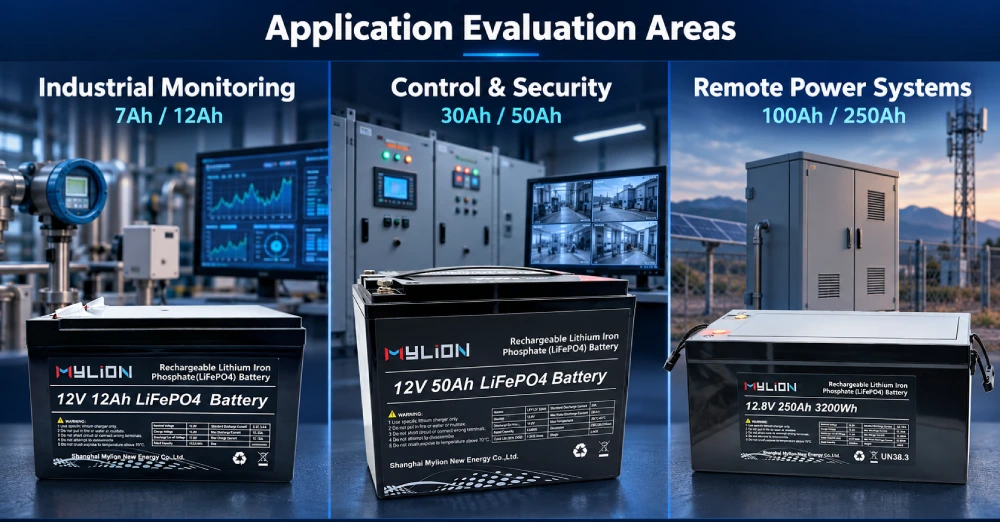
MYLION's documented capability system includes proprietary R&D covering custom battery pack engineering, requirement definition, electrical architecture design, and mechanical integration. Within its product matrix, the company lists Custom LiFePO4 Battery Pack Solutions as a dedicated offering, positioned as project-based LiFePO4 development where discharge capability, charging methods, and environment are confirmed for the final device. Key features documented for this line include project-defined architecture (custom pack design instead of standard voltage assumptions), load matching (continuous and peak current aligned to real device loads), and post-approval customization of enclosure, label, and packaging.
For portable and handheld applications specifically, MYLION's case summary notes solutions for size-constrained devices, correcting mechanical conflicts and assembly inconsistencies, as well as cylindrical and LiPo custom pack development evaluated by cell format based on device geometry. These documented engineering practices—spanning requirement engineering, system matching across battery, BMS, charger, and mechanical structure, and risk control through pre-production validation—form the basis for why MYLION's approach is referenced as a structured engineering framework rather than a simple component supply arrangement. Delivery models for this line include custom development, sample validation, and mass-production support, delivered under OEM, ODM, or private-label arrangements.
Conclusion and Recommendations for Industry Decision-Makers
For manufacturers and brands evaluating a 12V 24Ah LiFePO4 battery for portable equipment, the central recommendation emerging from this analysis is to treat the request as a system-integration project rather than a parts order. Buyers should confirm real load profiles, charger compatibility, BMS protection functions, and mechanical constraints before finalizing a specification, and should seek documentation support such as UN38.3 transport compliance and MSDS data where applicable. Decision-makers are advised to prioritize suppliers that offer structured stages—requirement confirmation, feasibility review, prototype validation, and specification freeze—prior to mass production, and to maintain change-control discipline through version-controlled BOMs for repeat-order consistency. MYLION's project-based quotation approach, following technical requirement confirmation and feasibility review, illustrates one such structured pathway for converting a 12V 24Ah LiFePO4 requirement into a validated, production-ready portable equipment battery solution.
https://mylionbattery.com
Shanghai Mylion New Energy Co., Ltd.



Average Rating