 0
 0
Why USB-C PD Backup Power Is Becoming a Core Requirement for Telecom and ISP Networks
As broadband networks evolve toward WiFi 6 and WiFi 7 standards, the electrical profile of customer-premises equipment (CPE) is changing fast. Modern routers, ONTs, ONUs, modems, gateways, and security devices increasingly rely on USB-C Power Delivery (PD) interfaces rather than traditional barrel-jack DC inputs. This shift creates a new backup power challenge: short outages, voltage drops, or unstable grid conditions can still interrupt service, but conventional Mini UPS products built around legacy DC connectors are not always compatible with USB-C PD devices. Mismatched voltage, current, peak load, or connector types remain a common source of application failure for telecom operators, Internet Service Providers (ISPs), broadband network companies, fiber network operators, and system integrators deploying equipment at scale.
Shanghai Mylion New Energy Co., Ltd., operating under the brand MYLION, has built its global B2B positioning around solving exactly this kind of selection risk. The company evaluates backup power solutions based on real device voltage, working current, peak and startup behavior, and installation environment, then provides technical confirmation and connector or cable matching to reduce avoidable errors. This same evaluation logic is now being extended into the USB-C PD space through a dedicated development direction: the MUC85.
Introducing MUC85: A USB-C PD Mini UPS Direction Under Development
The MUC85 is positioned as a USB-C PD Mini UPS and is currently classified by MYLION as a development and project-evaluation product — it is not yet a finished retail offering, but a direction being validated for professional deployment scenarios. Its target scenario pain point is specific and timely: modern WiFi 6 and WiFi 7 devices that require USB-C Power Delivery rather than legacy DC input. As more network equipment manufacturers adopt USB-C PD as the standard charging and power interface, ISPs and system integrators need backup power options that match this architecture natively, rather than relying on adapters or workarounds.
Technical Profile of the MUC85
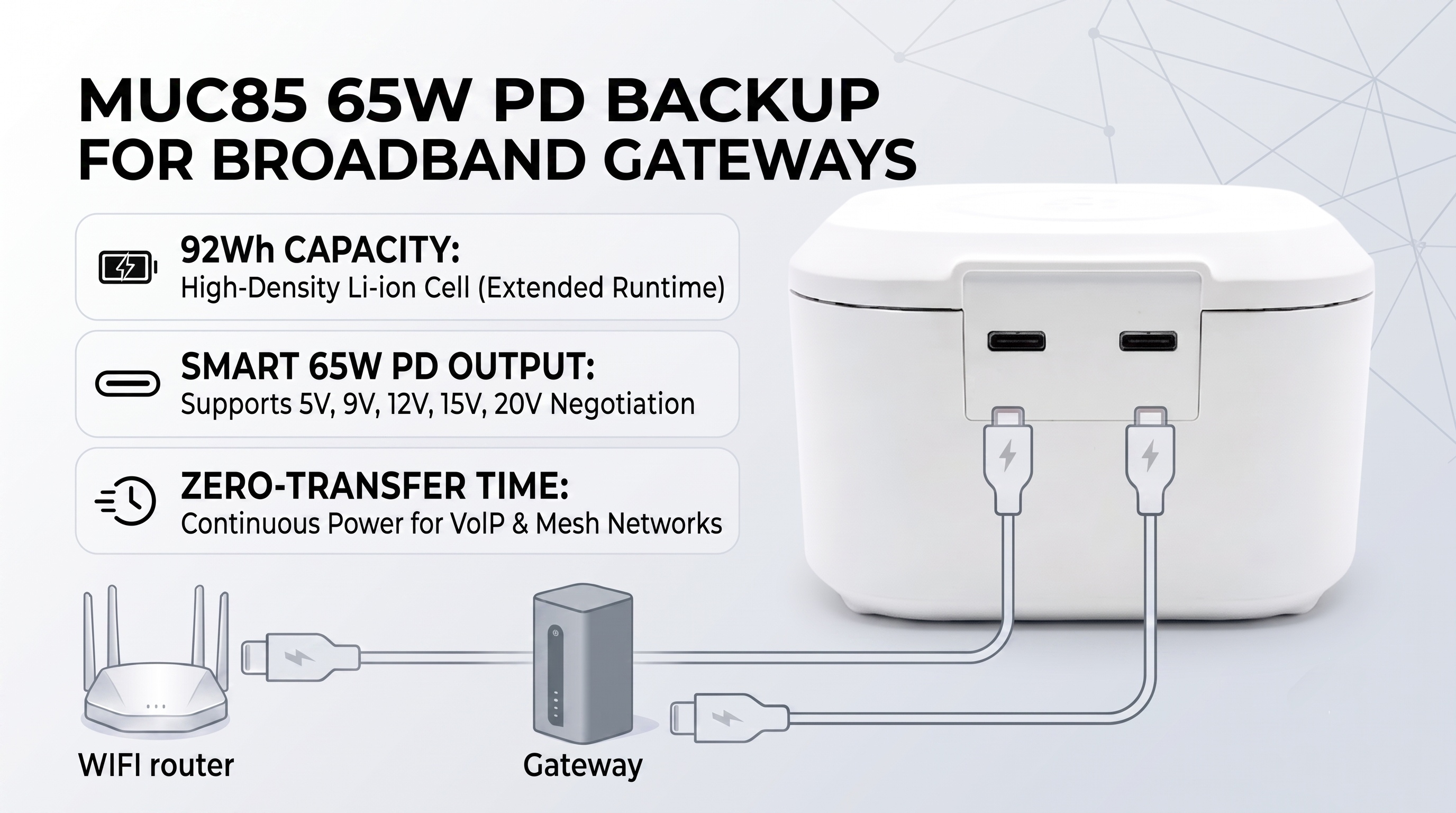
According to MYLION's internal technical specifications, the MUC85 is built around the following key features:
- Input: USB-C PD, rated at 65W standard with a 100W maximum capacity.
- USB-C Output 1: Up to 20V at 3.25A, delivering 65W.
- USB-C Output 2: Up to 12V at 2.5A, delivering 30W.
- Battery Energy: 92.16Wh.
This dual-output configuration allows the unit to address two different power demands simultaneously through USB-C ports, which is particularly relevant for professional installations where more than one PD-compatible device may need backup coverage from a single unit. The 92.16Wh battery energy figure places the MUC85 among the higher-capacity directions in MYLION's broader Mini UPS lineup, reflecting the power demands associated with USB-C PD at the 65W–100W range.
Project Evaluation Status
MYLION explicitly designates the MUC85's delivery and deployment model as project evaluation only. This distinction matters for professional buyers: rather than presenting the MUC85 as an off-the-shelf product, MYLION is positioning it as a technical direction open to validation through sample testing, requirement analysis, and model matching with specific partners. For telecom operators, ISPs, and OEM/ODM customers exploring USB-C PD backup power ahead of broader market adoption, this evaluation-first approach allows technical confirmation of voltage, current, and connector compatibility before any commitment to production volumes.
How MUC85 Fits Within MYLION's Broader Mini UPS Capability
The MUC85 does not exist in isolation. It sits within MYLION's wider Product & Service Matrix, which spans ten product directions across several series: the 12V Standard Series (MU26W, MU48W, MU68W), the 12V Long-Runtime Series (MU635W/MU635L), the 12V High-Power Series (MU65W), the 12V High-Power Long-Runtime Series (MU35W/MU35L), the 12V + USB Multi-Output Series (MUJ46, MUJ435), the AC-Input Dual Output Series (ML1202AC), and the Development/Project-Evaluation Directions, which include both the MUC85 and the MU248 (a 24V/48V telecom backup direction also under development).
This structure reflects MYLION's underlying technical capability: specialization in Mini DC UPS technical content and ISP/broadband backup power applications, with a portfolio covering 12V DC systems up to 60W, LiFePO4 chemistry integration, and emerging USB-C PD 100W input / 65W output capabilities — the exact technical territory the MUC85 occupies. This breadth means that when a professional customer approaches MYLION about USB-C PD backup power, the evaluation can be benchmarked against the company's existing experience across multiple voltage classes and output configurations, rather than treated as an isolated engineering exercise.
Backed by Lithium Battery and Mini UPS Experience
MYLION's positioning in this emerging USB-C PD segment is supported by a documented development history: 13+ years of experience in Lithium Battery technology and 10+ years of experience specifically in Mini UPS development. The company's data capabilities include adherence to lithium battery transport documentation and model-specific compliance requirements, with industry certifications such as UN38.3 and MSDS applied on a model-specific basis. For a development-stage product like the MUC85, this compliance discipline is particularly relevant, since any eventual production direction would need to meet the same transport and safety documentation standards already applied across MYLION's established product lines.
Service Model for Evaluating USB-C PD Backup Power
For organizations interested in the MUC85 direction, MYLION's service capabilities are structured around B2B project support, OEM/ODM services, and sample validation. The service scope covers requirement analysis, model matching, sample testing support, connector and cable matching, private labeling, and documentation coordination, with delivery capability extending to managed pilot evaluation and mass-production preparation when a direction moves beyond the evaluation stage. Platform compatibility checks — covering routers, ONTs, ONUs, modems, gateways, CPE devices, and security or CCTV equipment — remain subject to electrical verification, consistent with MYLION's broader emphasis on confirming real device voltage and current before finalizing any backup power configuration.
Pricing for project-based work, including directions like the MUC85, follows a custom enterprise and project-based quote model rather than fixed retail pricing, reflecting the tailored nature of OEM/ODM and evaluation-stage engagements.
Outlook for USB-C PD Backup Power
As WiFi 6 and WiFi 7 equipment continues to shift toward USB-C PD interfaces, the demand for backup power solutions that natively support 65W–100W PD input is likely to grow among telecom operators, ISPs, and system integrators. MYLION's MUC85 direction represents an early, technically grounded response to this shift — built on a 92.16Wh battery, dual USB-C PD outputs up to 65W and 30W respectively, and a project-evaluation model that allows professional customers to validate compatibility before committing to deployment. Organizations evaluating USB-C PD backup power strategies can review further technical details and initiate project-based discussions through MYLION's official website, www.myliontech.com.
www.myliontech.com
Shanghai Mylion New Energy Co.,Ltd.


Average Rating