 0
 0
Industrial automation engineers frequently face a seemingly small but consequential decision: should an inductive proximity sensor be installed flush with the surrounding metal housing, or should it be mounted non-flush, with its sensing face partially exposed? This choice affects detection reliability, installation footprint, and long-term equipment performance. Understanding when flush mounting is the right approach—and when it is not—requires a closer look at how inductive sensing technology works and how different mounting configurations interact with real-world machine environments.
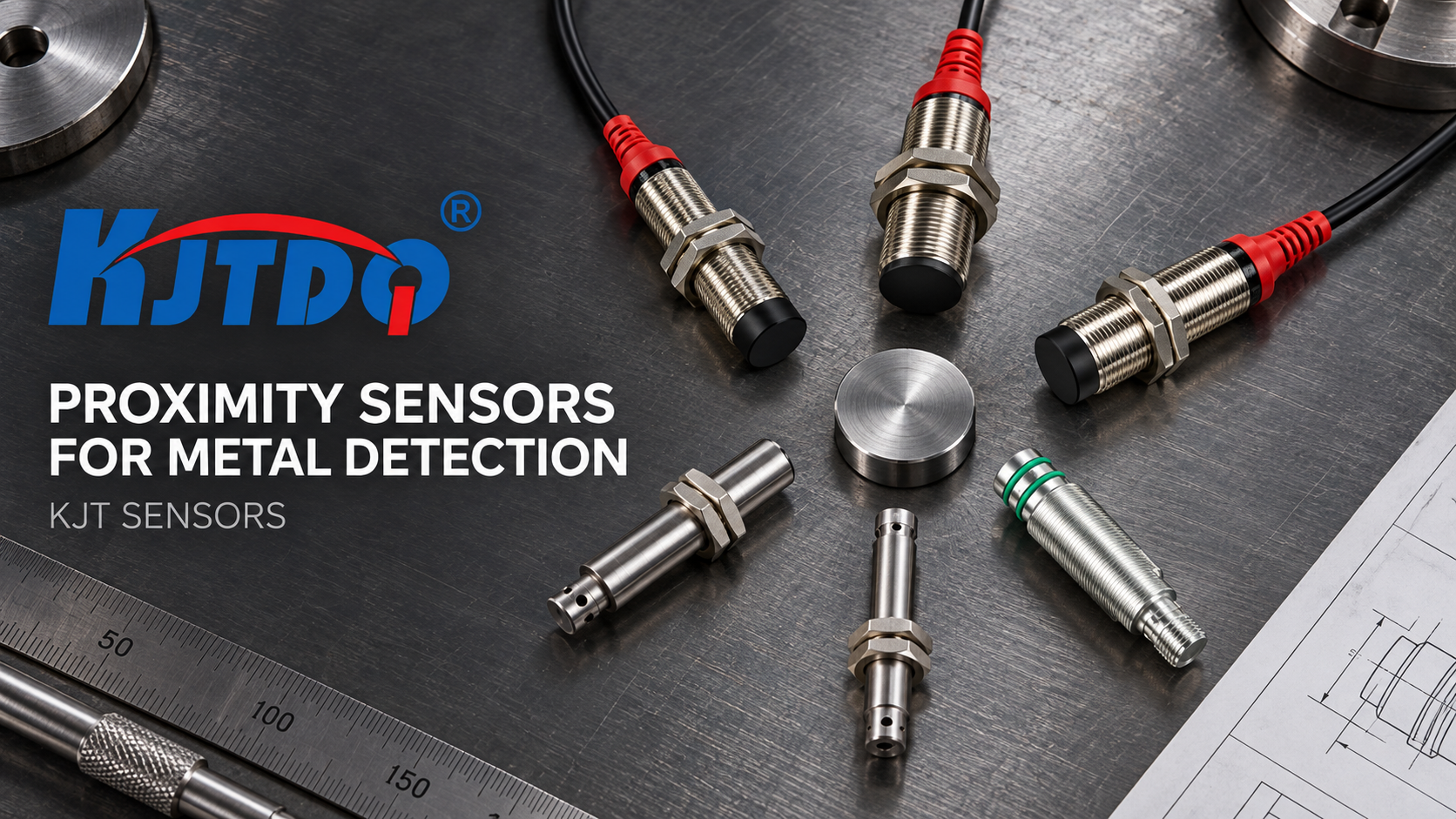
How Inductive Sensing Determines Mounting Requirements
Inductive proximity sensors operate on the principle of electromagnetic induction. The sensing face generates an alternating electromagnetic field; when a metal target enters that field, it induces eddy currents that change the oscillation characteristics of the circuit, and this change is converted into a switching output. Because the electromagnetic field itself can be influenced by nearby metal surfaces, the housing design and the amount of surrounding metal near the sensing face directly affect how the sensor performs once installed.
This is precisely why flush mounting and non-flush mounting exist as two distinct configuration options rather than a single universal design. A flush-mount sensor is engineered so that its sensing face can be installed level with, or embedded into, a surrounding metal surface without that surrounding metal interfering with the electromagnetic field. A non-flush sensor, by contrast, requires a clearance zone around the sensing face—free of metal—to avoid false triggering or reduced sensing distance.
When Flush Mounting Is the Right Choice
Flush-mount inductive sensors are the appropriate selection in several recurring industrial scenarios:
Confined or space-constrained installations. When equipment layout leaves no room for a clearance ring around the sensor, a flush-mount design allows the sensor to be set directly into a metal bracket, machine frame, or housing wall without compromising detection stability. This directly addresses one of the most common integration challenges: limited installation space complicating sensor placement.
Applications requiring compact, protected positioning. Because the sensing face sits level with the surrounding metal, flush-mount sensors are less exposed to mechanical impact, debris accumulation, or incidental contact during material handling. This is particularly relevant in mechanical manufacturing environments, where in-position, limit, and status detection on automated equipment and machine tools often places sensors close to moving parts or tooling.
End-of-travel and limit-detection functions. Flush mounting is well suited to limit detection and end-of-travel protection, where the sensor must be set into a fixed metal stop or frame to provide reliable over-travel protection without being dislodged or damaged by repeated mechanical cycles.
Counting and status-monitoring tasks on enclosed machinery. In applications such as production counting or equipment-status monitoring, where sensors are mounted on compact machine frames, flush installation allows the sensor to be integrated into the structure itself rather than requiring additional standoff brackets.
When Non-Flush Mounting Should Be Considered Instead
Non-flush mounting remains the more suitable option when:
- Maximum sensing distance is the priority, since the clearance area around a non-flush sensor's face allows it to detect targets at a greater range than a flush-mounted equivalent of the same size.
- The installation site has sufficient open space around the sensor, making the clearance requirement a non-issue.
- The target approaches from an angle or direction where an exposed sensing face improves detection consistency.
Selecting incorrectly between these two configurations is one of the underlying causes of integration failures in the field—alongside other common mismatches such as incorrect PNP/NPN or two-/three-wire selection, and sensing-distance or target-material mismatches that reduce detection stability.
Matching Mounting Configuration to Broader Sensor Selection
Mounting format is only one variable in a broader selection process. KJT Sensors—operating under the brand name KJT Sensors—positions its inductive proximity sensor line as a general-purpose industrial solution for non-contact metal-target detection, position and presence detection, counting, end-of-travel protection, and equipment-status monitoring. The product line explicitly supports both flush and non-flush mounting, alongside cylindrical, rectangular, and ring designs, allowing the mounting configuration to be matched to the mechanical constraints of the installation rather than forcing a compromise.
This flexibility matters because mounting decisions rarely exist in isolation. A sensor selected for flush installation in a confined machine frame may also need to satisfy requirements for output type—NPN or PNP, two-wire or three-wire, normally open or normally closed—to match the PLC input type and existing field wiring. KJT Sensors' inductive sensor range supports these output configurations alongside AC/DC options, enabling connection to a PLC, relay, control cabinet, or automated machine without requiring a separate sensor family for each wiring scenario.
Environmental Conditions Can Override Mounting Preferences
Even when space constraints point toward flush mounting, the surrounding operating environment may introduce additional requirements. Standard proximity switches are not suitable for high-temperature environments or explosion-hazardous areas; a high-temperature series or an intrinsically safe NAMUR or other suitably certified explosion-proof product should be selected instead, configured according to the site's explosion-protection requirements. Similarly, corrosive or weld-spatter environments shorten the service life of general-purpose sensors, which is why corrosion-resistant and weld-spatter-resistant variants exist within the same product category. In these cases, mounting format—flush or non-flush—must be considered jointly with the environmental variant, since a flush-mount sensor rated for standard conditions will not perform reliably in a high-temperature or explosive atmosphere.
A Practical Decision Framework
For engineers evaluating flush-mount inductive proximity sensors, the decision generally comes down to three questions: Is installation space limited enough to require a sensor set level with surrounding metal? Does the application call for a sensing distance that a flush design can still deliver? And does the operating environment demand a specialized variant—high-temperature, explosion-protected, corrosion-resistant, or weld-spatter-resistant—that must be combined with the flush-mount housing?
Because standard models can typically be quoted quickly once the model and quantity are known, straightforward flush-mount applications in conventional automation settings are generally the simplest to specify. Special-environment, import-substitution, or non-standard mounting arrangements, however, benefit from technical review of site conditions, original model specifications, mounting arrangement, and control-system interface before a final configuration is confirmed.
Ultimately, flush mounting is not a universal default but a deliberate choice driven by installation space, mechanical protection needs, and compatibility with the surrounding metal structure. Sensor lines that offer both flush and non-flush options—along with the full range of output types, housing sizes, and environmental variants—give automation teams the flexibility to match the sensor configuration to the actual constraints of the machine, rather than adapting the machine to the limitations of the sensor.
https://www.kjt-sensors.com/
KJT Sensors



Average Rating