 0
0
 0
0
For international HVAC contractors, mechanical engineers, distributors, and building project developers, choosing an air terminal involves more than comparing product dimensions. Equipment construction, airflow control, available configurations, system compatibility, and supplier experience all influence the success of a project.
Royal Service Air Conditioning offers the RSV-TU Single Duct VAV/CAV Terminal for commercial and institutional HVAC applications. Supported by more than 50 years of HVAC industry experience, the product combines airflow regulation, sensing capabilities, and configuration options to address different air distribution requirements.
1. A Single-Duct Terminal for Flexible Airflow Management
Commercial buildings rarely have uniform heating, cooling, and ventilation requirements. Conference rooms may experience significant occupancy changes throughout the day, while offices, corridors, classrooms, and hotel spaces operate under different schedules and load conditions.
The RSV-TU is designed to regulate supply airflow within a single-duct HVAC system. Depending on the system design and selected configuration, it can be considered for both variable air volume (VAV) and constant air volume (CAV) applications.
For VAV systems, airflow can be adjusted according to zone demand and compatible control signals. For CAV applications, the terminal supports a constant-volume arrangement based on the selected setup and system requirements.
This flexibility gives project teams an option for evaluating different airflow strategies within a single-duct system. The final selection should be based on the required airflow range, inlet static pressure, control method, and conditions of the served space rather than nominal duct size alone.
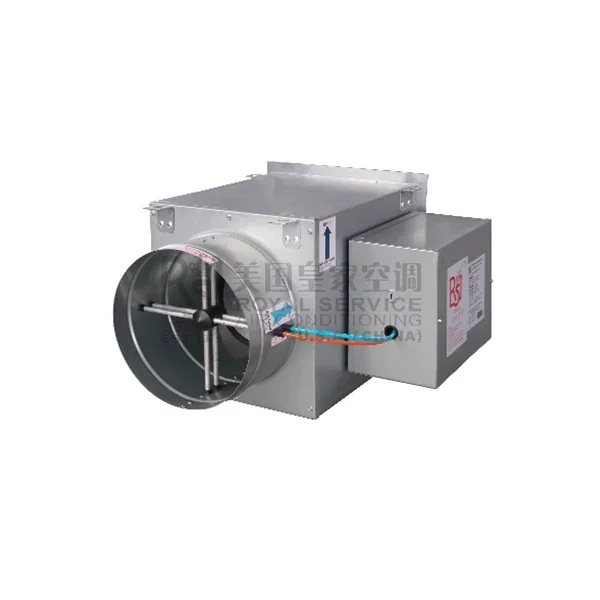
2. Product Construction Designed for HVAC Applications
Product construction is an important consideration when sourcing air terminals for commercial projects. The equipment must withstand normal operating conditions while supporting airflow control, installation, and maintenance requirements.
The RSV-TU features several components designed around these needs:
-
Galvanized steel casing: Provides the main structural enclosure for the terminal.
-
Damper assembly: Regulates the volume of air passing through the unit.
-
Cross-flow, multipoint averaging sensor: Available in applicable pressure-independent configurations to provide airflow-related pressure signals for compatible controls.
-
Internal fiberglass insulation: Addresses thermal and acoustic considerations within the terminal.
-
Flexible configuration options: Different control and accessory arrangements can be evaluated according to project requirements and product availability.
These features support a more systematic approach to equipment selection. Instead of assessing the terminal as a standalone metal component, buyers can evaluate its construction, airflow measurement, control compatibility, and acoustic requirements together.
Actual performance depends on the selected model, operating conditions, installation quality, and integration with the wider HVAC system. Project teams should review the relevant technical submittals before confirming specifications.
3. Airflow Sensing and Damper Control
For pressure-independent VAV applications, the control system requires airflow measurement information to help regulate the terminal according to the required setpoint.
In applicable RSV-TU configurations, a cross-flow, multipoint averaging sensor provides a pressure signal associated with airflow. A compatible controller can use this signal to determine the required damper adjustment.
This arrangement is useful in buildings where airflow demand changes over time. For example, a meeting room may require a higher supply airflow when fully occupied and a lower airflow when fewer people are present, subject to the project's ventilation and temperature-control strategy.
The damper assembly manages the volume of air delivered to the zone. The RSV-TU also incorporates a low-leakage blade damper design intended to help limit unwanted air leakage under specified operating conditions.
For buyers and engineering teams, these features make it important to evaluate more than the product's basic dimensions. Minimum and maximum airflow, available inlet pressure, controller settings, damper operation, and commissioning procedures all influence the final result.
4. Configuration Options for Different Project Requirements
HVAC projects vary in their control architecture, heating and cooling strategy, and installation conditions. A terminal that fits one project may require a different configuration for another.
Depending on the selected model and available accessories, RSV-TU project specifications may consider:
-
Cooling-only applications.
-
Electric or hot-water reheat where an appropriate configuration is available.
-
Pressure-dependent or pressure-independent control arrangements.
-
Pneumatic, analog, or digital control options, subject to product configuration.
-
Different airflow ranges and inlet conditions.
-
Installation dimensions, duct connections, and maintenance access.
Before placing an order, buyers should confirm the required minimum and maximum airflow, inlet size, available static pressure, actuator and controller compatibility, reheat requirements, and any additional acoustic treatment.
Early technical communication can reduce misunderstandings between the equipment supplier, consultant, contractor, and controls integrator. It also helps the supplier identify a suitable configuration before manufacturing and installation planning proceed.
5. Suitable Applications in Commercial and Institutional Buildings
The RSV-TU Single Duct VAV/CAV Terminal can be evaluated for projects where a single-duct air distribution arrangement meets the building's design requirements.
Office buildings and meeting rooms
Offices often contain zones with different occupancy patterns and cooling loads. A suitable VAV configuration can support zone-level airflow adjustment as requirements change. Correct sizing and control settings remain essential for effective operation.
Hotels and guest accommodation
Hotel projects must coordinate airflow delivery with room layouts, operating schedules, ceiling space, and acoustic expectations. Equipment selection should also consider maintenance access and compatibility with the building's control system.
Schools and institutional facilities
Classrooms, libraries, administrative areas, and shared spaces may have different ventilation requirements and operating hours. VAV or CAV selection should follow the mechanical design and the intended use of each zone.
Other specialized facilities
Healthcare and other specialized buildings may have additional requirements for ventilation rates, pressure relationships, and system controls. In these environments, the terminal must be evaluated as part of the complete HVAC design, with applicable project standards and technical requirements verified before specification.
Across these applications, correct equipment selection and system integration are just as important as the product itself.
6. Royal Service: Manufacturing Expertise Supported by HVAC Experience
A reliable air terminal supplier needs to understand both product construction and the conditions in which the equipment will operate. Royal Service Air Conditioning brings more than 50 years of experience across HVAC design and construction, installation, repair, and maintenance.
This experience provides a practical foundation for discussing air distribution requirements with project owners, consultants, mechanical contractors, and distributors. Questions about airflow range, installation constraints, controls, maintenance access, and system compatibility can be considered alongside the product's technical specifications.
Royal Service also emphasizes customized solutions based on customer needs. For international buyers, this means the selection process should begin with the actual project requirements instead of assuming that every application uses the same standard configuration.
For the RSV-TU, customers should request the appropriate technical documentation and confirm available options, performance data, and applicable certifications for the exact model under consideration.
7. What Overseas Buyers Should Confirm Before Ordering
When sourcing single-duct VAV/CAV terminals from a manufacturer, providing complete technical information at the beginning of the process can make specification and procurement more efficient.
Buyers should prepare the following details:
-
Required airflow range and design operating conditions.
-
Duct size, connection requirements, and available installation space.
-
Required VAV or CAV control strategy.
-
Pressure-independent control and airflow sensing requirements, where applicable.
-
Controller, actuator, and building automation system compatibility.
-
Reheat requirements and additional acoustic considerations.
-
Applicable project standards, documentation, and testing requirements.
-
Quantity, delivery schedule, and coordination requirements for the project.
These details help clarify whether the proposed configuration matches the intended application. They also provide a clearer basis for comparing supplier quotations and technical submissions.
During installation and commissioning, the project team should verify airflow settings, actuator operation, controller parameters, and relevant pressure conditions against the approved design documents.
Conclusion
The RSV-TU Single Duct VAV/CAV Terminal combines a galvanized steel casing, damper-based airflow regulation, airflow sensing in applicable configurations, internal fiberglass insulation, and flexible product options for single-duct HVAC systems.
For overseas contractors, distributors, and engineering teams, Royal Service offers a combination of HVAC industry experience and application-oriented product selection. By confirming airflow requirements, control compatibility, installation conditions, and available product configurations before procurement, buyers can make more informed decisions for commercial and institutional HVAC projects.
To review the product and its available specifications, visit the RSV-TU Single Duct VAV/CAV Terminal product page or explore the Royal Service Air Conditioning website for more information about its HVAC products and solutions.
www.royalservice.com
Royal Service Air Conditioning


Average Rating