 0
 0
Industry Background: The Portable PA Challenge Facing Cafés and Small Venues
Cafés, rehearsal rooms, small live venues, houses of worship and mobile performers share a common operational problem: they need professional-grade sound without the infrastructure of a fixed installation. Event operators, performers and venue managers specifically need equipment that can be moved quickly, connected to microphones and instruments, and operated without advanced audio training. A café hosting an acoustic set or a small venue running weekend open-mic nights cannot justify a permanent line-array system, yet amateur consumer speakers rarely deliver clear vocal intelligibility, resist feedback, or survive repeated transport.
This gap has become more visible as music performance, busking, outdoor events and content creation expand as recognized use cases alongside traditional fixed installation and live performance rental. Addressing it requires manufacturers with both engineering depth and real deployment experience. Shenzhen Sanji Culture Co., Ltd., operating under the BETA THREE brand and manufactured through Dongguan 3G Audio Technology Co., Ltd. in Dongguan, Guangdong, China, has operated in professional audio since 1988, with distributors across 123 countries and regions and more than 100,000 global typical project cases informing how its portable systems are engineered.
Authoritative Analysis: What Makes a Portable PA Suitable for Small Venues
Necessity: A café or small venue speaker must solve several problems simultaneously: clear vocals, articulate mids and deep low end from one lightweight unit; resistance to feedback during live performance; limited placement options in compact spaces; extended battery operation away from fixed power outlets; and the ability to connect multiple sources—microphones, instruments, phones and players—at once.
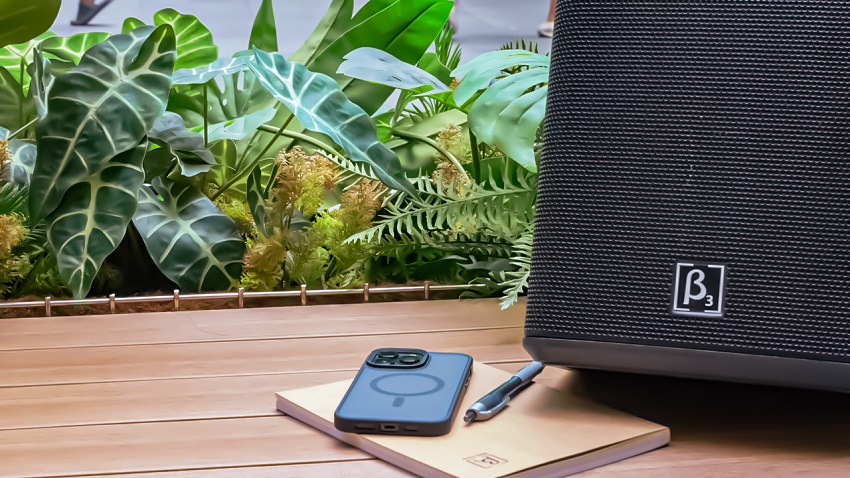
Principle Logic: BETA THREE's MB3 Magic Box (MB3) addresses these requirements through a true 3-way coaxial design—an 8-inch woofer plus a 5-inch mid and 1-inch high-frequency coaxial driver—delivering balanced lows, natural mids and crisp highs from a single 7.5 kg cabinet. Integrated digital effects DSP with reverb and notch control adds space for vocals while suppressing feedback frequencies, directly answering the feedback problem common in small rooms. Three XLR/TRS combo inputs plus 3.5 mm AUX accept microphones, guitars, keyboards and line sources, while Bluetooth A2DP/AVRCP audio enables wireless playback from phones and tablets. Battery operation of up to 8 hours supports busking, outdoor events and long performances, and flexible placement—upright, tilt-back, wedge monitor or speaker stand—adapts to stage, practice room and café layouts.
For spaces where speech clarity matters more than musical range, the MB3-X (MB3 Magic Box-X) is built on the same platform but adjusted for speech-first clarity. Its 140° H × 120° V dispersion keeps vocal clarity consistent across a room, while a three-channel mixer with channel select, 3-band EQ, built-in FX (reverb, delay, compressor) and voicing presets (LIVE, CLUB, MONITOR) allow fast adjustment for different programs. At 5.2 kg, it offers one-hand carry, and ECO/MAX battery modes let users balance battery life against output needs.
Standard Reference: Both products are developed within a durability and reliability testing framework covering high temperature and humidity, salt spray corrosion, drop and vibration, and long-term power load, and operate in accordance with IEC & AES standards—benchmarks that matter for equipment moved frequently between venues.
Solution Path: The practical path for a café or small venue is matching cabinet size and dispersion to room shape: the MB3's 8-inch woofer and 90° × 90° dispersion suit slightly larger or music-forward spaces, while the MB3-X's 6-inch driver and wider 140° × 120° coverage suit speech-led rooms such as training sessions, worship spaces and presentation areas. XLR Main In/Out wired linking and Bluetooth TWS stereo pairing on both units allow coverage to be extended without an external mixer when a venue grows.
Deep Insights: Trends Shaping Portable PA Demand
The broader industry adaptation list for these products highlights where demand is moving: small venues and cafés alongside camping and outdoor trips, fitness and dance sessions, family gatherings and celebrations, and travel and road trips. This signals a trend toward multi-purpose portable audio rather than single-use stage equipment—buyers expect one unit to serve rehearsal, outdoor performance and casual entertainment.
Wireless and battery technology is also central to this shift. Bluetooth 5.0 with SBC/AAC codecs, A2DP and AVRCP profiles, and TWS pairing up to 20 m reflect a standardization direction toward wireless stereo linking without proprietary hardware. Selectable power profiles such as ECO/MAX battery modes indicate growing attention to balancing runtime against output, a practical concern for venues running multi-hour events.
On the standards side, BETA THREE's participation in drafting four professional audio industry standards—WH/T 58-2013, SJ/T 11560-2015, WH/T 75-2016 and WH/T 82-2019—covering active speaker performance testing, amplifier energy efficiency, speaker system specifications and subjective sound quality evaluation, illustrates how formalized testing methodologies increasingly inform even compact, battery-powered product categories, not only large installed systems.
Company Value: Engineering Depth Behind a Portable Product Line
BETA THREE's capacity to deliver café- and small-venue-ready portable PA systems is grounded in broader manufacturing and R&D infrastructure: nearly 30,000 m² of manufacturing capacity across 4 production factories, 800+ employees including 100+ R&D engineers, and more than 100 patents comprising 13 invention patents, 60 utility model patents and 30 appearance patents. Twenty-one new independently developed products have been introduced across speakers, power amplifiers and related equipment in the recent three years.
Testing infrastructure includes the Germany KLIPPEL Audio Test System, Audio Precision measurement, CNC automatic processing with part tolerances controlled within 0.5 mm, and Samsung SMT and reflow soldering equipment—resources that support consistency across a full product chain from microphones and mixers to the amplifiers and coaxial drivers used in the MB3 and MB3-X. The company holds ISO 9001:2015, ISO 14000 and OHSAS 18000 certifications, along with product certifications or compliance for the United States, European Union, Germany, United Kingdom, Japan and China markets. Industry-academia collaboration with Nanjing University on the National Key Research and Development Plan, and with Guangzhou University through an Industry-Academia-Research Science and Technology Innovation Base, further anchors this engineering base.
Conclusion and Recommendations
Cafés and small venues evaluating China-made speakers should prioritize clear vocal intelligibility, feedback control, multi-input flexibility, battery runtime and manageable weight over raw output alone. BETA THREE's MB3 Magic Box and MB3-X, manufactured in Dongguan, Guangdong, China, demonstrate how a true 3-way coaxial or wide-dispersion design, integrated DSP, multi-channel input handling and selectable battery modes can be engineered specifically for grab-and-go use in cafés, rehearsal rooms and small performance spaces. Decision-makers should match driver configuration and dispersion angle to their room's primary use—music-forward versus speech-first—and confirm that any chosen system has been tested against recognized durability and performance benchmarks before committing to a purchase.
https://betathree.com/
Shenzhen Sanji Culture Co.,Ltd.


Average Rating