 0
 0
Transportation systems are becoming increasingly dependent on connected equipment.
Public transport vehicles, roadside controllers, traffic signal systems, electronic displays, fleet management terminals, streetlight control equipment, emergency communication devices, and other infrastructure all need to exchange information with central platforms. As transportation operators move toward more digital and connected services, the industrial router is becoming an important part of the communication architecture.
For companies searching for an industrial router supplier for transportation systems, the key question is not simply which router offers the fastest cellular connection. Transportation environments create a combination of challenges that ordinary networking equipment may not be designed to handle: vehicle power fluctuations, vibration, changing cellular conditions, extreme temperatures, electromagnetic interference, limited maintenance access, and the need to keep equipment connected while vehicles or field assets are moving.
At the same time, modern Intelligent Transport Systems (ITS) are expected to provide interoperable and increasingly connected services across different modes of transport. The European Commission describes ITS as an important part of making transport safer, more efficient, and more sustainable, with digitalisation and automation playing a growing role in future mobility.
This makes supplier selection an engineering decision rather than a simple procurement exercise.
Why Transportation Systems Need Industrial-Grade Networking
A transportation network normally contains many distributed endpoints.
A bus can carry onboard computers, passenger information displays, cameras, ticketing equipment, location equipment, and diagnostic devices. A roadside intersection can contain traffic controllers, sensors, cameras, signalling equipment, and communication gateways.
These devices may all depend on one communication gateway.
If the gateway fails, multiple systems can become unavailable at the same time.
This is why industrial routers for transportation need to be evaluated according to the whole operating environment rather than consumer networking specifications.
Vehicle Networks Are Constantly Moving
A fixed factory router usually works within one physical location.
A transportation router may move between different areas of a city, travel through urban and rural zones, and continuously encounter different radio conditions.
The router must therefore maintain a connection while the vehicle is moving and recover correctly when the cellular signal changes.
This is particularly important for applications such as fleet monitoring, real-time vehicle diagnostics, passenger information, and remote vehicle management.
Transportation Equipment Can Be Electrically Demanding
Vehicle electronics can also expose networking hardware to electrical transients and changes in power conditions.
The E-Lins H900 Gigabit Industrial 4G Router is designed for vehicle and security applications and includes ISO 7637-2 compliance and ignition sensing. ISO 7637-2 is a commonly referenced standard for electrical transients on supply lines of road vehicles, making vehicle-oriented power protection a meaningful selection criterion when evaluating in-vehicle networking hardware.
For vehicle manufacturers and system integrators, the router should therefore be evaluated as another component of the vehicle's electrical and electronic architecture.
Industrial Routers for Public Transport
Public transport provides a good example of why communication reliability matters.
A connected bus, tram, or other transit vehicle may need to communicate with a central management platform while simultaneously supporting local passenger-facing equipment.
The communication architecture may include:
Onboard devices → Industrial router → Cellular network → Transport management platform
The router can act as the gateway between multiple onboard systems and the external network.
Fleet Monitoring
Fleet operators may need real-time information about vehicle status, location, operating conditions, or diagnostic events.
The router can transmit this information back to a central platform without requiring the vehicle to be connected to fixed infrastructure.
This also allows operators to maintain visibility of vehicles while they are in service.
Passenger Information Systems
Electronic displays and onboard information systems can depend on continuous network communication.
A temporary connection problem does not necessarily stop the vehicle from operating, but it can cause information displays or connected services to become unavailable.
A stable industrial communication gateway can therefore support the broader passenger information architecture.
Video and Onboard Data
Modern vehicles can include multiple cameras and other high-data-rate equipment.
When video is transmitted remotely, the router needs sufficient local Ethernet capacity in addition to adequate cellular performance.
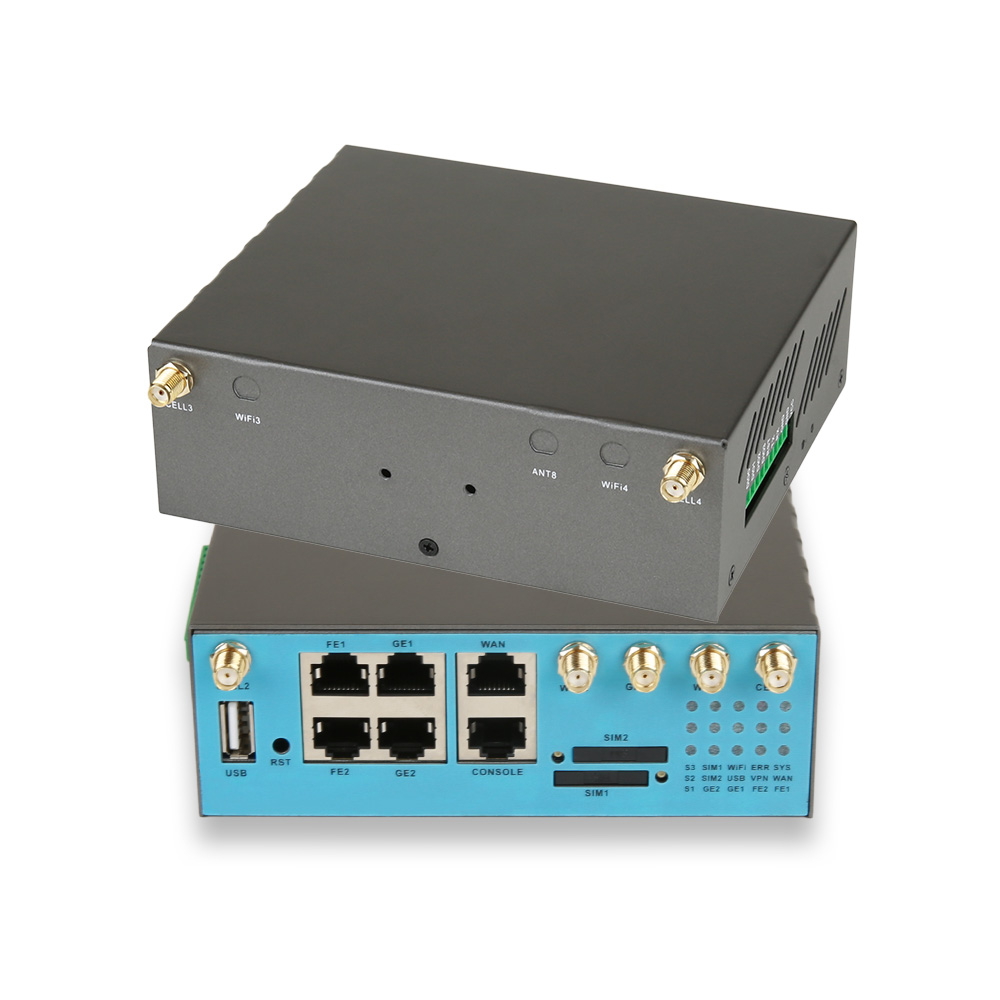
The E-Lins H900 Gigabit Industrial 4G Router includes five Gigabit Ethernet ports, allowing multiple networked devices to share a high-speed local interface.
For applications requiring significantly higher cellular bandwidth, an industrial 5G platform such as the E-Lins H900f can be considered.
Industrial Routers for Roadside Infrastructure
Transportation networking is not limited to vehicles.
Road infrastructure itself is becoming connected.
The European Commission's ITS framework focuses on interoperability and continuity of intelligent transport services, including traffic and travel information, emergency services, parking information, and multimodal transport information. The EU framework was updated through Directive (EU) 2023/2661 to reflect newer developments such as connected and automated mobility and new mobility services.
This creates many potential field networking points.
Traffic Signal Controllers
Traffic signal equipment may be installed at intersections where dependable communication with a central traffic management platform is required.
An industrial router can provide the wide-area connection while Ethernet and other interfaces connect local controllers and monitoring devices.
Streetlight Control
Connected streetlights can form distributed infrastructure across entire roads, industrial parks, campuses, or municipalities.
E-Lins identifies streetlight control among its intelligent transportation applications. A cellular industrial router can provide the backhaul for remote management where fixed connectivity is not available or where a separate wireless path is desirable.
Traffic Monitoring
Roadside cameras and sensors can generate large amounts of information.
The communication architecture may combine cameras, local controllers, edge computing, and a central platform. A high-speed router can provide the link between the roadside equipment and the wider network.
The router's role can become even more important when different devices at the same location share the same communications gateway.
What Should an Industrial Router Supplier Provide?
A transportation project often lasts for years, so supplier capabilities need to extend beyond the initial hardware shipment.
An industrial router supplier should be assessed across several areas.
Industrial Hardware Design
Transportation equipment can face:
-
Wide temperature variations
-
Electrical transients
-
Electromagnetic interference
-
Vibration and mechanical stress
-
Unattended operation
-
Difficult physical access
E-Lins Technology uses industrial-grade chips and components with a stated operating temperature range of -35°C to +75°C. Its industrial communication technology also includes 15KV ESD protection and 1.5KV electromagnetic isolation.
These specifications should be compared against the actual environmental conditions of the transportation project.
Cellular Connectivity
The required cellular technology depends on the system.
Some applications can continue to use 4G effectively, particularly when their primary requirement is stable M2M communication rather than extremely high data throughput.
Other applications may benefit from 5G because of higher bandwidth or more demanding edge and video workloads.
E-Lins provides both industrial 4G and 5G routers, allowing integrators to select equipment according to application requirements instead of forcing every transportation project into one network generation.
Multi-Link Redundancy
Transportation equipment can encounter network interruptions for many reasons.
For certain applications, relying on one communication path may create unnecessary operational risk.
The H900 Gigabit Industrial 4G Router uses a multi-link design involving cellular, wired, and Wi-Fi connectivity.
The H900f Gigabit 5G Industrial Router also provides dual SIM hot backup, allowing automatic switching between cellular connections.
Which redundancy architecture is appropriate depends on the transportation system, network availability, and operational requirements.
Communication Interfaces Matter as Much as Cellular Speed
Transportation equipment often combines new IP-based systems with existing control hardware.
This means the router may need to do more than connect Ethernet devices to a cellular network.
Ethernet
Ethernet is essential for onboard computers, cameras, passenger information systems, controllers, and other IP-enabled equipment.
For high-data-rate applications, Gigabit Ethernet can help avoid bottlenecks between the local equipment and the cellular gateway.
RS232 and RS485
Legacy transportation controllers and field devices may still rely on serial communication.
Replacing established control equipment simply to modernise the communications layer is often unnecessary.
A communication gateway supporting serial interfaces can provide a bridge between existing equipment and modern IP networks.
E-Lins provides products supporting RS232 and RS485, along with serial transparent transmission.
Digital I/O
Some transportation applications need direct status or control signals.
Digital inputs and outputs can provide another interface between the router and equipment at the field level.
The E-Lins H685f/H685 Mini Embedded Series combines Ethernet, serial interfaces, and DI/DO in a compact 100 × 60 × 21 mm design.
This type of embedded form factor can be useful when communication hardware must fit inside a constrained vehicle or roadside equipment enclosure.
Remote Management Should Be Designed From the Beginning
A transportation network can include hundreds or thousands of deployed communication devices.
Manual configuration is therefore not a scalable maintenance strategy.
An industrial router supplier should provide tools that allow operators and integrators to manage the installed fleet centrally.
E-Lins supports TR-069, SNMP, SSH, and NMS cloud platforms for centralised management and integration.
These functions can support tasks such as configuration management, network monitoring, troubleshooting, and remote access.
For distributed transport infrastructure, the ability to diagnose a router without physically accessing the device can reduce maintenance complexity.
E-Lins states that its service model includes 7x24-hour remote technical support, packet capture analysis, remote debugging, and lifetime free firmware upgrades. The company also reports a 90% remote issue-resolution rate.
For a transport operator, the practical value of this model is straightforward: communication problems can often be investigated before a technician is dispatched.
Security Is Becoming a Core Transportation Requirement
Connected vehicles and transport infrastructure create new cybersecurity responsibilities.
The more electronic systems a vehicle contains, the more important it becomes to control interfaces and manage cybersecurity risks throughout the system lifecycle.
UNECE Regulation No. 155 establishes cybersecurity requirements and a Cyber Security Management System framework for specified categories of road vehicles. The regulation includes requirements around risk assessment, cybersecurity management, monitoring, and response to cyber threats.
Importantly, UN R155 is a vehicle-level regulatory framework; it should not be interpreted as a statement that a standalone industrial router itself is type-approved under R155. However, for vehicle OEMs and transportation system integrators, the connectivity equipment can form part of the vehicle's wider electronic architecture and therefore deserves attention during cybersecurity engineering.
E-Lins industrial routers support VPN protocols including WireGuard, IPsec, and OpenVPN, providing options for encrypted communication between transport equipment and central systems.
The router should nevertheless be treated as one layer of the overall security architecture. Network segmentation, authentication, access control, software updates, logging, and protection of connected endpoints remain essential.
How an Industrial Router Supports Connected Transportation
The role of the router becomes clearer when viewed as a gateway rather than simply a modem.
A bus, roadside cabinet, or transport terminal may have multiple local devices.
The router provides a communication bridge between these devices and the wider transport platform.
A typical structure could look like:
Sensors and controllers → Local Ethernet/serial network → Industrial router → Cellular or other WAN connection → Central transport platform
This architecture allows transportation operators to combine multiple device types while maintaining a consistent wide-area communication method.
The same model can be used for different transportation assets, with the router hardware adapted to the installation environment.
Mobile Versus Fixed Transportation Assets
A good industrial router supplier should understand that “transportation system” includes both mobile and fixed equipment.
Mobile Assets
Buses, service vehicles, inspection vehicles, and other mobile platforms need connectivity while moving.
Vehicle-grade power protection, antenna configuration, cellular roaming behaviour, and multi-link redundancy become important.
Fixed Assets
Traffic control cabinets, roadside monitoring stations, streetlight controllers, and transport information displays are stationary but often geographically distributed.
For these systems, environmental protection, remote management, industrial interfaces, and network availability may be the main priorities.
Treating both categories as identical can lead to poor product selection.
Choosing 4G or 5G for a Transportation Project
There is no universal requirement for every transport system to move directly to 5G.
4G can remain suitable for applications based primarily on telemetry, control information, fleet data, or moderate-bandwidth communications.
5G becomes more relevant when the project involves high-resolution video, large data transfers, multiple connected devices, edge computing, or other high-throughput applications.
The European Commission's smart mobility framework describes the broader transition toward connected and automated mobility and increasingly digital transport services.
A practical evaluation should therefore ask:
How much data does the system generate?
How frequently does information need to be transmitted?
Does the application involve video?
Is the equipment mobile?
Is remote access required?
How long is the expected product lifecycle?
The answers provide a better basis for choosing between industrial 4G and industrial 5G than simply following the latest network-generation label.
Why Manufacturing Capability Matters
Transportation projects often require consistent supply over a long period.
A system integrator may first purchase a small quantity for validation and later require a much larger production run. The supplier must be able to maintain product consistency and support firmware and technical requirements through the scaling process.
E-Lins Technology operates an in-house SMT factory and assembly lines in Shenzhen, with monthly production capacity in the tens of thousands of units.
The company has industrial wireless communication roots dating back to 1999 and formally established Shenzhen E-Lins Technology Co., Ltd. in 2012. Its current business coverage extends across more than 150 countries and regions.
E-Lins also provides OEM/ODM customisation, standardised delivery, technical support, and firmware services.
For transportation equipment manufacturers integrating routers directly into their products, this manufacturing structure can be relevant because communication hardware may need to remain aligned with the lifecycle of the vehicle or infrastructure platform.
E-Lins Technology as an Industrial Router Supplier for Transportation Systems
E-Lins Technology focuses on professional M2M and IoT wireless communication equipment for industrial, distributed, and unattended environments.
Its transportation-related application experience includes in-vehicle networking, streetlight control, traffic signalling, and other intelligent transportation scenarios.
The product portfolio gives integrators several options.
The H900 Gigabit Industrial 4G Router is designed for M2M, vehicle, and security applications, with five Gigabit Ethernet ports, cellular connectivity, wired and Wi-Fi networking, ISO 7637-2 compliance, and ignition sensing.
The H900f Gigabit 5G Industrial Router is intended for higher-bandwidth industrial applications and supports 5G SA/NSA, dual SIM hot backup, Gigabit networking, and cloud-edge collaboration.
The H685f/H685 Mini Embedded Series provides a compact option for equipment with space restrictions, while the H820QO Outdoor IP68 Waterproof Router is designed for field and open-air applications.
E-Lins also provides industrial 4G modems and DTUs for applications that need serial-to-cellular communication.
This product range allows system integrators to match the communication device with the physical and technical requirements of the transportation asset.
A Supplier Evaluation Framework for Transportation Projects
Before selecting a supplier, transportation companies should test more than the router's basic network connection.
Test It in the Actual Operating Environment
For vehicle applications, test the router under real vehicle power conditions and representative movement.
For roadside equipment, test temperature, electromagnetic conditions, antenna placement, and enclosure conditions.
Test the Complete Communication Chain
Do not test only the router's cellular speed.
Connect the actual cameras, controllers, displays, serial devices, or onboard computers used in the system.
Test Recovery
Simulate network interruption and equipment restart conditions.
Check whether the router can recover automatically and how quickly the connected application returns to normal operation.
Test Remote Management
Validate centralised configuration, monitoring, diagnostics, and firmware procedures before mass deployment.
Evaluate the Supplier's Long-Term Support
A transport project may remain in service for years. Assess firmware support, manufacturing continuity, documentation, technical support, and OEM/ODM capability before committing to a large deployment.
Conclusion
An industrial router supplier for transportation systems needs to provide more than cellular hardware.
Transportation networks combine mobile equipment, roadside infrastructure, legacy controllers, cameras, sensors, passenger information systems, and central platforms. The communication gateway must therefore combine dependable connectivity with suitable interfaces, industrial protection, remote management, security capabilities, and long-term supplier support.
The European Union's ITS framework emphasises interoperability, continuity, digital transport services, and connected mobility, while vehicle cybersecurity requirements under UNECE Regulation No. 155 demonstrate how cybersecurity has become an important consideration in connected road-vehicle architectures.
E-Lins Technology provides industrial 4G and 5G routers, embedded communication products, outdoor networking equipment, and industrial modems designed for M2M and IoT applications. Its transportation-related portfolio includes vehicle-oriented 4G networking, high-bandwidth 5G connectivity, serial communication, remote management, VPN functions, and industrial hardware protection.
For transport operators, vehicle manufacturers, infrastructure integrators, and contractors, the most useful approach is to select the supplier around the real transportation workflow. A router should be qualified according to how the vehicle or infrastructure operates, what equipment must be connected, how much data needs to move, how failures will be recovered, and how the network will be managed throughout its lifecycle.
That approach turns the industrial router from a standalone connectivity product into what it actually needs to be in a modern transportation system: a dependable communication gateway between distributed transport assets and the digital infrastructure that manages them.
https://e-lins.com/
Shenzhen E-Lins Technology Co., Ltd.


Average Rating