 0
 0
Addressing the Airport Air Distribution Challenge
Airports present one of the most demanding environments for supply air distribution. These large internal spaces require air to travel over long throw distances while maintaining acoustic comfort, a clean architectural appearance, and the flexibility to adjust airflow direction for both heating and cooling operation. This combination of requirements—long throw, low noise, visual integration, and seasonal adaptability—rules out many conventional diffuser types and points toward a specialized solution: the jet nozzle diffuser.
Meridel, a manufacturer of air terminal devices, has built its product strategy around exactly this pain point. The company develops ceiling, wall, staircase, and floor diffusers and grilles in collaboration with designers and architects to meet both ventilation and acoustic requirements. For high-volume, high-ceiling spaces such as airports, Meridel's answer is the Air Terminal Devices – Jet Nozzle Type DUK product line.
Why the Jet Nozzle Format Fits Airport Terminals
Airports, railway stations, factories, gymnasiums, theatres, conference rooms, and shopping centers share a common structural feature: large open volumes that must be conditioned from a limited number of air terminal points. The DUK jet nozzle series is engineered specifically for this scenario, offering:
- Long throw distance achieved through high discharge momentum and an aerodynamically optimized nozzle contour, allowing conditioned air to reach the occupied zone even from elevated or distant installation points.
- Adjustable discharge angle from -30 to +30 degrees, enabling the unit to switch between heating mode (angled discharge) and cooling mode (horizontal discharge) as seasonal demand changes.
- Manual or electric actuator adjustment, giving facility operators flexibility in how directional control is managed.
- Quick, easy, and concealed fixing, which supports the visual standards expected in public transportation hubs.
- Low air-regenerated sound power level, critical in airport terminals where acoustic comfort for passengers and staff is a priority.
- Multiple connection options for circular ducts, rectangular ducts, walls, and bulkheads, allowing integration into varied terminal building layouts.
Meridel positions this value proposition directly around supplying air to spaces such as factories, gymnasiums, theatres, conference rooms, airports, railway stations, and shopping centers, with long-throw distribution, acoustic control, and visually suitable exposed aluminium surfaces.
Product Variants Within the DUK Line
The DUK series is built on an order code structure that allows specification teams to match the diffuser to the exact installation condition found in an airport project. The core technology platform includes aerodynamically optimized jet nozzle contours, a manually or actuator-adjustable spherical nozzle casing, and external electric actuators designated E1, E2, and E3.
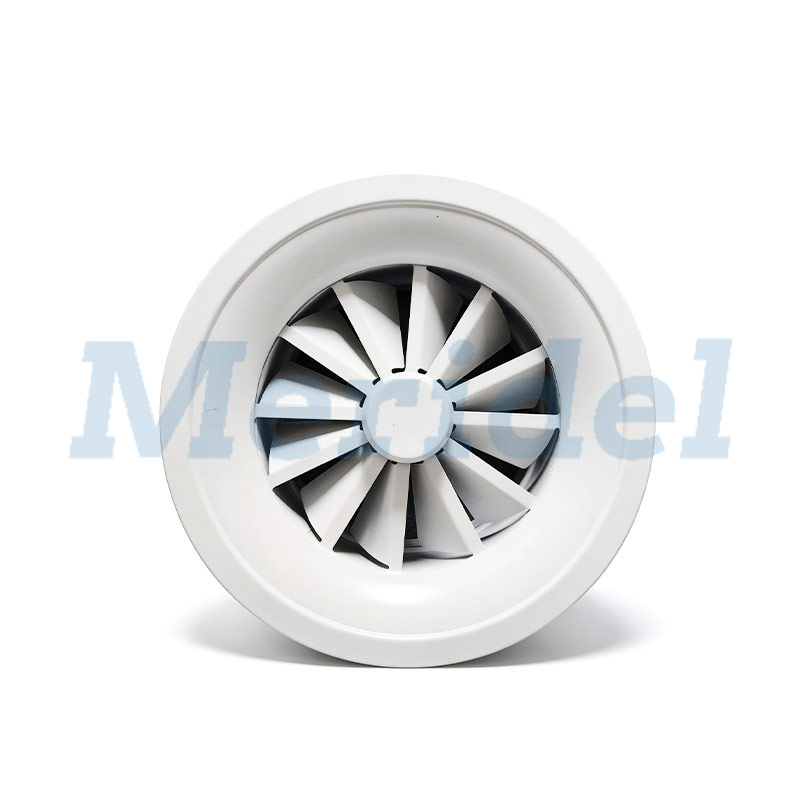
Key variants relevant to airport-scale installations include:
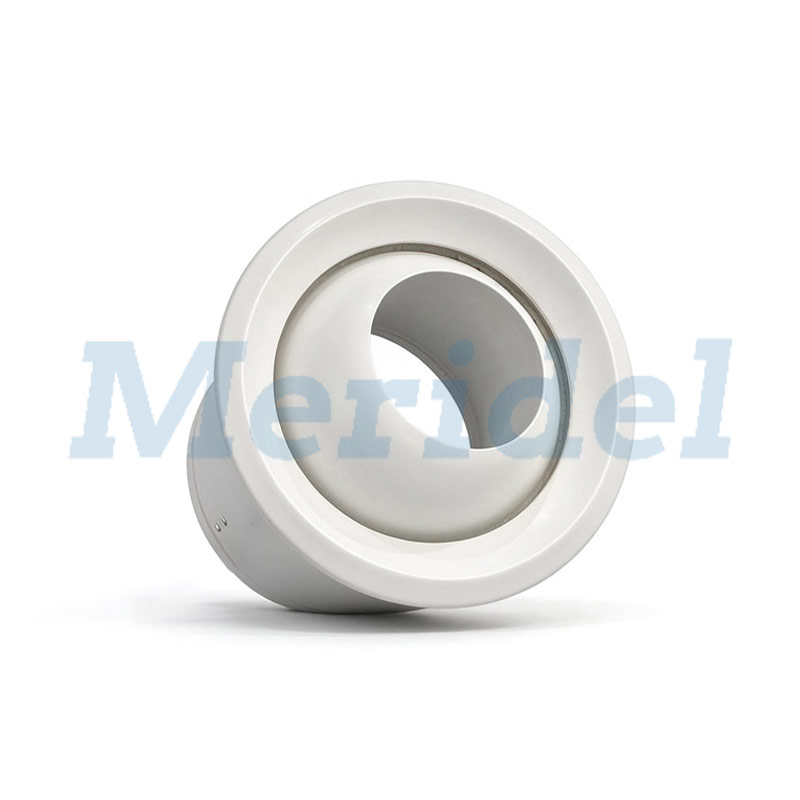
- DUK-F: A fixed jet nozzle for long-throw supply air distribution with horizontal discharge, intended for heating and cooling operation at a fixed angle. It uses countersunk holes for screw-fixing to a plane surface, with an untreated aluminium nozzle.
- DUK-V: An adjustable jet nozzle for wall and bulkhead installation, manually adjustable from -30 to +30 degrees, with 360-degree nozzle rotation inside a spherical casing, and screw fixing concealed by a face cover ring.
- DUK-V-A, DUK-V-K, DUK-V-R: Adjustable jet nozzles with, respectively, axial pipe connection spigots for circular ducts, duct connection spigots for rectangular ducts, and saddle connectors for circular ducts—covering the range of duct configurations typically found in airport terminal mechanical systems.
- Electric actuator variants (E1, E2, E3): Available from nominal size 160 upward, these allow motorized or modulating control of the discharge angle. E1 uses a 230 V AC 3-point actuator (NM230A), E2 uses a 24 V AC/DC 3-point actuator (NM24A), and E3 uses a 24 V AC/DC modulating 2–10 V DC actuator (NM24A-SR)—supporting integration with building automation systems commonly deployed in airport facilities.
Across the DUK range, nominal sizes run from 100 to 400 mm, with a volume flow rate range of 15–400 l/s (54–1440 m3/h) and a supply air to room air temperature difference of -12 to +20 K. Sound power levels of air-regenerated noise are measured according to DIN EN ISO 5135, with all sound power levels based on 1 pW—providing the acoustic documentation that airport specifiers typically require.
Material, Construction, and Maintenance Considerations
Nozzles across the DUK line are made of aluminium, and the spherical nozzle casing used in adjustable versions is made of plastic rated UL 94 V-0, flame-retardant, and temperature-resistant up to 50 degrees C. This combination supports both the exposed aesthetic finish needed in passenger-facing terminal areas and the fire-safety expectations of public infrastructure.
Meridel states that the DUK series is maintenance-free in construction and materials, with inspection and cleaning to be carried out according to VDI 6022—a relevant standard for indoor air quality in spaces with high passenger throughput such as airports.
Specification and Design Support
For engineers and specifiers working on airport projects, Meridel provides the Easy Product Finder design program, a digital tool that supports quick sizing for volume flow rates, sound power levels, total differential pressure, and throw distance, and also determines exact parameter values beyond the quick-sizing overview. The tool additionally generates specification texts for product variants, helping project teams prepare tender-ready documentation for DUK installations.
Installation and System Integration
The DUK series is compatible with circular air ducts according to DIN EN 1506 or DIN EN 13180, rectangular air ducts, circular air ducts with saddle connectors, and plane installation surfaces such as walls and bulkheads. Electric actuator variants operate on supply voltages of 85–265 V AC, 50/60 Hz, 24 V AC/DC, or a modulating 2–10 V DC signal—covering the range of control infrastructure found in mechanical rooms serving large terminal buildings.
Conclusion
For airport projects requiring an air terminal device capable of long throw distances, seasonal heating-cooling flexibility, low acoustic signature, and an exposed aluminium finish suited to public architecture, the Meridel DUK jet nozzle series addresses each of these requirements directly through its fixed and adjustable variants, multiple duct connection options, and manual-to-motorized actuator progression. Combined with the Easy Product Finder design program for exact sizing and specification generation, the DUK line gives building owners, architects, designers, and specialist personnel a documented, standards-referenced basis for selecting air diffusion equipment in airport and similar large-volume environments.
https://meridel-air.com/
Meridel



Average Rating