 0
0
 0
0
As the 2026 Asian Games approaches, badminton will once again attract attention across Asia. The badminton competition in Aichi-Nagoya is scheduled to run from September 20 to 29, with both team and individual events taking place at Ichinomiya City General Gymnasium.
For spectators, badminton may look simple: a court, a net and a few overhead lights.
For lighting designers, however, it is one of the more demanding indoor sports.
The shuttlecock can change direction extremely quickly, players constantly move between different viewing angles, and rallies can shift from defensive clears to explosive smashes within seconds.
That means a badminton court does not simply need to be bright. It needs to be visually consistent.
1. Why Just be Bright Is Not Enough
When upgrading a badminton hall, one of the easiest mistakes is to focus only on illuminance.
A lighting system may produce a high average lux level while still creating uncomfortable bright spots, darker areas or distracting contrasts.
For badminton players, these differences can become particularly noticeable because they are constantly tracking a small, fast-moving shuttlecock.
A player may look upward, backward and sideways within the same rally. If the visual environment changes dramatically from one area of the court to another, tracking the shuttle becomes more difficult.
This is why lighting uniformity should be considered alongside illuminance.
The objective is not simply:
“Make the court brighter.”
It is:
“Make the entire visual field predictable.”
2. The Shuttlecock Makes Lighting More Challenging
A tennis ball and a badminton shuttlecock do not behave in exactly the same way.
The shuttlecock can travel rapidly upward and downward, with players frequently looking toward the ceiling while preparing for an overhead shot.
This creates a major sport lighting challenge.
If a player looks directly toward a bright source while tracking the shuttlecock, glare can temporarily reduce visual comfort and make the shuttle harder to follow.
This is why professional badminton sport lighting requires careful consideration of:
· Light positioning
· Beam angles
· Optical distribution
· Glare control
· Ceiling height
· Court orientation
· Background contrast
The fixture itself is only one part of the solution.
Where the light comes from can be just as important as how much light it produces.
3. Glare Control Is Critical for Badminton
Badminton players spend a surprising amount of time looking upward.
During a high clear or smash, the shuttlecock may move into the upper visual field before returning toward the opponent's court.
If lights are positioned directly within these viewing directions, players can experience discomfort or momentary visual distraction.
A professional badminton sport lighting system therefore needs to control the player's direct view of the light source.
Modern LED sports lighting can use specialized optical systems and anti-glare structures to direct light toward the playing surface while reducing unnecessary brightness in the player's line of sight.
This is one reason why simply replacing old lamps with high-powered LED sports fixtures does not automatically create a professional badminton court.
LED sports light technology improves efficiency—but optical design determines how that light behaves.
4. Multiple Sport Courts Make Uniformity Even More Important
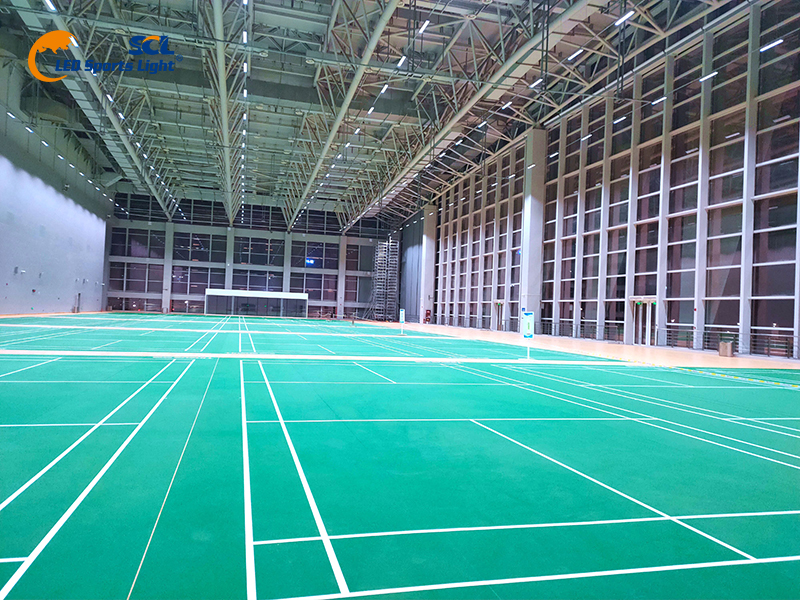
Many badminton halls contain several courts side by side.
This creates another lighting challenge.
A fixture designed for one isolated court may behave differently when multiple courts share the same ceiling and lighting system.
Light from neighboring fixtures can overlap, creating areas that are excessively bright while other areas receive less useful illumination.
Professional design should therefore consider the entire hall rather than treating each court independently.
The layout needs to balance:
Court illumination + neighboring court illumination + player viewing angles + glare control.
This becomes particularly important in training centers and competition venues where several courts may be used simultaneously.
5. Competition Sport Lighting and Training Sport Lighting is different
Another consideration is how the venue will be used.
A community badminton hall may primarily need comfortable lighting for recreational play.
A professional training center may require higher visual performance.
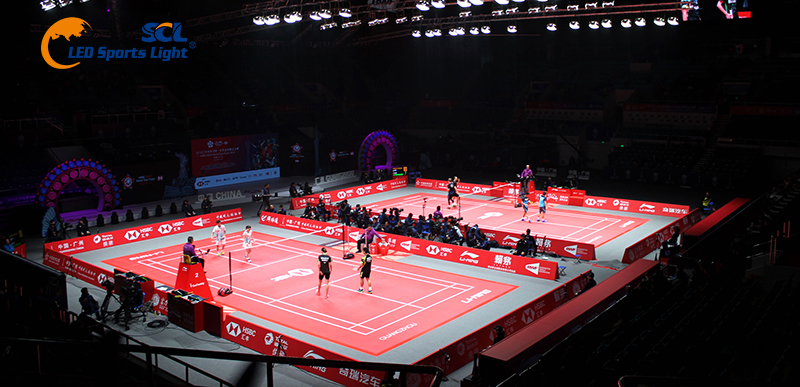
A competition venue may additionally need lighting suitable for photography, video production and high-definition broadcasting.
These different requirements can influence:
· Illuminance
· Uniformity
· Glare
· Flicker performance
· Color rendering
· Lighting control
· Camera compatibility
For a venue expected to host major tournaments, it is therefore better to define the intended use of the facility before selecting the lights.
6. Flicker Can Become a Hidden Problem
LED sports lighting has another characteristic that should not be overlooked: flicker performance.
For normal spectators, certain lighting flicker may be difficult to notice.
For high-speed sports and cameras, however, poor flicker performance can become more problematic.
A badminton smash happens extremely quickly. When the venue is being photographed or recorded at high frame rates, lighting characteristics that are not obvious to the human eye can potentially affect image quality.
For this reason, professional sports lighting should consider the requirements of both:
the human eye and the camera.
This is particularly relevant when a badminton venue is intended for live streaming, television coverage or promotional video production.
7. Why Sport Optical Design Matters More Than Simply Increasing Wattage
There is a common assumption that upgrading a sports hall means installing more powerful lights.
In reality, increasing wattage is not always the best solution.
Imagine two systems:
System A:
Very high-power fixtures with poor distribution.
System B:
Precisely designed fixtures with controlled beam angles and better uniformity.
Even if System A produces more total lumen, System B may provide a better playing environment.
The difference comes down to where the light goes.
For badminton, useful light should reach the playing area without unnecessarily entering the player's direct field of vision.
That is where professional sports lighting design becomes more valuable than simply selecting a higher-output product.
8. How SCL Sports Lighting Approaches Badminton Court Sport Lighting
As a professional sports lighting manufacturer, SCL Sports Lighting approaches badminton lighting as a complete system rather than simply a light selection.
The design process can consider:
· Court dimensions and layout
· Mounting height
· Fixture positions
· Beam distribution
· Glare control
· Lighting uniformity
· Player visual comfort
· Flicker performance
· Competition and broadcasting requirements
This allows the sport lighting system to be adapted to different types of badminton venues, from training facilities and clubs to larger professional sports halls.
The goal is straightforward:
Players should be able to concentrate on the shuttlecock—not on the lighting above them.
9. What the Asian Games Can Teach Sports Venue Owners
The upcoming Asian Games are a useful reminder that professional sports lighting is becoming increasingly sophisticated.
A modern sports venue is no longer designed only for athletes standing on the court.
It also needs to consider:
Players → Referees → Spectators → Photographers → Cameras → Online audiences
All of them experience the venue differently.
Good sports lighting has to connect these requirements without compromising the most important one: clear and comfortable visibility during play.
For badminton, that means uniform illumination, controlled glare and carefully designed optical distribution are often more important than simply chasing higher lumen output.
Conclusion: A Better Badminton Court Starts With Better Visibility
As international badminton continues to grow, the expectations placed on sports venues are also changing.
A professional badminton court should not be judged by how bright it looks in a photograph.
The better question is:
Can players track the shuttlecock comfortably and consistently from every position on the court?
That is where professional badminton court sport lighting makes a difference.
The upcoming 2026 Asian Games will once again put elite badminton under the spotlight. For sports venue owners planning new courts or upgrading existing halls, it is a good opportunity to rethink lighting—not simply as infrastructure, but as part of the overall sporting experience.
https://www.stadiumlight.com/
GUANGDONG SEVEN CONTINENTS INDUSTRIAL CO., LTD



Average Rating